
The banking sector is a cornerstone of Bangladesh's economy, supporting industrialization, trade, agriculture, exports, and infrastructure development. However, over the past decade and a half, rising non-performing loans, weak corporate governance, regulatory shortcomings, and a lack of transparency have raised serious concerns and weakened public confidence in the sector.
Recognizing these challenges, policymakers, bankers, economists, academics, and media professionals gathered at a seminar titled "Good Governance in the Banking Sector and the Role of the Media" to discuss the sector's current realities and the reforms needed to strengthen governance, restore trust, and ensure sustainable growth.
There Is No Alternative to Reform
Zahir Uddin Swapan
 Good governance in the banking sector cannot be separated from the broader governance environment of the state and society. Weak accountability and transparency within public institutions inevitably affect the banking system, contributing to irregularities, corruption, and financial crimes. Addressing these challenges requires comprehensive reforms, stronger governance, and the elimination of opportunities for misconduct created by institutional weaknesses and political influence. To support this effort, the government plans to establish a banking sector reform commission.
The media has played a crucial watchdog role by exposing irregularities and promoting transparency and accountability. However, media freedom must be accompanied by objectivity, fact-checking, and professional integrity. As a reflection of society, the media can only serve its purpose when it presents an accurate picture of reality.
Responsible, evidence-based journalism and unrestricted access to information are essential for sustainable economic development and good governance. Ultimately, restoring trust in the banking sector requires the combined efforts of the government, regulators, financial institutions, civil society, and the media. Only a transparent, accountable, and resilient banking system can ensure long-term public confidence and economic stability.
The Regulator's Role Must Be Strengthened
Nurun Nahar
 Good governance rests on four fundamental pillars: accountability, transparency, responsibility, and fairness.
Effective supervision is essential for maintaining stability in the banking sector. No bank can remain sustainable over the long term without strong risk management, robust internal controls, and transparent disclosure of information. Accountability must be ensured at every level of a bank, beginning with its board of directors and extending throughout the organization.
Building trust among regulators, banks, and customers is one of the greatest challenges ahead. To preserve the stability of the banking system, transparency in information and rule-based operations must be ensured. Regulators, banks, and the media must work together in a coordinated manner to restore public confidence in the banking sector.
Consistency in Governance Is Essential
Mohammad Mamdudur Rashid
 Bangladesh's banking sector is vital to the economy, but long-standing governance weaknesses have created serious challenges. For years, the true extent of non-performing loans was concealed. Recent steps by Bangladesh Bank have now made the situation clearer.
The sharp increase in reported non-performing loans over the past year and a half mainly reflects improved transparency and accurate disclosure, especially after the 2025 central bank directive.
The media has an important role in promoting ethics in financial institutions, but it must also avoid spreading misinformation that could unnecessarily erode public trust.
Overall, the current level of non-performing loans is not a recent development but the result of long-term issues.
Understanding this reality is essential for effective reform, making the present situation not only a challenge but also an opportunity for improvement.
The Media's Responsibility Is Evidence-Based Oversight
Shamsul Huq Zahid
 Economic journalism does more than simply report information; it serves as a powerful instrument for ensuring accountability. Investigative journalism plays a particularly important role in identifying irregularities, weaknesses, and risks within the banking sector.
To perform this role effectively, journalists must have access to information and the freedom to conduct independent investigations.
At the same time, proper verification and professional responsibility are essential when publishing information. Incomplete or misleading reports can create unnecessary panic in the financial sector. Ensuring the accuracy and reliability of information is therefore one of the media's most important responsibilities.
Good Governance Is Impossible Without
Human Resource Development
Dr. Md. Ezazul Islam
 Establishing good governance in the banking sector depends not only on policies and regulations but also on skilled human resources and ethical leadership.
If internal control systems are weak, or if bank employees and officials lack professional competence and ethical standards, good governance cannot be achieved. Strengthening training programs for bankers, introducing technology-driven supervision, and developing modern risk-management frameworks can significantly enhance the strength and resilience of the banking sector.
Dependence on Banks Must Be Reduced
Dr. M. Masrur Reaz

Excessive dependence on the banking sector within the country's financial system poses long-term risks. In advanced economies, a significant share of long-term financing comes from capital markets and bond markets. In Bangladesh, however, the overwhelming majority of financing still takes place through banks. Developing a strong capital market would reduce pressure on banks and diversify sources of financing across the economy. Such diversification would contribute to greater stability within the overall financial system.
Corporate Governance Is at the Heart of Good Governance
Professor Dr. Md. Shahidul Islam Zahid
 Weak corporate governance lies at the core of most problems facing the banking sector.
Good governance cannot be established unless the independence, professionalism, and accountability of boards of directors are ensured. A culture of professional decision-making must be developed in areas such as loan approvals, risk assessment, and financial reporting.
Creating a banking system that is free from political and personal influence will be one of the most important foundations for achieving a sustainable long-term solution.
Now Is the Time to Rebuild Trust
Professor Dr. Sayema Haque Bidisha
 Restoring public confidence in the banking sector is now one of the most urgent priorities. A banking system fundamentally operates on trust. If depositors, investors, and entrepreneurs lose confidence in the system, the normal flow of economic activity becomes disrupted.
Meaningful reform in the banking sector requires full autonomy for the central bank and a reduction in the Ministry of Finance's control over banking decisions. Ensuring the central bank's independence in policymaking is essential to addressing inefficiency and governance failures within the banking industry.
Good Governance in the Banking Sector and the Role of the Media: Summary of the Keynote Paper
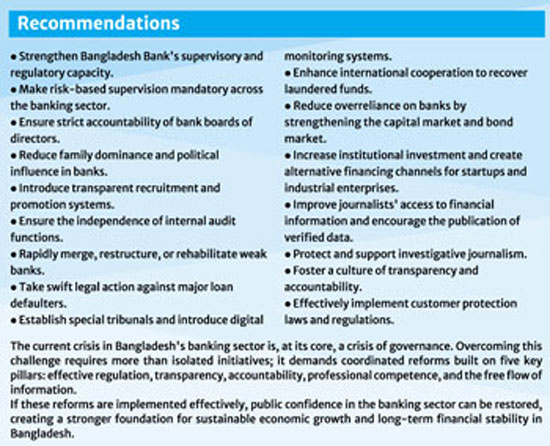
 Bangladesh's banking sector remains the primary source of financing for economic development, making its stability and governance critical to the country's economic health. However, public confidence has weakened in recent years due to loan scandals, money laundering, political influence, weak regulation, and the growing burden of non-performing loans (NPLs), which rose from BDT 22,481 crore in 2009 to nearly BDT 589,000 crore by March 2026.
The media has played a vital role in exposing banking irregularities and promoting transparency, accountability, and public awareness. Strengthening governance requires greater transparency, free access to information, accurate financial reporting, reduced political influence in bank management, and a more independent and accountable central bank. Equally important is ensuring accountability for wrongdoing while recognizing and encouraging institutions that uphold good governance.
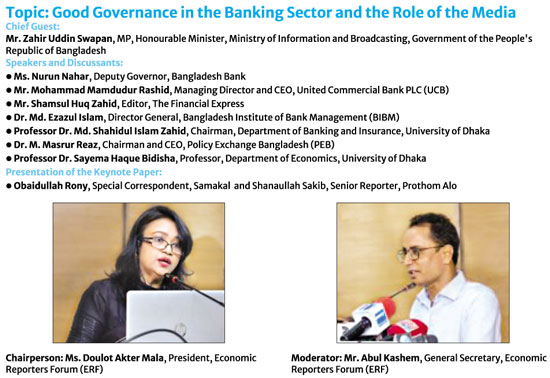


Organized by: Economic Reporters Forum (ERF), Supported by: United Commercial Bank PLC (UCB)
© 2026 - All Rights with The Financial Express

