Alliance Finance PLC has introduced a few digital initiatives, including e-KYC and SMS-based customer services, to streamline processes and enhance customer convenience.
Head of Business of the non-banking financial company Shahanur Rashid said this in an interview with The Financial Express (FE) recently ahead of the World MSME Day 2026.
As part of its digital transformation journey, Alliance Finance is piloting a fully digital nano-loan programme aimed at providing small business owners with faster and more efficient access to financing, according to the company's Head of Business.
He said Alliance Finance now offers working capital loans, term loans, machinery financing, vehicle financing, and various low-cost refinance schemes of Bangladesh Bank for SMEs, women entrepreneurs, startups, and cluster-based businesses, with SME financing being one of the company's strategic priorities.
Alliance Finance is a Joint Venture Financial Institution with multinational collaboration in Bangladesh. The majority stakeholder of Alliance Finance PLC is Peoples Leasing and Finance PLC, a subsidiary of Peoples Bank, Sri Lanka's largest state-owned bank.
"We are also focusing on faster loan processing with minimal documentation to make financing more accessible and convenient for customers," Mr. Rashid said.
Regarding the importance of the SME sector to Bangladesh's economy, he said the sector is one of the key pillars of the country's economic development. It creates opportunities for millions of people, particularly women, youth, and first-generation entrepreneurs.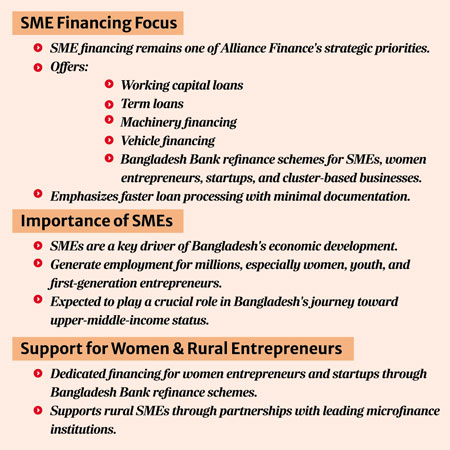 "As Bangladesh progresses toward upper middle-income country status, the SME sector will continue to play a vital role in driving inclusive and sustainable economic growth," the senior executive of the company explained.
Responding to another question about special plans for women entrepreneurs, young entrepreneurs and rural SMEs, Mr. Rashid said Alliance Finance offers dedicated financing programmes for women entrepreneurs and startups through Bangladesh Bank's refinance schemes as part of its commitment to inclusive entrepreneurship.
"We also support rural SMEs through partnerships with leading microfinance institutions. Going forward, we plan to further strengthen this support by introducing customized financial products, expanding digital services, and broadening our outreach initiatives," he noted.
Asked about the measures needed to improve SMEs' access to finance, Mr. Rashid said the financial sector needs to move beyond the traditional collateral-based lending approach and place greater emphasis on cash flow-based credit assessments.
He also stressed the importance of ensuring that loan proceeds are utilized for their intended business purposes to improve credit discipline and the effectiveness of financing.
Mr. Rashid added that simplifying documentation requirements, expanding credit guarantee schemes, accelerating digitalization, and enhancing financial literacy among entrepreneurs could significantly improve access to finance for deserving SMEs and support sustainable business growth.
Regarding SME repayment performance and non-performing loans (NPLs), the company's Head of Business said repayment performance remains satisfactory when financing is structured based on cash flow, business purpose and future prospects, supported by effective monitoring and follow-up. Although SMEs are more vulnerable to market volatility and economic challenges, the risk of default can be significantly reduced when loan funds are used for their intended business purposes.
He also said SME loan portfolios are generally more diversified than large corporate portfolios, helping spread risk across a broader customer base. While some SMEs fail due to operational challenges, business burnout or adverse market conditions, collateral is available in some cases to recover outstanding loans.
Based on Alliance Finance's experience, the level of non-performing loans in its SME portfolio has remained relatively low, reflecting sound portfolio quality and prudent credit management practices, according to Mr. Rashid.
Asked about the opportunities and challenges facing the SME sector over the next five years, the executive said the greatest opportunities lie in digital transformation, export diversification, and the increasing participation of women and young entrepreneurs.
However, he noted that SMEs will continue to face challenges, including limited access to affordable finance, rising operating costs, technological adaptation, skills development, and intensifying competition.
He added that businesses embracing innovation, strengthening corporate governance, and adapting to changing market dynamics would be best positioned to achieve sustainable growth and long-term success.
Regarding the coordinated efforts needed from policymakers and financial institutions, Mr. Rashid said stronger collaboration among the government, regulators, financial institutions and business associations is essential to unlock the full potential of the SME sector.
He said priority should be given to expanding credit guarantee schemes, strengthening credit information systems, improving financial literacy and promoting technology adoption.
"SME manufacturers are not only meeting domestic demand for products ranging from electrical components and hardware items to mechanical parts and light engineering products, but are also playing an increasingly important role in the country's industrial supply chains," Mr. Rashid noted.
siddique.islam@gmail.com