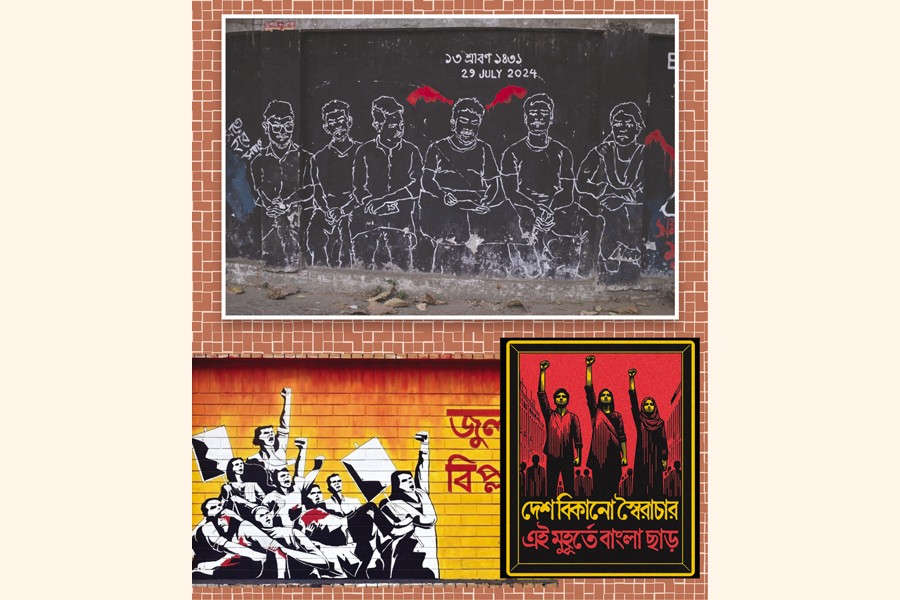
 A glimpse of posters and graffitis of July uprising
  A favourable business environment is crucial for fostering new entities, expanding existing enterprises, and encouraging the emergence of new entrepreneurs. In essence, this reflects the overall business confidence in the economy. When such confidence thrives, it stimulates growth across manufacturing, services, and agricultural sectors, leading to broader economic expansion and increased employment. This cycle is fundamental to a modern, dynamic business ecosystem.
For nearly 16 years, Bangladesh was governed by the authoritarian Awami League regime under Sheikh Hasina. While 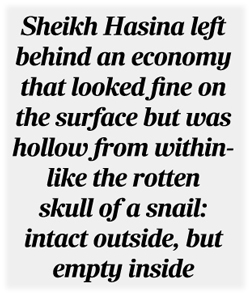 her administration frequently spoke about improving the business environment, the reality was starkly different. The system became increasingly centralised, with opportunities concentrated among a handful of industrial conglomerates closely aligned with the ruling elite.
These favoured groups included S Alam Group, Beximco Group led by Salman F Rahman, and the Summit Group. Outside these select entities, genuine private investment and new entrepreneurial ventures became nearly impossible.
After years, the prolonged struggle against the Hasina regime culminated in the victory of the people on August 05 last year. This triumph came at a heavy cost—at least 1,400 lives were lost, and several thousand others were injured, many sustaining lifelong disabilities.
In the aftermath of this turning point, we ask: how is the business landscape evolving? How are businesses responding, and what new opportunities are emerging in the economy? To assess this, we turn to a popular framework for evaluating business environment—PEST Analysis (Political, Economic, Social, and Technological factors).
Politics: Following the departure of Sheikh Hasina, an interim government led by Nobel Laureate Dr. Muhammad Yunus was formed. This transitional administration is governing the country based on political consensus, making key decisions in consultation with major political parties.
The interim government introduced many reform initiatives—some were widely welcomed, while others sparked debates. However, the most pressing issue on the national agenda has been the organisation of the next general election. While some stakeholders demanded elections only after key reforms completed, others argued for holding early polls to restore democracy quickly.
Initially, the interim government proposed a six-month transition period—from December 2025 to June 2026—to prepare for the elections. However, major political parties, including the BNP, insisted on holding elections by December 2025, citing parties have already reached a broad consensus on free and fair voting.
Amid extensive dialogue and political debate in Dhaka, Dr. Muhammad Yunus travelled to London and met with BNP leader Tarique Rahman. Following this high-level consultation, a new election timeline was announced: the 12th general election would be held by mid-February 2026. Both the interim government and major political parties have welcomed this timeline. The government has already instructed law enforcement agencies and the Election Commission to take necessary preparations to make sure that elections are held on time.
Thus, the return to democracy now appears to be a matter of “when,” not “if.” However, a new challenge has emerged: some smaller parties are demanding a shift to a proportional representation (PR) system. While PR is used in many countries, it remains poorly understood among the general public in Bangladesh. One of its major drawbacks is that it weakens the direct connection between voters and their representatives, as constituents vote for parties rather than individual candidates.
Given the situation, the country is likely to proceed with a conventional electoral model, where eligible voters directly elect Members of Parliament. The party securing a majority will form the next government.
In summary, the restoration of democracy is now within reach. The road is rocky but a glimmer of hope is visible at the end of the tunnel. So the bottom line is: a peaceful political environment persists in the country and the restoration of democracy is a matter of time.
Economics: Sheikh Hasina left behind an economy that looked fine on the surface but was hollow from within—like the rotten skull of a snail: intact outside, but empty inside.
The banking sector was nearly drained. Government coffers were depleted, largely due to weak revenue collection and excessive borrowing from both domestic and international sources. This borrowing spree, including from multilateral institutions, led to a significant buildup of the debt burden. Foreign exchange reserves were rapidly dwindling. Meanwhile, inflation—a key barometer for investment—remained at the double-digit level. Although the true inflation rate was never known due to manipulated data, the Bangladesh Bureau of Statistics (BBS) consistently reported rates exceeding 10 per cent.
The capital market had performed the worst during the past regime. The market was synonymous with losing money, not earning.
After taking office, the interim government took steps to restore the independence of the BBS. As a result, more realistic inflation data began to emerge, confirming that the rate had indeed crossed 10 per cent. To tackle this, the government adopted a two-pronged approach: tightening both fiscal and monetary policies to contain inflation. It also began efforts to dismantle market cartels—some of which met with partial success—though the distribution channels remained a bottleneck for ensuring a fair competition among producers and manufacturers.
Inflation has started to ease and currently stands below 9.0 per cent. While still high for robust investment, many economists remain hopeful that inflation can be brought down to around 6 per cent by December 2025.
The foreign exchange market had become highly volatile toward the end of the Hasina regime, with many alleging large-scale capital flight. While that claim requires deeper investigation, it’s true that reserves have since started to recover—driven by a rise in the inflows of remittances, export earnings, and funding from the IMF, World Bank, and ADB. These reserves are critical for business confidence and exchange rate stability.
Despite persistent high non-performing loans (NPLs) Bangladesh ‘s banking sector is beginning to stabilise, thanks to initiatives introduced by the central bank. Depositor confidence is gradually returning, as reflected in modest growth in bank deposits, even though the rate remains below historical averages.
Bangladesh’s investment promotion agency has also been working actively, implementing several reforms to attract both domestic and foreign direct investment (FDI). However, one issue often ignored in economic discussions is the country’s graduation from the Least Developed Country (LDC) status. To my view, there is an opportunity loss for Bangladesh’s economy. Championed by former Finance Minister AHM Mustafa Kamal, it was largely pursued as a political milestone to satisfy Sheikh Hasina’s ambitions.
A fresh challenge has now emerged with the imposition of tariffs by the United States. According to Fitch Ratings, Bangladesh stands to be one of the hardest-hit countries in the Asia-Pacific region. However, this challenge could also be seen as an opportunity. Bangladesh currently exports about $7.0 billion worth of goods to the U.S., while importing roughly $2.0 billion. Of the $7.0 billion in exports, actual value addition within Bangladesh is estimated at around 40 per cent—or $2.8 billion. In reality, the retained value is likely even lower due to import dependence and low local content.
There are also many undisclosed conditions tied to U.S. market access. If Bangladesh can diversify its export destinations and products as well as focus on exporting skilled manpower and services, the potential gains could outweigh the losses. In the long run, this shift may lead to a more sustainable and resilient economic model.
Social: Bangladesh’s social trends are becoming increasingly favourable for business. Consumers are showing a growing preference to new, innovative, and quality products—both locally produced and imported. The rising demand for goods and services reflects a more dynamic and consumption-driven economy.
Religious customs and major festivals—such as Eid-ul-Fitr and Eid-ul-Adha—further stimulate economic activity, creating seasonal booms in retail, food, clothing, and travel sectors. Moreover, Bangladesh’s demographic profile presents a major advantage: a large and youthful population that not only drives consumption but also provides a growing, trainable workforce.
Technology: Bangladesh has made a significant stride in the technology sector. From automation in industries to the rapid expansion of online and mobile banking, technology is transforming how businesses and government services operate. Many public services have now been digitized, making access easier and more efficient.
The introduction of Starlink—a high-speed satellite internet service—has further revolutionised connectivity in remote and underserved areas. This advancement will ultimately benefit both businesses and the broader economy by enabling digital inclusion, boosting productivity, and supporting the growth of startups and tech-based enterprises.
The PEST in summary reveals that there is an overall positive trend this government maintains. Once the election is completed within February next, the confidence will dramatically improve. And this trend needs to be nursed and the business activities harnessed, mostly by the private sector. In that case the much-needed foreign direct investment (FDI) might reach its peak in the coming months.
jasimharoon@yahoo.com
© 2026 - All Rights with The Financial Express

