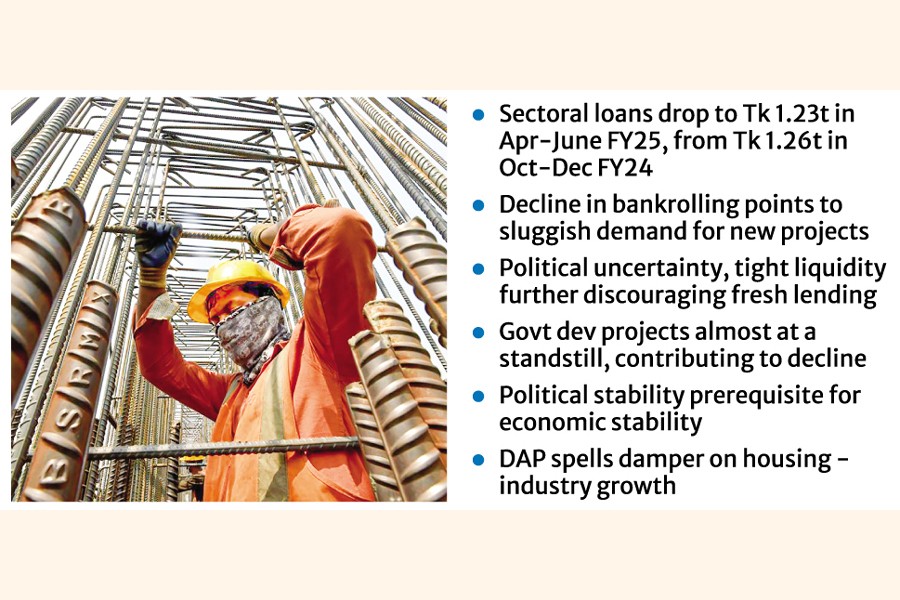
Realtors reckon the fallout as lending to finance construction by banks had been on a decline over the last two quarters in signs of a slowdown in fresh investment and stagnation in both public-and private-sector projects.
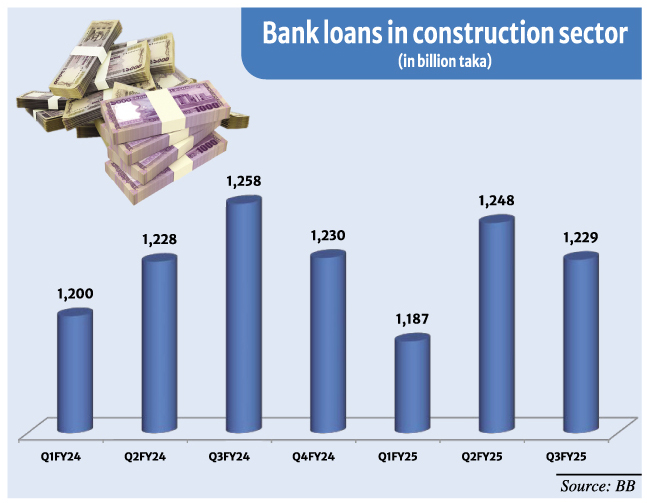 The amount of outstanding construction loans fell to over Tk 1.23 trillion in April-June period of the fiscal year 2024-25 from over Tk 1.26 trillion in October-December FY24, according to Bangladesh Bank data.
By the same account, the construction-sector loans dropped by 1.01 per cent to Tk 1.23 trillion in April-June FY25 from Tk 1.24 trillion in the January-March quarter of the same fiscal year.
The central bank's figures show that construction loans stood at Tk 1.20 trillion in July-September and Tk 1.24 trillion in April-June FY24.
Of a total Tk 17.34 trillion worth of economic-purpose loans and advances, the construction sector's share fell to 7.08 per cent in April-June 2025 from 7.24 per cent in January-March 2025, reflecting a slight decline in its proportion of overall credits channelled into economic activity.
Construction loans include housing (commercial) outstanding loans for developers and contractors, housing (residential) outstanding loans for urban areas for individuals, housing (residential) outstanding loans for individuals in rural areas, infrastructure development for roads, culverts and bridges, house renovation, repairing or extension, and commercial buildings like markets, factories, hotels, cold storages, warehouses etc, according to the BB categorization of financing.
They also cover establishment of solar panels, effluent -treatment plants (ETP), loans against work orders/pay orders, waterworks, and sanitary services.
Commercial- housing loans for developers and contractors rose by 4.33 per cent to Tk 374.61 billion in April-June 2025 from Tk 359.07 billion in January-March of the year while residential-housing quantum for urban areas for individuals declined by 3.96 per cent, falling to Tk 314.26 billion in April-June 2025 from Tk 327.21 billion in January-March 2025.
On the other hand, housing (residential) loans for individuals in rural areas declined by 1.34 per cent, falling to Tk 38.26 billion in April-June 2025 from Tk 38.78 billion in January-March 2025.
Loans for infrastructure development like road, culvert, bridge stood down at Tk 96.26 billion in April-June from Tk 98.28 billion in January-March 2025, marking a quarter-on-quarter decline of 2.05 per cent.
Lending for house renovation, repair, or extension amounted to Tk 75.21 billion in April-June in a decline from Tk 76.23 billion in January-March 2025, marking a quarter-on-quarter contraction of 1.32 per cent.
Experts take a cue from the statistics to explain that the construction sector, a key driver of the economy of a developing country as Bangladesh, is witnessing cautious lending amid shifting market dynamics.
While commercial-housing loans for developers see some growth, residential loans for individuals have moderated, reflecting a careful approach by banks and developers, according to them.
Dr Masrur Reaz says, "The latest BB data shows that outstanding construction loans have continued to decline over the last two quarters, standing at Tk 1.23 trillion in April-June FY25 from Tk 1.26 trillion in October-December FY24."
While loans for housing (commercial) for developers and contractors increased by 4.33 per cent, residential loans for urban and rural individuals saw a moderate decline of 3.96 per cent and 1.34 per cent, respectively, he states.
"This trend suggests a cautious approach by banks and developers amid changing market dynamics," Dr Reaz told the FE writer, adding that although the construction sector remains a key part of the economy, its share of total loans had slightly fallen to 7.08 per cent from 7.24 per cent in the previous quarter.
He suggests that policymakers and financial institutions may need to explore targeted measures to support sector growth, particularly in infrastructure and rural housing, to strike a balance.
Outstanding loans for commercial buildings, such as market, factory, hotel, cold storage, warehouse etc reached Tk 156.45 billion in April-June 2025, down from Tk 164.49 billion in January-March 2025, marking a quarter-on-quarter decline by 4.88 per cent.
Lending for the establishment of solar panels amounted to Tk 901.1 million in April-June, down from Tk 1.369 billion in January-March, marking a quarter-on-quarter decline of 34.2 per cent.
Effluent-treatment plants (ETP) received Tk 32.8 million in April-June, down from Tk 48.1 million in January-March of the year under review, marking a quarter-on-quarter decline of 31.8 per cent.
Loans against work orders, pay orders, and earnest money stood at Tk 170.53 billion in April-June, down from Tk 173.77 billion in January-March, marking a quarter-on-quarter decline of 1.89 per cent.
Outstanding loans for water works reached Tk 691.4 million in April-June, up from Tk 471.7 million in January-March, marking a quarterly increase of 46.5 per cent.
Sector-insiders have said the decline in outstanding construction loans points to sluggish demand for new projects, as both public and private investments remain largely stalled. They also pointed out that persistent political uncertainty and tight liquidity in the banking sector are further discouraging fresh lending and investment in construction.
Mosleh Uddin Ahmed, Managing Director and CEO of Shahjalal Islami Bank Limited, says that government development projects are currently "almost at a standstill", contributing to a decline in outstanding construction loans.
He notes that the modest growth in housing and commercial projects is primarily driven by higher profitability prospects.
However, he adds, a sustained increase in such projects would depend on an improvement in the overall economic environment. His bank has also received proposals aligned with these projects.
"The wheels of business must keep turning," says Mr Ahmed, stressing that a vibrant private sector is essential for economic momentum.
He stresses the need for political stability, saying that it is "essential to ensure economic stability and create a favorable environment for investment".
The banker also urges policymakers to avoid frequent changes to key regulations such as tax and VAT as such shifts significantly disrupt business activities.
Liakat Ali Bhuiyan, senior vice-president of the Real Estate and Housing Association of Bangladesh (REHAB), says the real estate sector has slowed down in recent months as most developers shy away from launching new projects, largely due to restrictions imposed under the 2022 Detailed Area Plan (DAP).
According to Mr Bhuiyan, the DAP has severely impacted the growth of the housing industry and is stalling progress across more than 200 related sectors.
"Landowners have stopped providing land to developers since the DAP gazette was issued, as the plan drastically reduced the permitted building heights."
Earlier, REHAB called on the government to amend the DAP to revive development momentum and protect the broader housing ecosystem.
sajibur@gmail.com
© 2026 - All Rights with The Financial Express

