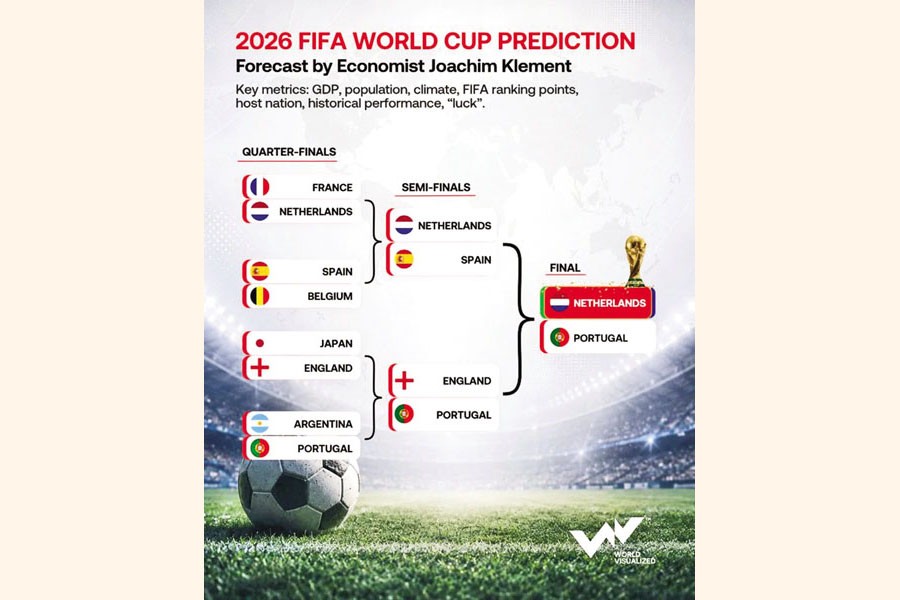
 The path German economist Joachim Klement believes the Netherlands will take to victory at this year's World Cup, from the quarter-final stage
 The 2026 FIFA World Cup got underway on June 11, with hosts Mexico opening their campaign against South Africa. As fans across the globe dream of seeing their nations go all the way, predictions about the eventual champion have once again become a major talking point, report agencies.
Football has seen its fair share of famous forecasters over the years. Many still remember Paul the Octopus, whose uncanny predictions stole the spotlight during the 2010 World Cup.
But among the more unlikely names to earn a reputation for accuracy is German economist Joachim Klement.
Klement has built a track record that few pundits can match. Using a statistical model that factors in variables such as population size and FIFA rankings, he successfully predicted Germany's triumph in 2014, France's victory in 2018, and Argentina's title-winning run in 2022. Ironically, Klement never set out to become a football oracle. In fact, he originally designed the model to demonstrate just how difficult it is to forecast a World Cup winner. Reflecting on his first successful prediction, he told Der Spiegel, "The first time I was horrified when Germany became world champions in Brazil, also because all the experts had pointed out that no European team had ever won a World Cup in South America." Despite his remarkable record, Klement insists there is no magic behind his forecasts. Speaking to DW News, he downplayed the significance of his model and credited much of his success to fortune. "I actually tried to get it wrong," he joked, adding, "but I must be the luckiest economist in the world to get it right three times in a row."
According to Klement, his formula can account for only about half of what influences a football match, with the rest coming down to unpredictable moments and sheer chance. "People keep asking me what my crystal ball says," he said. "But the truth is, I don't have one. I've just been lucky so far."
So, which team does his model favour in 2026? Klement's answer may surprise many football fans. While most predictions revolve around traditional powerhouses such as France, Argentina, Spain, and England, his simulation points elsewhere.
"It's sad to say as a German," Klement revealed, "but I predict that the Netherlands will win their first ever World Cup this time around." His forecast suggests the Dutch will finally end their long wait for football's biggest prize, defeating Portugal in the final to lift the trophy.
The German has confessed in the past though that his predictions should not be taken as fact, with a fair amount of chance factored in. He said: "It's completely irrational. It's like playing the lottery. I always say that if anyone places a bet based on my prediction of who will be the next world champion, they're beyond help.
"It's like tossing a coin. You might predict that the coin will land on heads four times in a row rather than tails, and that might well happen. But that doesn't guarantee it will happen again next time."
© 2026 - All Rights with The Financial Express

