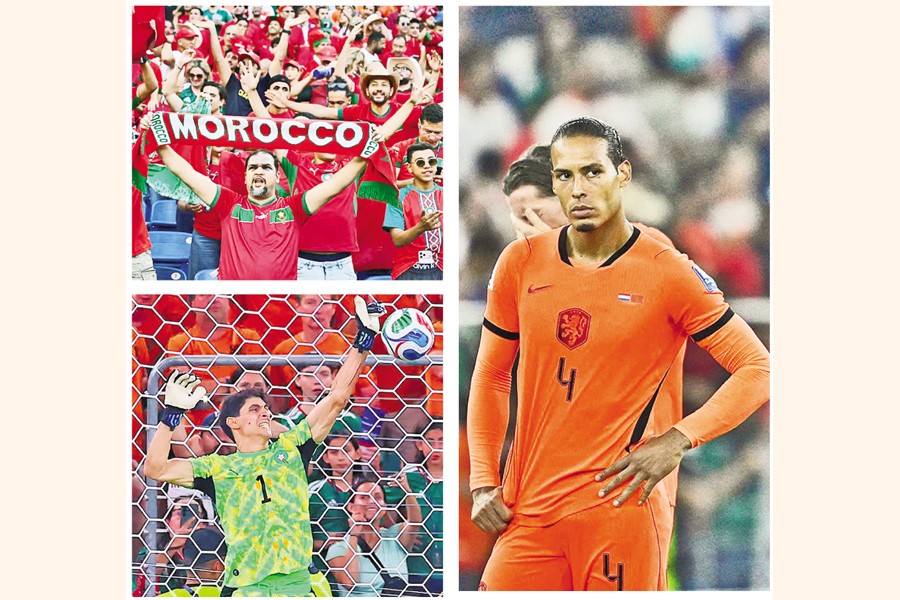
 Clock-wise: Netherlands' Crysencio Summerville misses a penalty during the penalty shootout saved by Morocco's Yassine Bounou, Morocco's fans cheer their team during the 2026 World Cup round of 32 football match against Netherlands and Netherlands' defender Virgil van Dijk reacts after losing the penalty shootout at the Monterrey Stadium in Guadalupe on Tuesday (as per BST)- AFP, Reuters
 DUBAI, June 30 (Gulf News): Any suggestion that Morocco's remarkable run to the 2022 World Cup semi-finals was a fluke has quickly been put to bed.
The Atlas Lions keep on exceeding expectations on the major stage, this time defeating the Netherlands for the first time in their history to book their place in the 2026 World Cup round of 16.
Morocco had already cemented their place in African World Cup history before the knockout stages, surpassing Ghana and Nigeria to become the continent's most successful nation with a record seven World Cup victories.
Now extending that record to eight wins, the fearless Atlas Lions are the story that keeps on giving, leaving football fans across the globe captivated.
The years before the glory
For much of their World Cup history, Morocco were a nation capable of producing talented players and memorable performances, but they lacked the consistency to establish themselves among the tournament's elite. Their first appearance came in 1970, where they exited in the group stage, and while qualification itself was an achievement, it marked the beginning of a long period of frustration on football's biggest stage.
Four years later they failed to qualify, before finally producing a moment that would define African football in 1986.
That tournament in Mexico remains one of the most significant in the continent's history. Morocco became the first African nation to top a World Cup group, finishing ahead of England, Poland and Portugal before narrowly losing 1-0 to West Germany in the Round of 16.
Rather than signalling the start of sustained success, however, it proved to be an isolated high point. Morocco returned in 1994, 1998 and 2018, but on each occasion failed to progress beyond the group stage, often leaving the tournament wondering what might have been.
Despite regularly producing technically gifted players and enjoying success at continental level, the Atlas Lions remained on the fringes of the global game, with their breakthrough in 1986 looking more like an exception than the start of a new era.
The tournament which changed everything
The 2022 World Cup in Qatar marked the moment Morocco's footballing story changed forever.
Under Walid Regragui, Morocco became the first African nation and the first Arab nation to reach a World Cup semi-final, shattering a barrier that had stood since the tournament's inception in 1930. Although their remarkable journey ended with defeats to eventual champions France in the last four and Croatia in the third-place play-off, a fourth-place finish remains the greatest achievement by any African nation at a World Cup. What made the run even more extraordinary was the calibre of opponents Morocco overcame. They topped a group containing 2018 runners-up Croatia, Belgium and Canada before eliminating
former champions Spain on penalties in the Round of 16 and then knocking out Cristiano Ronaldo's Portugal in the quarter-finals thanks to Youssef En-Nesyri's towering header.
Proving the doubters wrong
Heading into the 2026 World Cup, Morocco were no longer the surprise package they had been four years earlier, but there were still plenty who questioned whether they could replicate the heights of their historic run in Qatar.
Their preparations were thrown into further uncertainty when the architect of that success, Walid Regragui, stepped down as manager just three months before the tournament, with the relatively inexperienced Mohamed Ouahbi handed the daunting task of succeeding him.
© 2026 - All Rights with The Financial Express

