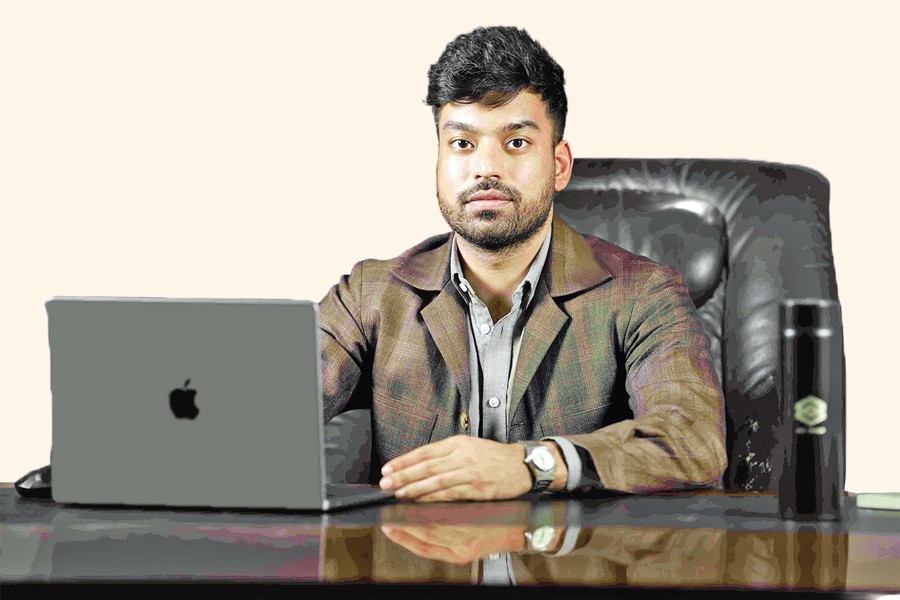
 BHL Group Director Sifat Arman
 BHL Group, one of the country's leading diversified conglomerates, is committed to ensuring innovation and quality of its tiles and sanitary products, aiming to earn customers' trust.
The BHL Group began its journey with the import of ceramic tiles, gradually evolving into modern, technology-driven local production in 2018. With a short span of time, it has doubled its initial daily tiles production capacity to 40,000 square meters.
After diversifying into sanitary ware manufacturing in 2022, the BHL Group now produces approximately 90,000 high-quality sanitary products every month.
"Our vision is to earn customers' trust by consistently delivering world-class quality. We are committed to developing environmentally-friendly sustainable technologies. Customer satisfaction remains our foremost measure of success," BHL Group director Sifat Arman said in an interview with the FE.
About the prospects of Bangladesh's ceramic industry, he said the future of this sector is highly promising as the demand for ceramic items has been on rise following the rapid growth in the domestic market and ongoing development initiatives.
Mr. Arman, however, said recent political uncertainty and reduced purchasing power have temporarily slowed market movement.
"With appropriate policy support and government incentives, Bangladesh's ceramic manufacturers-including us-hold strong potential for global expansion. Like the leading ceramic producers, we maintain consistent production capacity, adopt advanced technologies, and ensure stringent quality control across both tiles and sanitary segments," said the BHL Group director.
Talking about the tiles segment, Mr. Arman said urban consumers are increasingly shifting toward larger slab tiles.
Keeping such growing demand in view, the BHL Group has installed state-of-the-art machinery that is capable of producing popular sizes of tiles such as 600×1200 mm and 800×800 mm.
"We use digital press systems, modern kilns, and advanced surface finishing technologies that enable premium finishes such as Rocker, Glossy Granula, and Glue Granula-all produced in-house," he said.
The company also produces the latest international surface finishes-including Rocker Finish, Glossy Granula, and Glue Granula-in our own factory, he said, adding: "Compared to many other brands, we prioritize environmentally friendly technologies that make our production more sustainable."
About the sanitary segment, the BHL Group has significantly reduced import dependence by manufacturing high-end one-piece water closets locally.
"Notably, we are the first in Bangladesh to produce smart-technology-based commodes in our own facility-an important milestone for the sanitary industry."
Mr. Arman said the demand for ceramic products has grown sharply due to expansion in the housing sector, infrastructure development, and an increasing focus on aesthetic interior design.
Over the next five years, the industry is expected to grow even faster, driven by economic development, smart city initiatives, rising disposable income, urbanisation, and new construction technologies. With stable energy supply, export incentives, and supportive policies, Bangladesh's ceramic industry can strengthen its position both locally and globally.
"Our facility manufactures high-quality one-piece models and smart-technology commodes using advanced molds, robotic glazing, and automated testing systems. These ensure durability, functionality, hygiene, and long-term performance," said Mr. Arman.
The company also integrates environmentally friendly and energy-efficient solutions to make our entire production process more responsible and sustainable, he mentioned.
Mentioning that technology and innovation drive every stage of the company's production, Mr. Arman said his company relies on state-of-the-art European machinery, automation systems, and precision-based quality control technologies to meet international standards in manufacturing both tiles and sanitary wares.
About raw material sourcing, he said Bangladesh has limited natural availability of ceramic raw materials, which has made the industry heavily dependent on imports.
"We source raw materials from China, India, Europe, Australia, Vietnam, Malaysia, and Thailand," said Mr. Arman.
However, global geopolitical issues, foreign exchange fluctuations, rising sea freight charges and global market volatility directly impact the company's import costs and supply chain stability.
He also identified shortage of gas, higher import duties on raw materials and dollar scarcity as the key challenges for the local industry.
"Despite having such challenges, we remain committed to maintaining product availability and quality through efficient management and technology-driven production," said Mr. Arman.
Mentioning that Bangladesh's ceramic industry helps conserve foreign currency by reducing dependence on imported finished goods, he stressed the need for smooth supply of gas with predictable pricing to maintain competitiveness, he observed.
Since ceramic products are widely used in both rural and urban homes, reducing supplementary duties on imported raw materials would support the industry growth, help meet rising local demand, and strengthen Bangladesh's position in the global ceramic market.
"We firmly believe that Bangladesh's ceramic industry can establish a strong export presence similar to the garment sector. With the right mix of policy support, technological advancement, and rigorous quality control, we can compete effectively with global manufacturers in China, India, and beyond-ultimately placing Bangladesh prominently on the global ceramic map," he said.
Keeping Bangladesh's significant sanitation challenges in view, the BHL group is intensifying our R&D to develop high-quality, user-friendly sanitary solutions.
"To our valued customers-your trust and support inspire our continued commitment to innovation and quality. We are dedicated to ensuring that locally manufactured, high-quality tiles and sanitary products enhance the beauty and functionality of your homes and construction projects.
He further said: "Our goal is not just to sell products but to make your everyday life easier, more sustainable, and more beautiful."
© 2026 - All Rights with The Financial Express

