The newly appointed chief of the securities regulator said he had been given a mandate by the government's top leadership when he took charge, and that mandate was to turn the market around, for which he would enjoy absolute independence.
Masud Khan, in his maiden interview with The FE as chairman of the Bangladesh Securities and Exchange Commission (BSEC), spoke at great length about his market goals and his means of accomplishing them.
He said he would put emphasis on simplifying rules and regulations to make the secondary market attractive for non-listed companies and investors, and on adopting automation to discipline market stakeholders. If any political interference came in the way of his work, Mr Khan said, he would leave the position.
"I will not make any compromise," added the BSEC chief.
First target: listing large local and multinational firms
Mr Khan said he would strive to bring multinational and large local firms to the market through direct listing.
Although the existing listing regulations have a provision for direct listing of private enterprises, an embargo was imposed in 2015 following the misuse of the legal scope.
"We will change the regulations and make them very easy [to comply with]," he said, giving an example that if Incepta showed interest in entering the market, he would not require any regulatory scrutiny. Likewise, if bKash or Unilever Bangladesh agreed to list, the commission would just ask them to offload 10 per cent of their shares in the stock market.
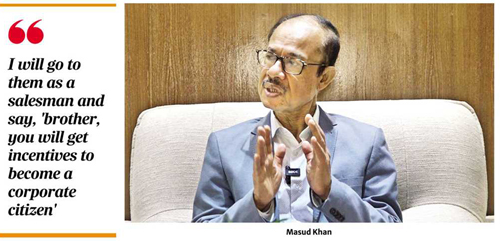
"I will go to them as a salesman and say, 'brother, you will get incentives to become a corporate citizen'."
Mr Khan joined the BSEC at a time when the market had remained bearish for a long time due to a sluggish domestic economy and a global meltdown. Investors had also turned away from the market owing to policy mishaps and repeated market scams committed under the very watch of the regulatory bodies, without any effective measures to rein them in.
His appointment on June 4 amid the newly elected government's pledge to fix and strengthen the equity market roused hope among investors and market operators, reflected in the recent increase in the broad index of the primary bourse and in the turnover.
Practicality in, theories out
Mr Khan said he would simplify mutual fund rules, public issue rules and margin rules, taking into account solutions to practical problems.
Referring to margin issue rules, he said they were ineffective because they were too focused on theories.
"I think the theoretical input is too high in the formulation, and practical input is too low."
Mr Khan's plan is to talk to relevant people informally before making further amendments to the rules.
Describing the process of issuing IPOs as cumbersome, he said it required submission of a pile of papers and more than a year to float a public issue.
"I have to cut short the process and simplify it."
Mr Khan said he would hold a meeting this week with the Dhaka bourse, Financial Reporting Council (FRC), the Institute of Chartered Accountants of Bangladesh (ICAB) and the issue managers as part of the move for further simplification of the rules.
Highlighting complex elements of the IPO rules, the BSEC chief said a company willing to go public under the book building method was required to collect bidding prices from 40 eligible investors.
"But where will 40 eligible investors be found practically? So, we need practical changes."
Mr Khan has also contemplated how to combat market manipulation and scams, and how to keep fraudsters from taking advantage of the lengthy legal remedial process.
A special High Court bench for capital market
Some market intermediaries concentrate more on handling lawsuits to use the law in their favour than on giving services to investors. They have enough funds to appoint prominent lawyers. When any enforcement action is taken by the securities regulator against their malpractices, they file a writ petition to get a stay order from the upper court. Jurists often lack knowledge about market operations, and the BSEC fails to convince the court about the necessity of the enforcement actions.
"Anyone has the right to challenge a decision. But when it [the matter] goes to court as a civil case, it lingers," Mr Khan said.
The special tribunal for the capital market was established in 2012 to try previous market-related cases, including those tied to the 1996 scams.
After joining the BSEC, Mr Khan found that the regulator could not file any case with the tribunal because it could not take cognizance of any ongoing matter. "We are going to change the law so we can file cases directly with the tribunal," the BSEC chief said.
The commissioner handling the legal matters, Nahid Mahtab, has already been asked to speak with the Chief Justice.
"We want a special [HC] bench for the capital market," said Mr Khan.
Anyone willing to file a writ petition would go to the special bench having a judge who understood the matter. Mr Khan said the tendency of challenging market-friendly decisions would decrease if the court checked the merits of the matters.
Deregulation empowering the exchanges
In the past, it was observed that the securities regulator took up the roles of the stock exchanges. Moreover, the exchanges had to take permission from the BSEC before conducting any inspection at listed firms.
Similarly, BSEC's permission was needed to conduct an inquiry into market operators. The time lapsed before any effective action resulted in losses of general investors because frauds could not be prevented.
Mr Khan said the BSEC had already returned the authority to fix market control mechanisms and the limits of circuit breakers to the bourses. The stock exchange will soon be empowered to inspect listed entities without the regulator's permission.
"They will send us the full file after completing inspections. Very soon there will be a lot of deregulation. Within the next week, you will see many things coming," said Mr Khan.

Delisting of junk stocks
Listing and delisting go hand in hand across the globe, but Bangladesh's capital market is an exception. Here, many loss-making companies, which have remained out of operation for a long time, have been creating volatility in the market through artificial rallies.
Mr Khan said he had inquired about the non-operational companies. "The DSE is preparing for delisting."
Meanwhile, the DSE has started taking other measures, such as halting trades in junk stocks, for example, which never happened in the past.
The bourse has also been engaged in upgrading the existing surveillance system by this year.
"AI surveillance will be introduced next year," said Mr Khan, insisting that the new commission would adopt technology to overcome all regulatory weaknesses that hindered the growth of the capital market.
mufazzal.fe@gmail.com
© 2026 - All Rights with The Financial Express

