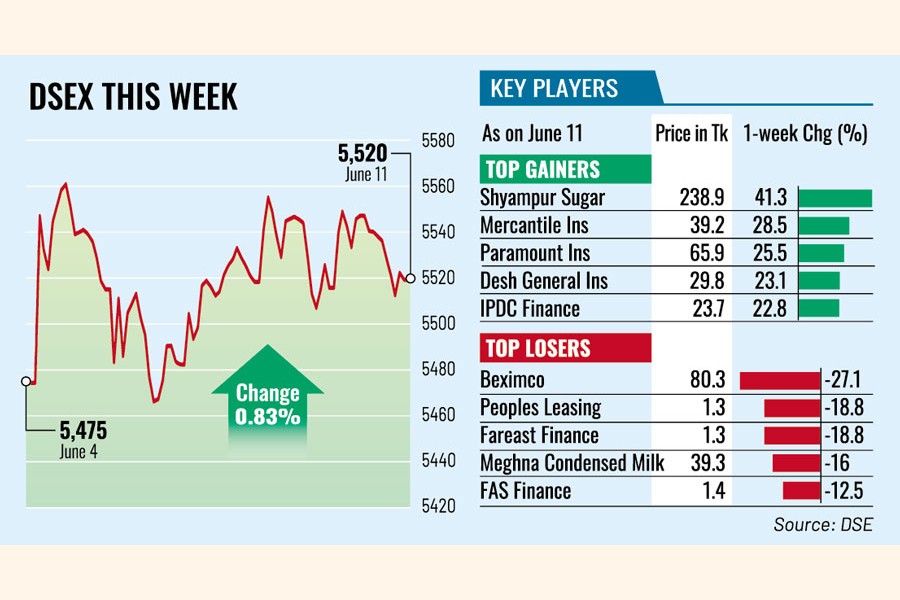
The benchmark index of the Dhaka Stock Exchange (DSE) surpassed the 5,500-point level for the first time in three and a half months this week, driven by investor optimism over capital market-friendly proposals in the national budget, despite heavy selling pressure following the withdrawal of floor prices on two major stocks.
The market remained upbeat amid expectations of regulatory reforms under the newly reconstituted Bangladesh Securities and Exchange Commission (BSEC) and policy initiatives aimed at improving market efficiency, liquidity and investor confidence.
The benchmark DSEX index climbed 45 points, or 0.83 per cent, to close the week at 5,520 -- its highest level since March 2. The blue-chip DS30 index advanced 5 points to 2,073, while the Shariah-based DSES index rose 6 points to 1,114. Over the past four weeks, the benchmark has surged by a cumulative 215 points.
The week's trading was closely watched for the formal end of a nearly four-year floor-price regime. On Monday, the newly formed Bangladesh Securities and Exchange Commission (BSEC) lifted price floors on Beximco and Islami Bank.
Both stocks came under immediate selling pressure following the removal of the price restrictions.
Beximco took a heavy hit, plunging 27.1 per cent to Tk 80.30 to become the week's worst performer as investors rushed to offload shares that had been trapped under the floor-price mechanism for years.
Islami Bank also saw initial price erosion in its first two sessions before rebounding on Thursday.
However, market analysts said the effect on the broader market was limited. Beximco had already been excluded from the DSEX during the latest index rebalancing. Furthermore, more than 80 per cent of Islami Bank's shares remain held by sponsors and strategic investors, reducing its influence on overall market movements.
The week started on a strong note, with the benchmark index extending its rally for a tenth straight session as investors accumulated fundamentally strong stocks in anticipation of supportive measures in the national budget.
Although some investors opted to book profits ahead of the budget announcement, causing a brief correction, buying interest returned later in the week on optimism that fiscal measures would help revive private-sector investment and improve corporate earnings.
Of the week's five trading sessions, three closed higher and two ended lower, all marked by robust investor participation.
According to EBL Securities, market momentum remained positive, supported by expectations that budgetary measures would improve business confidence, stimulate investment and enhance corporate profitability.
The finance minister's budget for FY27 proposed adopting a digitalised and time-bound initial public offering (IPO) process, but stopped short of offering any new tax incentives to encourage fresh listings -- a long-standing demand of market participants.
Although the budget did not introduce any new incentives for public listings, Finance Minister Amir Khosru Mahmud Chowdhury proposed several measures considered broadly supportive of the capital market.
Among the key proposals were the conversion of tax deducted at source (TDS) into an advanced tax system, static corporate tax rates for the next five years through 2031, and a phased introduction of T+0 settlement to improve market efficiency and liquidity.
The budget also proposed allowing foreign investors to repatriate profits and transfer proceeds from shares purchased through non-resident investor taka accounts within one working day, a move expected to improve the attractiveness of Bangladesh's capital market to overseas investors.
Salim Afzal Shawon, head of research at BRAC EPL Stock Brokerage, said the overall budget framework is supportive of the capital market.
Banks, telecom operators, pharmaceutical companies, ICT firms, fuel distributors, power companies, electronics manufacturers and automobile producers are likely to emerge as the biggest beneficiaries of the proposed measures, he said.
Market participation strengthened significantly during this week's trading. Total turnover on the DSE rose to Tk 64.4 billion as against Tk 46.2 billion in the previous week.
Accordingly, average daily turnover increased 11 per cent to Tk 12.87 billion, compared with Tk 11.56 billion a week earlier.
Investors remained mostly active in the insurance sector, which accounted for 19.3 per cent of the week's total turnover, followed by engineering (13 per cent) and pharmaceuticals (10.5 per cent).
Gainers slightly outnumbered losers. Of the 386 issues traded on the DSE, 183 advanced, 173 declined and 30 remained unchanged.
Most major sectors closed higher. Non-bank financial institutions led the gains with a 4.4 per cent rise, followed by telecom, power, pharmaceuticals and engineering.
NCC Bank emerged as the week's most-traded stock, with shares worth Tk 1.34 billion changing hands. It was followed by Dominage Steel, IPDC Finance and Summit Alliance Port.
The Chittagong Stock Exchange (CSE), however, ended the week lower. Its All Share Price Index (CASPI) fell 73 points to 15,195, while the Selective Categories Index (CSCX) shed 62 points to 9,320.
babulfexpress@gmail.com
© 2026 - All Rights with The Financial Express

