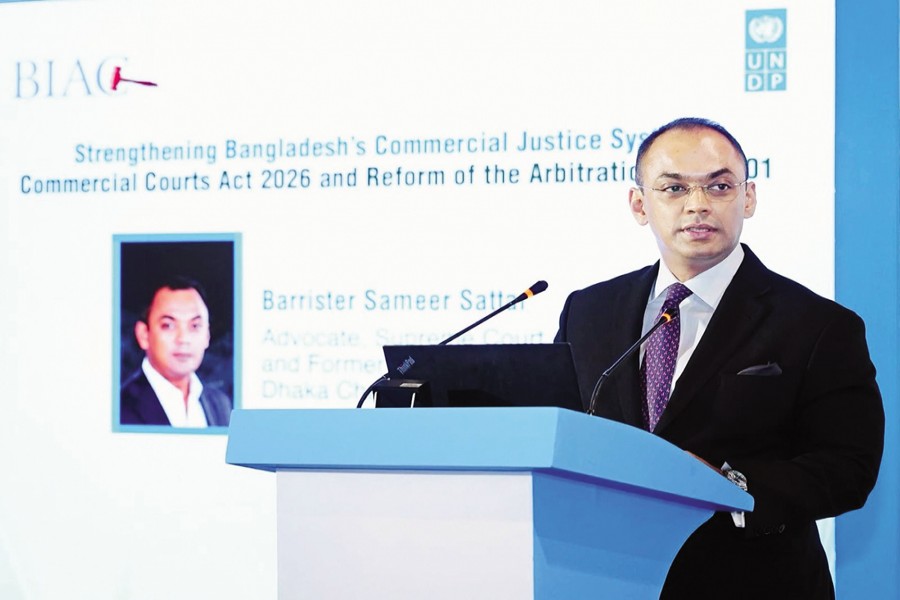
 Md Sameer Sattar delivers a keynote address at a seminar titled "Strengthening Bangladesh's Commercial Justice System: Commercial Court Act and Reform of the Arbitration Act 2001" last week. He later spoke at length with The Financial Express in a sit-down interview, sharing his observations about the commercial legal landscape in Bangladesh and how the act can play a role in ensuring a business-friendly environment in the country for both local and foreign entrepreneurs.
 The recently passed Commercial Court Act 2026 should help drive Bangladesh up the global dispute resolution index through efficient contract enforcement, earning the confidence of both local and foreign investors.
In an interview with The FE, Supreme Court lawyer Barrister Md. Sameer Sattar made this observation while explaining why legal and institutional mechanisms to resolve business disputes must improve for the economy to grow — both through business expansion and by attracting new investments.
Contract enforcement means that the parties to a legal agreement comply with the conditions of the deal, and in case of a violation, they can seek legal remedy from courts or through other mechanisms, such as arbitration. It is one of the key indicators used by the World Bank's Ease of Doing Business index and similar assessments.
According to a World Bank report for 2020, Bangladesh ranked 189 out of 190 nations in contract enforcement, trailing even Nepal, Pakistan and Sri Lanka.
Mr Sattar said any business dispute resolution currently takes an average of 1,442 days in Bangladesh, while disposal of a lawsuit under the Commercial Court Act — from the initiation of a case to the delivery of the judgement — must not exceed 90 days.
He, however, emphasised the importance of effective implementation of the law.
"We are waiting to know how the government will implement the law," said Mr Sattar, also a former president of the Dhaka Chamber of Commerce & Industry (DCCI).
Apart from introducing digital submission and e-judgements, the act empowers judges to resolve disputes based primarily on robust documentary evidence and pleadings, bypassing the lengthy traditional procedures of civil litigation. The act also promotes the appointment of specialised judges with strong commercial acumen.
"Reliable, efficient and predictable enforcement of contracts is not optional for investors — it is a baseline requirement for capital entry, expansion and risk assessment," Mr Sattar said.
He also highlighted the cost of litigation, which can itself serve as a deterrent to entrepreneurs.
SMEs bearing heavy costs
Consider, for example, two partners with a contract involving Tk 5 million, where non-payment of Tk 4 million resulted in a breach. The affected partner files a lawsuit with a district court. If the trial drags on for years before a judgement is announced and an appeal is subsequently filed with a higher court, the cost of pursuing the lawsuit and the time spent often surpass the original claim.
"This creates an unnecessary burden [particularly] for small entrepreneurs."
Meanwhile, the loss of investments is the biggest cost the country bears from its flawed commercial legal landscape.
While the SME sector in other countries, including neighbouring India, has become an economic powerhouse driving exports significantly, Bangladesh has been failing to provide smooth settlement of disputes, hampering the growth of SMEs.
Here, claimants chase lawyers and court proceedings for months on end. As a result, a substantial portion of business capital gets blocked due to unresolved disputes, disrupting overall business operations. "If the claimant gets a verdict within 90 days from the date of the initiation of the suit, he will have a better cash flow [in business]," said Mr Sattar.
Restoring confidence of foreign investors
Efficient commercial courts will help restore Bangladesh's reputation and earn the confidence of foreign investors. When investing in a country, foreign investors assess its infrastructure, legal landscape and regulatory environment.
On the legal and regulatory front, Mr Sattar said foreign investors place great emphasis on how efficient a country's court system is and whether there is an effective mechanism to dispose of cases.
Referring to the World Bank Business Ready 2024 report, he said Bangladesh scored very low on dispute resolution. One of the key reasons behind the poor performance is that "we didn't have any dedicated commercial court." Since the current government has enacted the law, it sends a positive signal to the international community, though the government must ensure the commercial courts operate effectively.
The act states that commercially aware and knowledgeable judges will be given priority in appointments to the commercial courts. "So, automatically, when a judge is proficient in a subject matter, it will be faster and easier for them to resolve the cases."
"Strengthening contract enforcement is not only a legal reform but an urgent economic necessity for Bangladesh," Mr Sattar added.
A good start
The government moved swiftly to enact the law and roll out a mechanism for dispute resolution. Law Minister Md. Asaduzzaman acknowledged at a seminar last week that there are loopholes in the act that need to be addressed.
"It's a good start, but the expected outcome of the law would depend on effective implementation," Mr Sattar said.
Asked about the types of disputes to be settled at the commercial courts, Mr Sattar said any breach of a financial contract — except for bank-related matters, which are handled by the Artha Rin Adalat (money loan court) — can be resolved there.
When it comes to the capital market, scams by stockbrokers and other intermediaries are a major financial concern. The securities regulator and stock exchanges have so far been unsuccessful in recovering money from brokers and returning it to their clients.
Asked whether victims of stockbroker fraud could seek remedy from the commercial courts, Mr Sattar said, "Brokers definitely received funds from clients under contracts. So, the affected clients can go to the commercial courts. But everything will depend on effective implementation of the law," he cautioned.
He also stressed the importance of intensive training for judges and lawyers of the commercial courts.
mufazzal.fe@gmail.com
© 2026 - All Rights with The Financial Express

