The operations of Bus Rapid Transit (BRT) to modernise the worsening traffic system of Dhaka and its surrounding areas will be managed by a government-owned Dhaka BRT Company, operating on commercial basis, sources concerned said.
The company will manage the public transportation business and ensure quality bus operations by managing the performance-based contracts under which the private sector operates the buses.
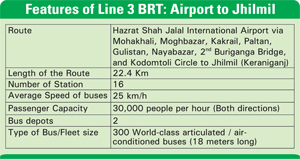
Bus terminals and depots will be located at Mohakhali (being the redeveloped intercity bus terminal) and Keraniganj near Jhilmil Project location.
"We are going to urgently improve the public transport system under the planning guidance of the Dhaka Strategic Transport Plan (STP) which consists of a network of three BRT Lines and three Metro Rail Lines (MRT)," the source said.
Dhaka Transport Coordination Authority (DTCA) is undertaking the project which includes the development of a 22km BRT Line-3 between Airport in the North and Jhilmil in the south with the support of the World Bank.
"The BRT system will introduce a new culture of passenger transport for Dhaka and improve the social and economic conditions of the city,"
At the Airport, BRT Line-3 will be connected with the northern BRT Line operating to Gazipur, currently being developed by Roads & Highways Department with the support of Asian Development Bank (ADB) to create a total of over 40km of North-South BRT line.
The main features of the BRT are central control of the system, so that operations are managed in 'real -time'.
The BRT system will operate platoons of high occupancy buses at 2 minute frequency on a physically segregated median busway, synchronised to the intersection signals to provide 'green-light priority'.
BRT stations will be located at the centre of the road median and will be accessed through pedestrian underpasses using escalators with facilities to cater for elderly and disabled.
Station platforms provide a safe and comfortable waiting area for the orderly boarding and alighting of buses with level-boarding at the bus entry for getting access.
Electronic 'smart-card' ticketing at station entry will provide simple and easy fare payment with a range of discounts applied for special needs groups and high volume travelers.
Passenger information will include visual information, public announcements as well as 'next station' announcements on the bus.
Importantly, BRT will be integrated into the other transport modes, especially feeder buses and rickshaws (and also the MRT rail lines) which are essential to provide a complete and connected network of passenger service to homes and suburbs.
The BRT system will engage with existing bus operators for the removal of the existing bus fleets along the corridor and include these operators as contracted operators of the new fleet to provide services to the BRT system. For bus operators, this represents a new business opportunity.
The effect of the BRT (and removal of the existing bus operations) will see both a better quality of public transport along the corridor and more orderly traffic operation, free of the disruptions of stop-starting buses in mixed traffic lanes.
BRT Line-3 development will have positive impact on neighborhoods, with the renovation of sidewalks, street lights and traffic signals along the corridor. The Gulistan inner city area will be redeveloped as a pedestrian-friendly environment around the BRT facilities.
© 2026 - All Rights with The Financial Express

