The stock index witnessed the biggest single-day fall for the first time in six years on Tuesday as panicked investors tried to exit the market amid the intensifying Middle East conflict.
Investors were rattled, which was reflected in the intense selling pressure across the board as the market opened. The pressure escalated as the session progressed, instead of ebbing.
The benchmark index of the Dhaka Stock Exchange (DSE) finally slid 209 points, or 3.80 per cent, to 5,325, after recovering 72 points the previous day.
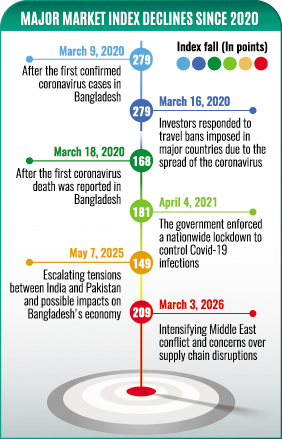
Tuesday's index plunge is the biggest since March 18, 2020, the day when the coronavirus outbreak triggered a sharp fall.
Investors remained wary of potential macroeconomic repercussions of the ongoing geo-political tension, particularly the risks of fuel and power supply disruptions within the country, said Akramul Alam, head of research at Royal Capital.
The news that fuel oil reserves would last for 15 days also shocked investors, as the escalating Iran conflict has already driven up global gas and oil prices, raising concerns that Bangladesh's import costs could rise significantly, he said.
Iran has reportedly closed the Strait of Hormuz in response to the attack by the US and Israel. Nearly 90 per cent of Bangladesh's primary energy imports pass through this vital waterway.
The disruption and fears of a prolonged closure have caused oil and natural gas prices to jump, with Brent crude futures up nearly 25 per cent this week after the conflict triggered multiple oil and gas shutdowns in the Middle East.
Bangladesh's energy security remains heavily dependent on Middle Eastern suppliers such as Saudi Arabia, the United Arab Emirates, and Qatar - making the country acutely vulnerable to disruptions in the Gulf.
"Any disruption in fuel imports could hamper power generation and industrial output, potentially slowing overall economic activity," he added.
While oil prices rise amid instability in the Middle East and key sea routes such as the Strait of Hormuz become insecure, Bangladesh is confronted with multiple economic stresses.
Economists and market insiders have already warned that if the conflict persists, the consequences could be immediate: longer shipping routes, higher freight costs, and ultimately rising energy prices that directly hit production costs across the economy.
Meanwhile, QatarEnergy has reportedly halted liquefied natural gas (LNG) production, raising fears of a big impact on Bangladesh, as energy security remains heavily dependent on Middle Eastern suppliers.
Global oil and gas shipping rates have already soared, with supertanker costs in the Middle East hitting all-time highs after Tehran targeted ships passing through the Strait of Hormuz, according to media reports.
International gas prices surged, rising by as much as 50 per cent on Monday and climbing another 30 per cent at one point on Tuesday morning.
Global media report that world energy markets face one of their gravest shocks in decades as joint US and Israeli strikes on Iran and Tehran's retaliatory missile attacks across the Gulf disrupt oil exports from the world's most important producing region.
Oil prices had already been climbing for weeks amid rising geopolitical tensions. Crude prices jumped more than 8 per cent on Tuesday to $84 a barrel as markets braced for a prolonged conflict and fears of supply disruptions began to materialise.
Further escalation could push prices even higher in the coming days.
Bangladeshi businesses have already expressed deep concerns, saying the intensifying conflict may pose fresh challenges and drive up the cost of doing business.
Higher oil prices would directly inflate Bangladesh's import bills, placing renewed pressure on foreign exchange reserves. An increase in LNG and fuel oil prices would raise electricity generation costs, potentially affecting industrial output and export competitiveness, particularly in energy-intensive sectors.
There is also a risk of renewed inflationary pressure if transport and production costs climb in response to rising fuel prices.
"Some investors sold their shares out of fear," said Md. Sajedul Islam, a DSE director.
However, he said some vested groups may also have influenced market direction; otherwise, why did the market index surge on Monday without any fundamental or policy change?
On Tuesday, investor participation increased by 13 per cent to Tk 8.9 billion over the previous day as investors aggressively sold off, even at losses.
Losers strongly outnumbered gainers on the DSE trading floor. Of the 391 issues traded, 349 saw price declines, 31 ended higher, and 11 remained unchanged.
Price declines in blue-chip stocks - BRAC Bank, Islami Bank, BAT Bangladesh, Beximco Pharma, and Square Pharma - largely dragged the market down. They jointly accounted for a 60-point drop in the key index.
The blue-chip DS30 index plunged 86 points to 2,050 as all 30 blue-chip stocks experienced price erosion.
The port city bourse, the Chittagong Stock Exchange, also fell, with its CSE All Share Price Index (CASPI) losing 414 points to 15,085 and the Selective Categories Index (CSCX) shedding 270 points to 9,228.
babulfexpress@gmail.com
© 2026 - All Rights with The Financial Express

