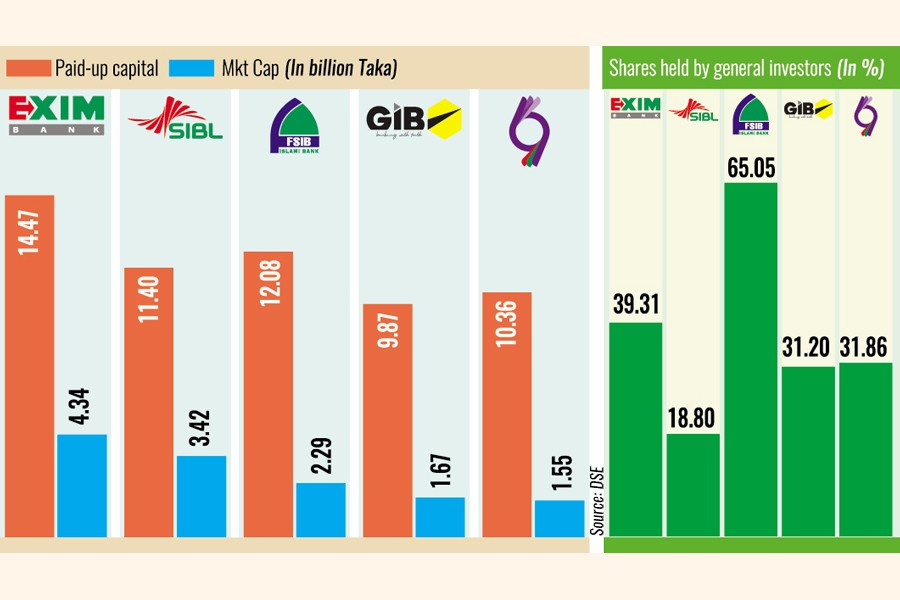
As the central bank moves forward with the merger of five troubled Islamic banks, general shareholders of these listed banks should either be offered shares of the merged entity or allowed to subscribe to its shares at a discounted price.
This view has been voiced by market experts as well as officials of the Bangladesh Securities and Exchange Commission (BSEC), amid growing criticism over the central bank's stance of excluding general investors from any benefits in the new entity.
The five banks involved in the merger-First Security Islami Bank, Union Bank, Global Islami Bank, Social Islami Bank, and EXIM Bank-have been facing financial difficulties, prompting the central bank to step in with a plan to consolidate them into a single entity.
The new bank, Sammilito Islami Bank, will have a paid-up capital of Tk 352 billion, with the government contributing Tk 202 billion and the remaining Tk 150 billion coming from institutional investors.
BSEC officials explained that in the case of a liquidation, shareholders may not receive any return if there are insufficient assets to cover the liabilities.
However, in the case of a merger, shareholders are entitled to shares in the new entity.
"General shareholders must be offered shares in the merged entity at a certain ratio against their existing holdings," said Prof. Abu Ahmed, Chairman of the Investment Corporation of Bangladesh (ICB).
Alternatively, they could be given the option to subscribe to the shares of the new entity at a discounted price, he added.
BSEC representatives attending a meeting at Bangladesh Bank (BB) on Thursday emphasised that investors have the right to be informed about the merger developments.
They raised concerns that the lack of transparency has left investors in the dark, and different price sensitive information (PSI) misled them.
"We think it would be unfair to general shareholders if their ownership is not considered in the new company," said Md. Abul Kalam, a spokesperson for the BSEC.
Talking to the FE, he said at least 10 per cent of the shares in the new entity should be offered to general investors.
Former BSEC Chairman Faruq Ahmad Siddiqi noted that while the banks involved in the merger had previously published audited financial statements and paid dividends, the provisioning done in line with the central bank's decisions complicates the situation.
"It's a matter to see how the central bank will explain its position on those approvals," Siddiqi said.
He also said that it's not possible to complete the proposed merger within a short time because a large number of complexities.
"It may take at least five years to complete the merger and different problems may surface day by day," he added.
Echoing his views, BSEC officials said the financial positions of the five banks would have been revealed to investors if the central bank had played its due role in a timely manner.
The central bank said in a press briefing on Thursday that the bank's net asset value had become negative, ranging between Tk 350 and Tk 420 per share.
BSEC officials said that many general investors would have been aware of the banks' actual financial standing if proper monitoring and approvals had been conducted by the central bank.
For example, Social Islami Bank reported a profit of Tk 2.12 billion and distributed a 5 per cent cash dividend in the calendar year 2023, in line with the central bank's approval.
However, the bank's assets have now turned negative, according to the central bank's latest valuation.
A company merger takes place when two or more companies combine to form a single entity in order to increase market share, reduce costs, and expand into new markets.
Before seeking approval from of the regulator and the court, the transferor and transferee company settle an ownership structure in the new entity.
In that case, shareholders of the transferor company are offered shares of the new company in a certain ratio against their shares based on their holdings in the existing company.
Once approvals from the relevant regulators and the court are obtained, the ownership of the transferor company is established in the new company through the issuance of shares.
However, in this case, the existing shareholders of the companies involved in the merger will receive no compensation, and the merged entity will be primarily owned by the government, institutions, and depositors.
BSEC officials have said that the central bank's decision should take the interests of general investors into account.
Furthermore, under Section 77 of the Bank Regulation Ordinance, 2025, sponsors, directors, substantial shareholders, and top executives are held responsible for fraudulent activities in any scheduled bank.
However, general shareholders cannot be held accountable for the financial mismanagement that led to the merger of these banks.
BSEC officials also noted that while the assets of the five troubled banks might be negative, the human resources, infrastructure, and customer bases of these banks remain valuable. These assets would benefit the merged entity in the long term.
Despite this, the general shareholders will receive no share of the new company's ownership, which market experts and BSEC officials deem unacceptable.
mufazzal.fe@gmail.com
© 2026 - All Rights with The Financial Express

