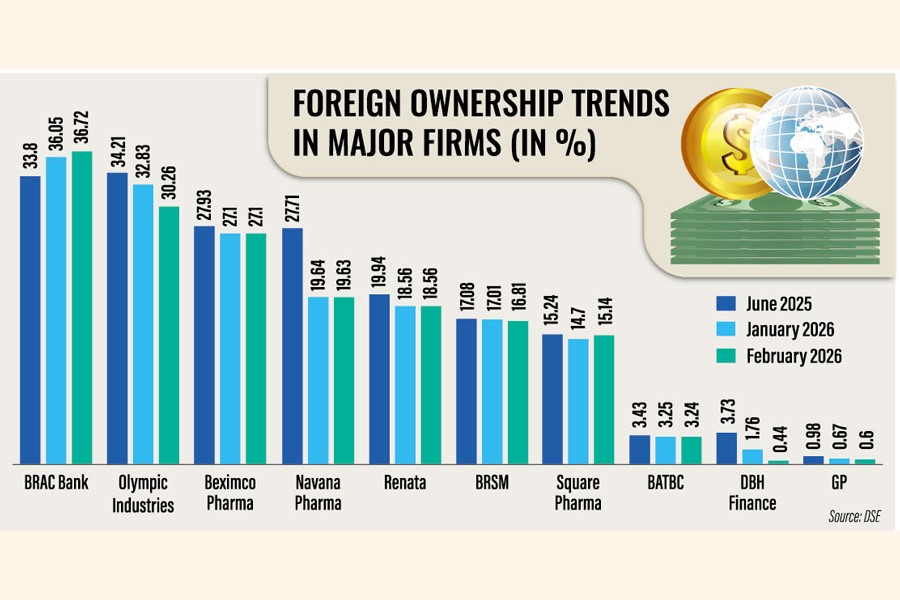
Foreign investors have continued withdrawing funds from Bangladesh's equity market over the past nine months through February this year amid persistent geopolitical tensions and macroeconomic uncertainties.
Political stability following the Bangladesh Nationalist Party's landslide victory in the February polls has failed to attract foreign investment, as intensifying conflict in the Middle East poses fresh economic challenges.
Md Akramul Alam, head of research at Royal Capital, said overall economic activity remained sluggish amid continued uncertainty, while the profitability of major listed companies stayed subdued due to high input costs.
"Persistent macroeconomic uncertainties and ongoing geopolitical tensions discouraged overseas investors from making fresh investments in stocks," he said.
Moreover, private sector credit growth fell to a historic low of 6.03 per cent in January, reflecting weak business confidence and tighter lending conditions, he added.
The ongoing US-Israel war involving Iran has already triggered volatility in global oil and gas prices, raising concerns about inflation and broader economic spillovers in Bangladesh.
"This has dampened the prospect of a sharp recovery in private sector credit demand and the much-needed spike in fresh investment," Mr Alam noted.
He also cited a confidence crisis, a high-value dollar against the local currency, and vulnerabilities in the banking sector as key deterrents to foreign investment.
Foreign investors typically seek a stable, predictable, and long-term policy environment under an elected government to ensure the safety of their investments with good returns.
The newly elected government has yet to outline a clear economic roadmap, while the intensifying Middle East conflict has added to global economic tension.
Ahsanur Rahman, chief executive officer of BRAC EPL Stock Brokerage, said foreign investors are seeking greater clarity. "They want more information and explanations," he told The Financial Express in a recent interview.
A limited number of investable securities and frequent policy changes have also discouraged foreigners from keeping funds in the Bangladesh equity market. The market has not seen any new listings for more than two years.
The impact on stocks is palpable. Foreign investors purchased shares worth Tk 18.25 billion in 2025 against sell-offs of Tk 20.95 billion; outflow outweighed inflow, according to data from the Dhaka Stock Exchange.
When it comes to investing in stocks in Bangladesh, foreigners usually prefer multinational companies. Currently, they are not interested in putting their money into these companies either, owing to lower-than-expected earnings in recent quarters.
Most multinational companies saw their profits decline in the nine months through September 2025 compared to the same period last year, largely due to high finance costs amid political uncertainty.
Grameenphone, the largest stock in terms of market capitalisation, reported its lowest annual profit of Tk 29.6 billion in 2025 in eight years, largely driven by cost pressures and a high tax burden.
What is more, GP projected a year-on-year decline in its financial performance for the first quarter of 2026, citing mounting pressures from global geopolitical tensions and domestic economic challenges.
Subsequently, foreign stakes in GP fell to 0.60 per cent in February this year from 0.98 per cent in June last year.
British American Tobacco (BAT) Bangladesh's profit also nosedived to Tk 5.84 billion in 2025, the lowest since its listing, due to lower sales, higher excise duty, and one-off costs for the Dhaka factory closure.
As a result, BAT's foreign stake dropped from 3.43 per cent to 3.24 per cent between June last year and February this year.
Olympic Industries experienced a similar trend. Its foreign stake fell to 30.26 per cent in February this year from 34.21 per cent in June last year.
Foreign shareholding in DBH Finance also dropped from 3.73 per cent to 0.44 per cent in the nine months through February this year.
However, BRAC Bank experienced a rise in foreign stakes from 33.80 per cent to 36.72 per cent during the period, while it reported record profits.
BRAC Bank's consolidated profit stood at Tk 15.36 billion for January-September 2025, surpassing its previous year's record annual profit.
Along with the record profit, BRAC Bank provided capital-gain opportunities in the secondary market, as its stock surged 78 per cent between June last year and February this year.
According to Akramul Alam, foreign investors are concerned about the high value of the dollar against the local currency.
Although the foreign exchange market has stabilised in recent months due to higher dollar inflows, supported by strong remittance and export earnings, the taka-dollar exchange rate remains as high as before.
"When the local currency weakens, foreign investors incur losses as the value of their assets falls even when share prices remain unchanged," Mr Alam said.
He also noted that many global fund managers have, in the meantime, rebalanced their portfolios, while others have shifted to gold to secure their investments instead of investing in equities.
"Foreign investors are closely monitoring Bangladesh. Portfolio investment may pick up again if geopolitical tensions ease," he added.
babulfexpress@gmail.com
© 2026 - All Rights with The Financial Express

