Grameenphone (GP), the country's largest mobile operator, saw its subscriber base shrink by about 0.85 million in December 2025, highlighting the growing tensions between regulatory intervention and persistent service quality issues that seem to be reshaping the telecom market.
 According to the latest data from the Bangladesh Telecommunication Regulatory Commission (BTRC), GP's active subscriber count dropped from 85.01 million in November 2025 to 84.16 million in December.
Over the course of November and December, the operator lost a total of 1.23 million subscribers.
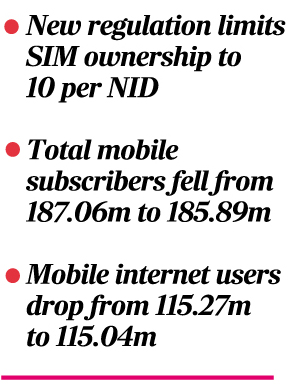
The decline occurred at a time when the industry as a whole also contracted, with total mobile subscribers falling from 187.06 million to 185.89 million in December.
GP attributes its loss largely to the enforcement of the government's new SIM ownership limit.
Sharfuddin Ahmed Chowdhury, Head of Communications at Grameenphone, explained that the reduction was a direct consequence of regulatory actions, rather than a decrease in customer demand.
"The government has imposed a regulation limiting SIM ownership to a maximum of 10 SIMs per NID. More than one million of our active subscribers got de-registered due to this regulation, but the revenue impact is very low because these were mostly low-usage connections," he said.
The SIM ownership cap, which took effect on 1 November 2025, limits mobile users to holding no more than 10 SIM cards against a single national identity card (NID), replacing the previous ceiling of 15.
As operators began deactivating excess SIMs, the market experienced an immediate adjustment in subscriber numbers. Yet, the scale of GP's losses suggests that regulatory factors alone may not fully account for the trend.
In December, Robi Axiata's subscriber base slipped marginally from 57.57 million to 57.40 million, while Banglalink's subscribers fell from 37.70 million to 37.52 million. Teletalk, by contrast, recorded a slight increase, rising from 6.78 million to 6.80 million.
Despite holding about 45 per cent of the market, GP accounted for nearly three-quarters of the total subscriber decline in December, indicating that its losses were disproportionately large compared to its competitors.
A longer-term view further complicates the narrative. GP's subscriber base stood at 86.17 million in May 2025 but fell steadily to 84.16 million by December, representing a cumulative decline of about 2.01 million users over seven months.
Importantly, a significant portion of this erosion occurred before the SIM limit came into effect in November, suggesting that structural factors were already at play.
These developments have unfolded against the backdrop of persistent regulatory scrutiny over GP's quality of service.
The operator has repeatedly failed to meet BTRC benchmarks on call drop rates, minimum 4G download speeds and call setup times.
Despite its market leadership and extensive network footprint, GP has faced show-cause notices, warnings of multi-million-taka fines and the lingering threat of further regulatory action if service standards do not improve.
Taken together, the data suggest that the SIM limit explains the timing of the sharp December decline but not the broader trajectory of GP's subscriber base.
While the company insists that deregistration of low-usage SIMs was the primary driver, the steady fall in subscribers since mid-2025 points to deeper challenges, including customer dissatisfaction and intensifying competition.
For Bangladesh's telecom sector, GP's losses signal more than a routine statistical adjustment. They mark a potential shift in a market long dominated by a single operator, where regulatory pressure, service quality and consumer behaviour are increasingly intersecting.
The downward trend in total mobile subscribers was also reflected in internet usage. Total internet subscribers slipped slightly from 129.89 million in November to 129.67 million in December.
Mobile internet users declined from 115.27 million to 115.04 million, while fixed internet subscribers remained unchanged at 14.62 million. The fall in mobile internet users indicates that the contraction was not confined to dormant or surplus SIM cards alone.
bdsmile@gmail.com
© 2026 - All Rights with The Financial Express

