State-run Power Grid has undisclosed liabilities which, if taken into account, would exceed the value of its assets and impair its ability to repay.
The company's auditors flagged the liabilities in qualified opinions attached to the FY25 financial statements. To get independent judgements about the financial status of Power Grid, The FE spoke with several auditors and experts, who said the company, already in the red, would be unable to meet its repayment obligations in its current financial position.
The company claimed that its assets were worth Tk 801.98 billion as of June this year, while liabilities amounted to Tk 674.70 billion.
Its auditors, Hoda Vasi Chowdhury & Co and ACNABIN, however, in the qualified opinions pointed to assets and receivables that will be hard to recover.
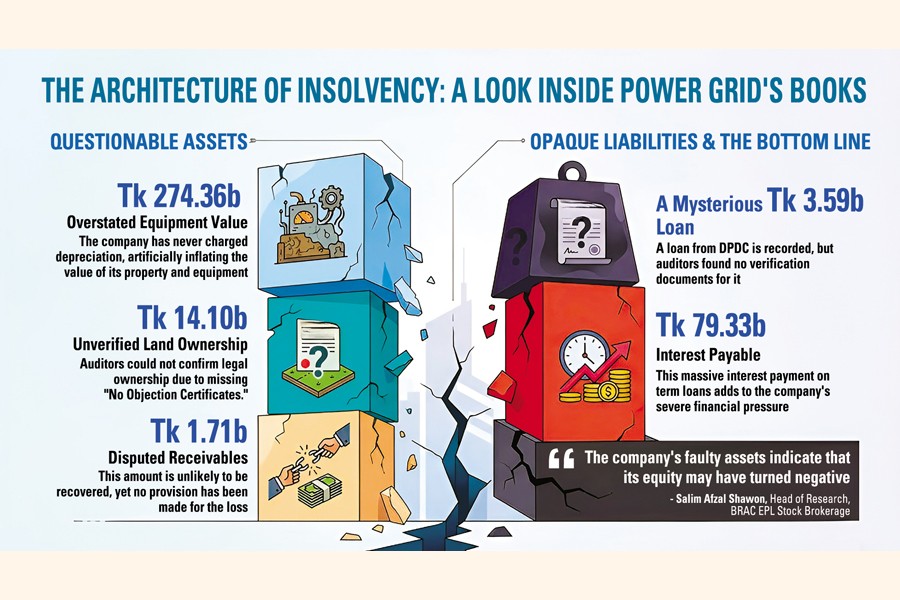
For example, the company has shown Tk 11.15 billion in receivables from different parties, including the Power Development Board (PDB). Of this amount, Tk 1.71 billion is disputed with the PDB and the Palli Bidyut Samity (PBS).
The company's auditors said the company is very unlikely to recover the amounts in full, and that no provision has been kept for the irrecoverable assets.
The financial statements for FY25 mentioned Tk 274.36 billion of property, plant and equipment (PPE). But the company has not recognised any depreciation and amortisation of the properties, according to Chowdhury & Co and ACNABIN.
Hence, the current value of the PPE would be much lower than the amount shown in the financial statements.
"It's really astonishing that a company like Power Grid has never charged depreciation costs on its property, plant and equipment," said Salim Afzal Shawon, head of research at BRAC EPL Stock Brokerage.
"So, definitely previous auditors of the company did not play their due role in addressing such a big anomaly," he said, adding that a forensic audit can define the actual value of the company's property, plant and equipment.
The company also cited its ownership of land worth Tk 14.10 billion and provided documents of ECNEC (Executive Committee of the National Economic Council) decisions in 1996, orders of the Power Division in 2001, and six vendor agreements in support of the claim to the auditors.
The vendor agreements stipulate that the PDB is committed to providing a "No Objection Certificate (NOC)" to facilitate the mutation of the land in the name of Power Grid. In the absence of the NOC and subsequent mutations, the auditors were unable to fully verify the legal ownership and valuation of the land.
Preferring anonymity, a partner of an audit firm that audits several state-run companies said Power Grid is not in a position to claim the land mentioned in the financial statements. He spoke on condition of anonymity to avoid professional harm.
The company also cited a loan of Tk 3.59 billion taken from the Dhaka Power Distribution Company (DPDC), but no document, according to its auditors, was found to verify the loan balance.
Surprisingly, the audited financial statements of DPDC for FY25 did not show the loan in receivables.
The auditor, who spoke with The FE preferring anonymity, said it would not be a problem for DPDC if it really did not disburse the loan to Power Grid. "But a very crucial question is who is the receiver of the loan mentioned by Power Grid."
Apart from all these anomalies, the company has interest payable of Tk 79.33 billion on term loans.
If all the financial mismatches are taken together, the company's liabilities are likely to be higher than its actual assets.
Power Grid has reported a loss of Tk 2.30 per share in FY25, down from a loss of Tk 6.69 per share reported for the previous year.
The FY25 losses would be much higher if the company revises its bookkeeping, addressing the anomalies.
Now, the question is whether the company will be able to continue operations in its current state.
Experts say that as Power Grid is a state-run company, it will get support from the government, but the crucial question is whether taxpayers' money should be misused due to inefficient management of Power Grid.
"The company's faulty assets indicate that its equity may have turned negative. So, its board should pay attention because the interest of general shareholders is linked to the company's financial position," Shawon said.
Power Grid's Managing Director Abdur Rashid Khan could not be reached for comments despite repeated attempts by The FE through calls and SMSs.
mufazzal.fe@gmail.com
© 2026 - All Rights with The Financial Express

