Leading non-bank financial institutions (NBFIs) posted improved financial performance year-on-year in 2025, buoyed by strong investment income despite persistent macroeconomic challenges and elevated funding costs.
Market analysts said reputed NBFIs managed to navigate the difficult business environment through diversified income sources, prudent Treasury management, and operational efficiency.
"The results were supported by robust investment income, higher interest earnings, strategic portfolio diversification, and disciplined cost management," said Akramul Alam, head of research at Royal Capital.
He noted that such companies maintained lower operating costs and mobilised funds at relatively cheaper rates due to their strong market reputation, enabling them to remain competitive.
Of the 23 NBFIs listed on the Dhaka Stock Exchange, six have so far published their financial statements for 2025. Some have not made their earnings data public for years, as their financial condition deteriorated due to widespread scams and irregularities, while the rest are yet to publish reports. As many as 15 NBFIs have already been relegated to junk status.
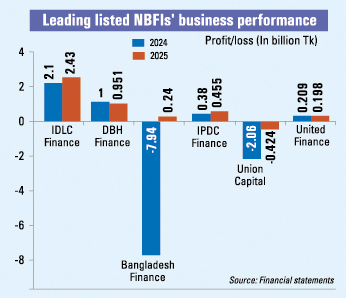
Among the six reporting firms, two posted double-digit profit growth, one returned to profit after heavy losses, one remained in the red, and two reported marginal profit declines.
IPDC Finance posted more than 25 per cent year-on-year growth in profit to Tk 455 million in 2025, supported by strong investment income and portfolio expansion.
Portfolio expansion and prudent lending practices led to a 7.4 per cent increase in operating income, while investment income surged by more than 93 per cent year-on-year, buoyed by higher Treasury yields.
Managing Director Rizwan Dawood Shams said the company strengthened its earnings base through diversified income streams and prudent cost management.
"Our focus on portfolio quality, efficient capital deployment, and strong risk governance enabled us to deliver sustainable profitability while reinforcing balance sheet strength," he said.
The company maintained tight control over operating expenses through resource optimisation, selective recruitment, and efficiency gains.
IDLC Finance also posted more than 21 per cent profit growth in 2025, recording its highest profit in four years, largely driven by strong returns from investments in government securities and the capital market.
Chief Financial Officer Masud Karim Majumder said Treasury bills generated significant returns, while capital market investments also performed strongly.
"Effective fund management amid interest-rate volatility and risk-based pricing of the lending portfolio also contributed to the improved financial performance," the CFO told The FE over the phone recently.
IDLC Finance's net interest income fell nearly 18 per cent year-on-year to Tk 3.92 billion. However, investment income surged 147 per cent to Tk 3.54 billion, offsetting pressure on core lending income.
Another firm, Bangladesh Finance, made a strong turnaround in 2025, reporting a profit of Tk 240 million after incurring a massive loss of Tk 7.94 billion in the previous year.
The company said the recovery was largely driven by loan recovery initiatives and the rescheduling of non-performing loans and lease accounts under regulatory policy support from Bangladesh Bank.
The firm also benefited from realised capital gains from securities investments and the reversal of provisions against loans, leases, and investments.
"These measures led to significant provision write-backs and reflected the impact of ongoing restructuring efforts," the company said.
Once considered a highly profitable firm, Bangladesh Finance slipped into the red in 2023, reporting a loss of around Tk 1 billion. The loss further escalated to Tk 7.94 billion in 2024.
The sharp losses stemmed mainly from a surge in non-performing loans, forcing the company to maintain hefty provisions against classified loans, leases, and capital market exposure.
The company said continued recovery initiatives, disciplined risk management, and supportive regulatory policies are expected to further improve its financial health and support sustainable long-term growth.
DBH Finance, which focuses exclusively on home loans, reported a profit of Tk 951 million in 2025, marking a 5.6 per cent year-on-year decline amid macroeconomic pressures.
However, the company posted a 26 per cent year-on-year increase in profit during the January-March quarter of 2026, supported by higher net interest income.
"Our sustained focus on efficiency, service excellence, and asset quality continues to drive DBH Finance's success and differentiate it from most other financial institutions in the country," said Nasimul Baten, managing director of DBH Finance, in a statement.
The company maintained non-performing loans at around 1 per cent of its total portfolio - one of the lowest levels in the industry - which helped reduce provisioning pressure and support profitability.
Union Capital reduced its losses to one-fifth of the 2024 level, reporting a loss of Tk 424 million in 2025, supported by lower provisioning requirements for loans, advances, and leases.
Higher recoveries from written-off clients, alongside tighter cost-control measures, also contributed to narrowing losses, the company said.
Meanwhile, 15 NBFIs, including Bangladesh Finance and Union Capital, are trading as junk or Z-category stocks due to non-compliance.
A stock is classified as "junk" or placed in the Z category if the company fails to declare dividends for two consecutive years, suspends operations for at least six months, or fails to hold annual general meetings on time.
Firms may also be downgraded if retained losses exceed paid-up capital or if they are unable to distribute at least 80 per cent of declared dividends within the stipulated period.
Some 16 NBFIs are trading below their face value of Tk 10 each, while several scam-hit NBFIs are struggling to repay depositors upon maturity.
Four listed NBFIs - FAS Finance, Fareast Finance, People's Leasing, and International Leasing - are now under liquidation.
In December last year, Bangladesh Bank announced plans to wind up nine NBFIs - eight of them listed companies - marking the country's first large-scale liquidation initiative in the financial sector. Later, the central bank selected five firms for liquidation out of the nine, including non-listed Aviva Finance.
babulfexpress@gmail.com
© 2026 - All Rights with The Financial Express

