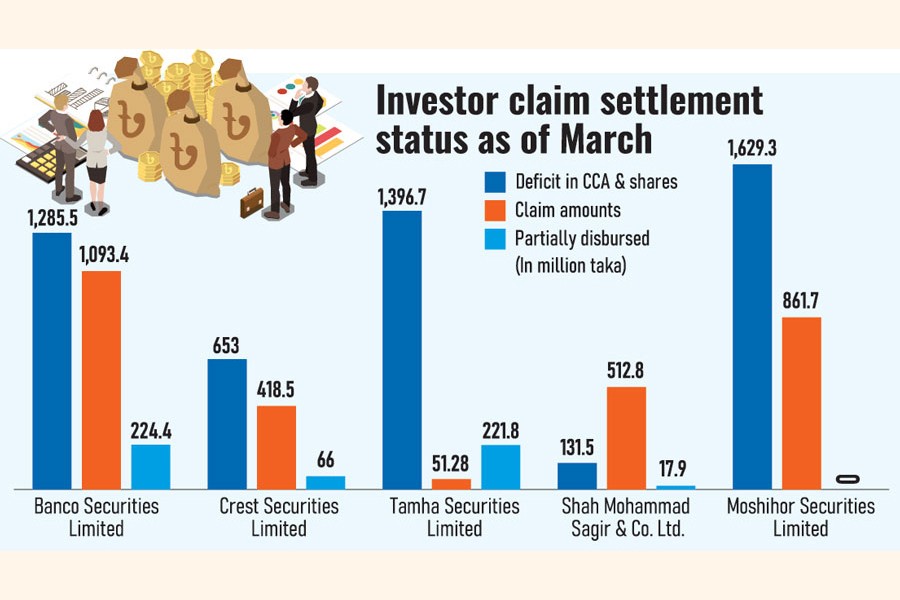
Investors have continued to endure partial or complete erosion of their assets, with total claimed losses surpassing Tk 5 billion as of March due to scams and embezzlement by brokers.
Only a fraction of the amount-Tk 0.53 billion-has so far been disbursed to victims of the financial fraud. The Dhaka Stock Exchange (DSE) has provided these refunds either from the investor protection fund or by recovering some assets from the firms.
Trading in the brokerage firms-Banco Securities, Crest Securities, Tamha Securities, Shah Mohammad Sagir & Co., and Moshihor Securities-has remained suspended. The suspension followed the market watchdog's discovery of misconduct between 2019 and 2024.
This means that years have passed, yet regulatory bodies have, to a large extent, failed to compensate victims for their losses.
Sources at the Dhaka bourse said that Tk 0.25 billion of the refunds came from the protection fund, with the remainder recovered from the brokers. Given the substantial amounts of cash and shares embezzled, the recovery is negligible and proceeding is at a snail's pace.
The Dhaka bourse has engaged with the five firms, its officials said, in efforts to recover investors' funds.
"Unlike banks, we do not have a direct recovery mechanism. Compensation is being made through the investors' protection fund, while efforts are underway to attach assets of the accused firms to recover the misappropriated funds," said Mominul Islam, chairman of the DSE, in a telephonic conversation with The Financial Express.
The Dhaka bourse has validated claims worth a little more than Tk 3 billion.
The case of Moshihor Securities is the latest, having been identified in August 2024 as another broker deceiving its clients and siphoning their money and shares worth Tk 1.63 billion.
Investigations revealed that the brokers had deployed duplicate or parallel back-office software to manipulate records, presenting false balances, fake transactions, and misleading portfolio statements to clients.
Such practices allowed brokerage houses to siphon off both cash and shares without immediate detection, exposing significant weaknesses in monitoring systems.
The exchange has refunded the scant amount on a pro-rata basis, as the available fund was much lower than the liabilities, making full recovery unlikely in the near term.
Meanwhile, repeated scams by brokers and regulatory failure to take stringent action against them, amid a sustained fall in the equity market, have undermined investor trust.
The DSE chairman said the bourse aims to prevent future occurrences of such scams.
He said the DSE had approved six standardised software systems for brokerage firms, and adoption of any one of them had been made mandatory.
"These systems are non-editable, which significantly limits the scope for misappropriation of clients' funds or shares," he said, adding that the probability of such fraudulent activities has now been reduced to nearly zero.
He further said the exchange had upgraded its monitoring framework by introducing a risk-based supervision system, which is capable of detecting irregularities at an early stage.
"We have also raised the capital adequacy requirements for brokerage firms to minimise the risk of default, and strengthened oversight to address irregularities in several firms in recent months."
According to Mr Islam, the DSE has planned as well to introduce an integrated platform that will enable real-time remote monitoring of brokerage activities.
However, he noted that 34 brokerage firms are yet to put in place the mandatory non-editable back-office software. The exchange is closely monitoring both non-compliant firms and those that have recently adopted the updated systems.
farhan.fardaus@gmail.com
© 2026 - All Rights with The Financial Express

