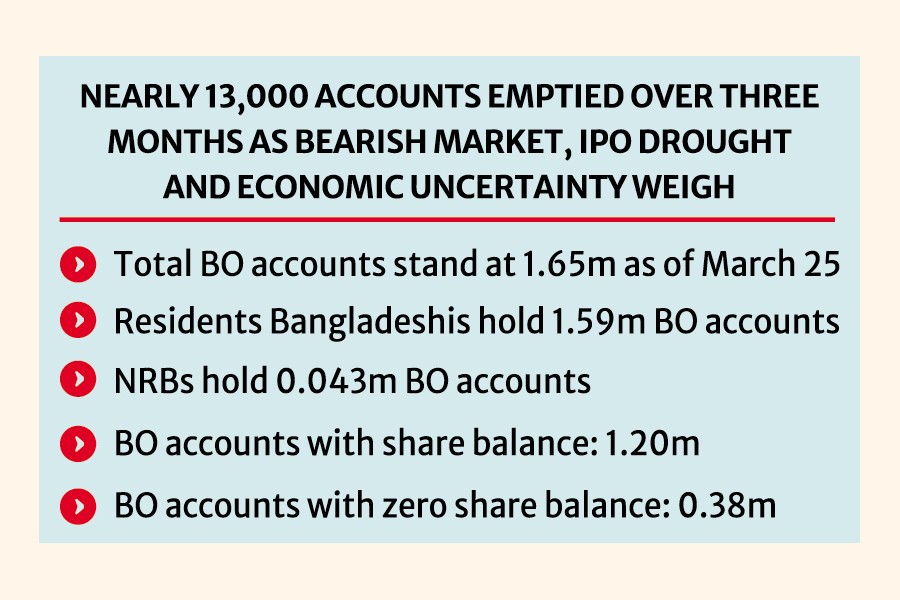
A prolonged bearish trend and deepening crisis of confidence in the capital market have prompted a large number of investors to exit equities, leaving nearly 13,000 beneficiary owner (BO) accounts empty over the past three months.
Data from the Central Depository Bangladesh Ltd (CDBL) show that BO accounts with zero share balance surged from 367,423 on December 30, 2025 to 380,297 on March 25, marking an increase of 12,874 such accounts during the period.
This means more than 23 per cent of the country's 1.65 million active BO accounts now hold no equities, signalling a significant retreat by retail participants from the stock market.
Market insiders attribute the exodus to persistent macroeconomic headwinds, lackluster returns from both primary and secondary markets, and growing uncertainty surrounding geopolitical developments. Many investors chose to exit even at a loss, unwilling to maintain exposure amid the market's depressed state.
CDBL data also show that some investors have consolidated holdings into fewer accounts as a defensive strategy amid economic uncertainty.
Weak returns, IPO drought dent sentiment
Experts attributed the trend to a combination of macroeconomic pressures, lack of quality investment options and absence of new initial public offerings (IPOs).
Akramul Alam, head of research at Royal Capital, said weak market returns and the absence of IPOs have significantly dampened investor interest.
"No new investors are entering the market, while many existing ones are withdrawing funds by selling their holdings -- even at a loss," he said.
Alam also noted that a substantial number of investors originally opened BO accounts solely to participate in initial public offerings. With no new IPOs launched in the past two years, many have lost incentive to keep their accounts active or funded.
Market participants also cited limited investable securities and poor performance of fundamentally strong stocks as key deterrents.
Shift to safer instruments
Higher yields on government securities, particularly treasury bonds, have encouraged investors to shift funds away from equities, further draining market liquidity.
"In the current environment, stock investments are less attractive compared to other financial instruments," said a leading stockbroker.
The decline in active BO accounts began nearly two years ago, partly following the introduction of mandatory minimum investment requirements for IPO applications -- a policy intended to stimulate secondary market activity but which inadvertently discouraged small investors.
Additionally, the annual cost of maintaining BO accounts -- around Tk 1,500 including banking charges -- has pushed smaller investors to close or abandon accounts.
Regulator steps, but pressure persists
In a bid to revive participation, the regulator has recently scrapped the minimum investment requirement for IPOs and reduced BO account maintenance fees to Tk 150 from Tk 450.
Despite these measures, the market remains under pressure due to inflation, currency depreciation and volatile energy prices, which have squeezed corporate earnings and limited stock returns.
Geopolitical tensions in the Middle East have further heightened investor caution, with businesses warning of rising costs and fresh economic challenges.
Market shows mixed signals
Despite the outflow of retail capital, the Dhaka Stock Exchange (DSE) benchmark index rose 9 per cent or 451 points over the past three months to close at 5,316 on March 25, buoyed by post-election optimism.
Market capitalisation also increased by Tk 200 billion to Tk 6.98 trillion during the period, while total BO accounts edged up to 1.65 million from 1.64 million, according to CDBL data.
However, analysts said the rise in indices has failed to translate into broad-based investor confidence, as reflected in the growing number of zero-balance accounts.
At the peak of IPO-driven enthusiasm in June 2015, the number of BO accounts reached an all-time high of 3.20 million. The current trend, however, underscores a markedly different market reality marked by caution and investor retreat.
babulfexpress@gmail.com
© 2026 - All Rights with The Financial Express

