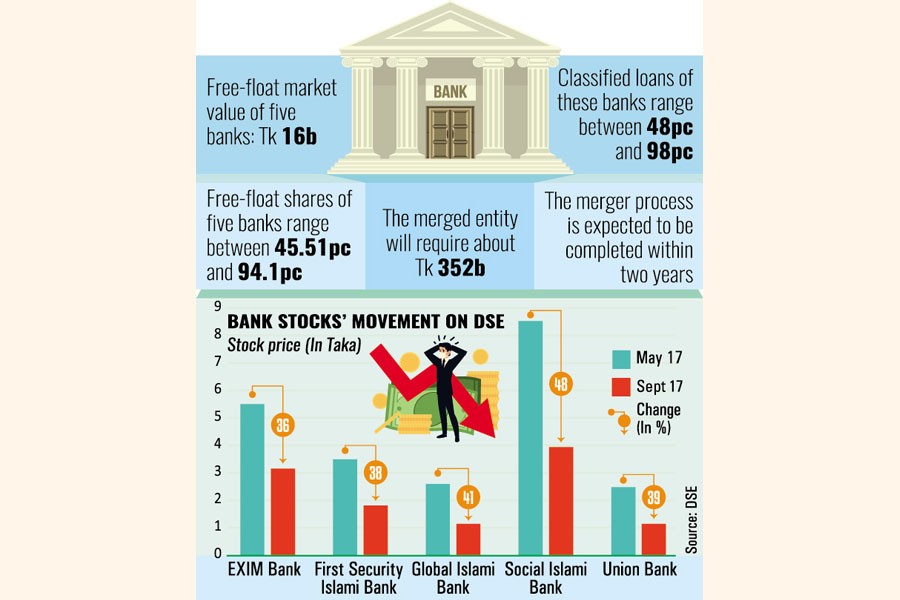
Investors in five troubled Islamic banks are in a tight spot, as their stock prices have been declining since the Bangladesh Bank announced four months ago its plan to merge the Shariah-compliant lenders.
Jittery investors have been dumping their holdings to contain portfolio losses.
The stocks of all five banks - EXIM Bank, First Security Islami Bank, Global Islami Bank, Social Islami Bank, and Union Bank - have dropped by 36 per cent to 48 per cent on the Dhaka Stock Exchange (DSE) during this period.
According to an estimate by EBL Securities, the benchmark equity index of the Dhaka bourse could lose about 59 points if the merger leads to the delisting of these banks.
"Shareholders are fearful that the merger may lead to delisting, which prompted them to dump their holdings even at losses," said Md Sajedul Islam, managing director of Shyamol Equity Management.
Although central bank governor Ahsan H. Mansur has repeatedly assured depositors that the merger is designed to protect their interests and urged them not to panic, no such reassurance has been given to stock investors.
Meanwhile, the Bangladesh Bank (BB) board on Tuesday approved the merger in a decisive move to stabilise the banking sector and rescue the lenders from worsening financial distress.
After the meeting, Arif Hossain Khan, executive director and spokesperson of the central bank, said the banks were now officially under the merger process, which is expected to take at least two years to complete.
Following the announcement, EXIM Bank shares plunged 7.5 per cent on Wednesday, while Social Islami Bank dropped 6.4 per cent and Global Islami Bank 5 per cent. Shares of the other two banks remained unchanged.
General shareholders remain in the dark about whether their investments will be protected post-merger. "There is no information yet about whether the post-merger entity will be listed," BRAC EPL Stock Brokerage said in a report.
"We expect the five banks' shares to be delisted or converted into new bank shares as part of the merger." However, it added, listing may not be feasible until the new entity stabilises, bad loans are resolved, and profits are sustained.
If the new entity remains unlisted, shareholders will require clarity on their investment status.
Mr Islam warned: "If [the banks are] delisted, there will be a huge negative impact on the overall stock market, as the majority of shares of these banks are free float."
Currently, general investors, institutions, and foreigners together hold between 45 per cent and 94 per cent of these banks' shares. As a result, around 59 points could be wiped off the prime index with the elimination of free-float shares.
The BB spokesperson, however, assured that the interests of small investors - particularly general shareholders - would be fully protected.
Mr Islam also flagged foreign ownership stakes in the banks as another unresolved concern.
The combined market capitalisation of the five banks stands at Tk 17.3 billion, reduced by 41 per cent in four months. The current market value of the free-float shares is Tk 13 billion.
Therefore, the banking sector's market cap may shrink by Tk 17 billion, or 2.42 per cent, after the merger.
The post-merger entity is expected to become one of the country's largest banks, requiring about Tk 352 billion. Of this, Tk 202 billion will come from the government, while Tk 150 billion will be mobilised from institutions and through the conversion of institutional deposits.
As per the resolution ordinance, the central bank is empowered to appoint administrators to implement the process, replace key management if necessary, and take other measures to achieve the merger's objectives.
Mr Khan said temporary administrative teams will be deployed at each bank but will not immediately replace existing management.
Among the five banks, four had been under the control of the controversial S. Alam Group until August 5 last year, while EXIM Bank was managed by Nazrul Islam Mazumder, founder of Nassa Group. Both Mr Alam and Mr Mazumder had strong ties to the previous regime and wielded significant influence in the banking sector.
Three of the banks had non-performing loan ratios above 90 per cent, underlining the urgent need for intervention.
babulfexpress@gmail.com
© 2026 - All Rights with The Financial Express

