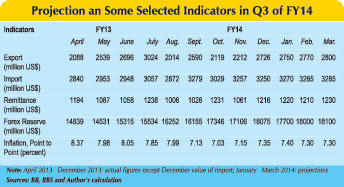
The Metropolitan Chamber of Commerce and Industry, Dhaka (MCCI) said the rate of inflation is expected to fall from February onwards as the supply situation will very likely see improvements in tandem with the political environment.
"It is assumed that the post election calm in the political situation will prevail. The rate of inflation can be expected to fall from February onwards as the supply situation will very likely improve with improvements in the political environment," the MCCI said in its latest review of Bangladesh economy during October-December-2013 period.
According to the BBS, the general point to point inflation accelerated to a 4 month high in December 2013 as food prices soared due to supply chain disruptions caused by the prolonged political programs of blockades and shutdowns. Inflation rate might climb up further if supply conditions do not improve. The general inflation rose by 0.20 percentage points and stood at 7.35 percent in December, above the previous month's 7.15 percent and highest since September 2013. The rise in inflation in December was also due to the hike in prices of other food items, cloth, house rent, furniture and domestic appliances, medical services, transport, educational equipment and different essential commodities.
Food inflation increased by 0.45 percentage points to 9.0 percent in December 2013 from November's 855 percent. The rise in food inflation in December was the highest since July 2012 when it was 2.23 percent. The shortage of supply was the major factor behind the upward trend of food inflation. The transport system across the country failed to function normally because of the long spell of shutdowns and political unrest.
However, non food inflation dropped slightly to 4.88 percent in December from 5.08 in November 2013. Consumers had to pay additional price for food items while they kept themselves out of buying non food items as political turmoil pushed up prices.
In the rural areas, the general point to point inflation rate surged to 7.22 percent in December, up from 6.92 percent in the previous month, but in urban areas it remained unchanged at 7.58 percent during the period. Food inflation in rural areas rose to 8.63 percent in December from 8.06 percent a month before but non food inflation came down to 4.69 percent from 4.88 percent. In the urban areas, food inflation was much higher and stood at 9.89 percent in December, up from 9.67 percent in November but non food inflation fell to 5.13 percent from 5.35 percent. Road blockades and shutdowns prevented smooth transportation of goods across the country, and hence food items could not enter into Dhaka or other urban centres from rural areas, for which reason prices were higher in the urban areas.
The MCCI said employment, mainly in the country's private sector, has dropped sharply due to the recent political unrest. Most of the manufacturers and entrepreneurs have almost put on hold their fresh investment and expansion plans following the unstable political situation. Because of non stop shutdowns, there was hardly any new employment in October December months, be it in industry or in the services sector. Instead, a large number of workers lost their jobs. Because of the deterioration, if not collapse, of business opportunities, thousands of workers in industry and services sectors have reportedly become unemployed in the past few months.
Besides, overseas employment of Bangladesh migrant workers was much lower in the 2013 calendar year, in comparison with the calendar year 2012. This was mainly due to various types of restrictions imposed by major labor importing countries, in particular the UAE, which has been the biggest recruiter of Bangladeshi workers in recent years. The government was also unable to send the expected number of workers to Malaysia. Major job destinations in 2013 for Bangladeshi nationals were Oman, Qatar, Singapore, Bahrain, and Jordan. The government is trying to send more skilled workers by giving proper training and language skills to strengthen their job capacity abroad.
The chances for Bangladeshi workers seeking employment in Japan, Iraq, Egypt and Saudi Arabia are not very encouraging. Government is of course, trying to revive the employment situation in the oil rich Middle East and send workers to emerging economies in Southeast Asia as well as to remote regions such as Australia and New Zealand, Europe, Latin America, and Africa. The concerned ministry officials are hopeful of a healthy growth of foreign jobs in those countries in the near future. At present, nearly 8.0 million Bangladeshis are working in 158 countries across the world but only a handful of these countries (20 or so) have absorbed the bulk of the Bangladeshi workers working overseas.
© 2026 - All Rights with The Financial Express

