The securities regulator has sought a compensation package for investors before delisting the non-bank financial institutions (NBFIs) that are set to be liquidated.
A committee from the Bangladesh Securities and Exchange Commission (BSEC) met representatives of the central bank a few days before the 13th national election and handed over a letter containing recommendations to protect the rights of investors in the NBFIs.
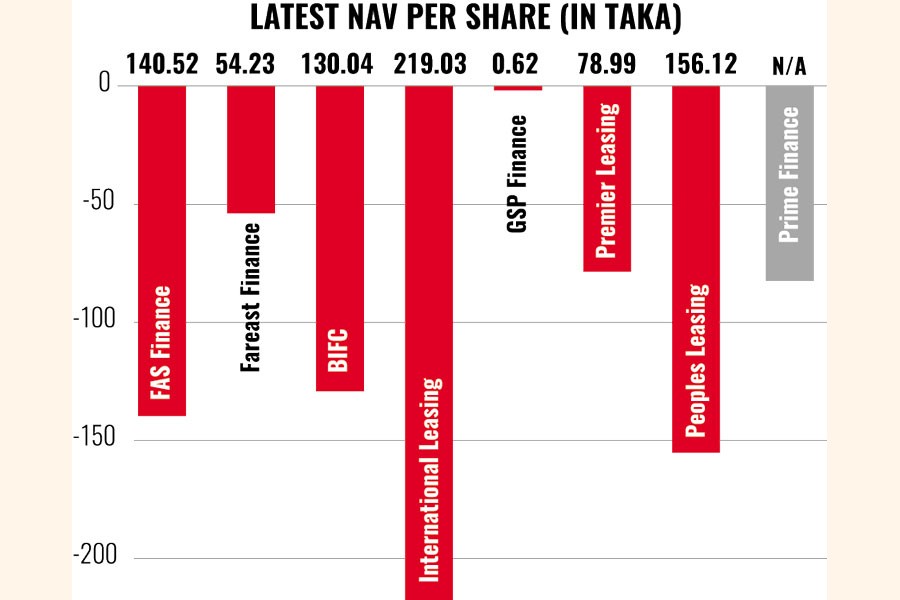
Initially, the regulator had planned to liquidate nine NBFIs. However, after two days of hearings, three companies - Prime Finance, GSP Finance, and Bangladesh Industrial Finance Company (BIFC) - were given three to six months' time to improve their finances.
The six NBFIs to be liquidated soon are FAS Finance, Premier Leasing, Fareast Finance, Aviva Finance,
People's Leasing, and International Leasing. Except for Aviva Finance, all are listed.
The BSEC spokesperson Md Abul Kalam confirmed the letter and its contents.
The market watchdog argues that the norms of liquidation will not be strictly followed in this case. Usually, if the net asset value is negative, depositors receive nothing after liquidation. However, investors in the financial institutions destined for closure have been promised a refund. Therefore, investors should not be deprived, the BSEC said in the letter.
The payback to depositors will reportedly require an expenditure of approximately Tk 50 billion.
The stock market watchdog submitted a 10-point recommendation on compensating investors.
The BSEC urged the central bank to determine the value of the entire stake of general shareholders, or the price to be paid per share to investors, before the liquidation or delisting of the NBFIs.
It also said it wants compensation for general shareholders, not for sponsor-directors who were involved in embezzling funds. The BSEC recommended that either the face value or the market price, whichever is higher, be paid by the government to general shareholders.
Moreover, it insisted on transparency in the liquidation process and proper disclosures to the DSE regarding trade cancellations of these NBFIs.
The regulator of listed companies also wants timely price-sensitive information so that investors remain well informed about decisions concerning these NBFIs.
In November last year, the central bank went ahead with the decision to liquidate nine NBFIs that had been hard hit by irregularities, mismanagement, and failure to return depositors' funds. It is the largest-ever attempt to date to clean up the financial sector.
Later, in January this year, six NBFIs were shortlisted for immediate liquidation.
In its letter, the BSEC warned that if Bangladesh Bank does not pay compensation to investors, the capital market may be affected in the future.
farhan.fardaus@gmail.com
© 2026 - All Rights with The Financial Express

