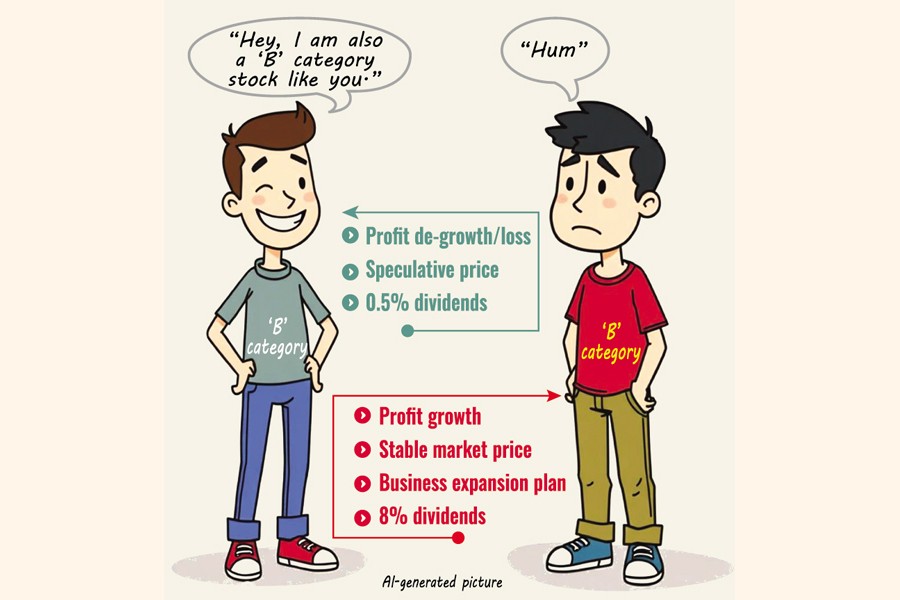
The association of listed companies has demanded that the regulator forgo the existing categorisation of equity-based securities and instead consider features that reflect organisations' real business performance.
Bangladesh Association of Publicly Listed Companies (BAPLC) broached the matter at a meeting with the board of directors of the Dhaka Stock Exchange (DSE) this week.
The stock exchanges now label stocks of listed companies on the basis of annual dividends that they pay to their shareholders. A stock belongs to the 'A' category if the company it represents has distributed at least 10 per cent dividends for the immediate past financial year, and if the dividend is less than 10 per cent, the stock falls into the 'B' category.
Both 'A' and 'B' category stocks are relegated to the 'Z' category over the companies' failure to issue any dividends for two consecutive years.
The BAPLC said the dividends paid by a company alone cannot manifest its actual financial strength and performance.
A good-performing company may refrain from sharing profits with shareholders to make further investment for business expansion. In that case, it would be unfair if the company's stock is downgraded for the non-payment of dividends for a given year.
The BAPLC said financial indicators, such as profitability, performance in the capital market, corporate governance, compliance with securities rules, contribution to the national economy and exchequer, sustainability, and ESG performance should be considered to determine the status of a company on the bourses.
A company's profitability or financial soundness is determined by earnings per share (EPS), return on equity (ROE), and overall financial stability. These parameters show a company's true strength but are not considered in the categorisation of listed companies, said the BAPLC.
Other factors such as price stability, market capitalisation, and liquidity are also very important in the categorisation.
Presently, stocks can also be downgraded to the junk category for the closure of business operations for six consecutive months or more and for the failure to complete the distribution of approved dividends within 30 days. Moreover, a company has to hold its annual general meeting (AGM) every year to keep its status on the bourses unchanged.
The existing categorisation risks labelling a good company's stock as junk while deciding a stock as 'B' stock for the disbursement of as little as 0.5 per cent dividends.
"A company that demonstrates transparency and accountability, makes timely disclosures and adheres to regulatory requirements should be recognised for all the good practices that boost investor confidence," said the BAPLC.
Besides, environmental, social and governance (ESG) practices are now globally recognised as critical to long-term resilience. So, the incorporation of ESG standards into company categorisation would align the country's capital market with international best practices, said representatives of the association in the meeting.
Neighbouring and emerging markets do not categorise listed companies solely based on dividends. For instance, India classifies companies based on performance, size, and other factors such as liquidity and financial strength.
The flawed practice in Bangladesh is also linked to credit facilities offered to investors, which in turn contributes to market volatility.
Firstly, investors are prohibited from obtaining margin loans for investments in 'Z' category stocks. Secondly, the trading cycle for junk shares is T+3, while it is T+2 for 'A', 'B', and 'N' category stocks. Investors prefer the shorter cycle, as they want to keep their money rolling.
And the third advantage is the netting facility, which is available for all but junk stocks.
Netting facility allows investors to purchase new stocks immediately after selling their holdings of one or more stocks.
These are the reasons why even a non-performing company tries to avoid the non-marginable category by distributing nominal dividends, and that ultimately creates volatility in the equity market.
mufazzal.fe@gmail.com
© 2026 - All Rights with The Financial Express

