Fuel subsidies consume a significant share of government revenue each year, yet the benefits rarely reach those who need them most.
The government bears this burden largely due to political pressure, but redirecting subsidy spending could free up funds for targeted support to the poor and underprivileged - as well as for growth-oriented development projects. Such a move can also bring about behavioural changes to stem the misuse of energy.
During talks with the FE, experts stressed that any attempt to withdraw energy subsidies may spark a public backlash - but that can be avoided if the government first addresses corrupt practices and mismanagement in the supply chain, which add additional layers to the subsidy burden.
Public trust is imperative for such a move to succeed, and securing it remains the major challenge the government faces. It is against this backdrop that the International Monetary Fund (IMF) has been urging Bangladesh to reduce power and gas subsidies to relieve fiscal pressure. The authorities discussed a comprehensive roadmap last year to gradually phase out subsidies and stabilise the economy in line with IMF guidelines.
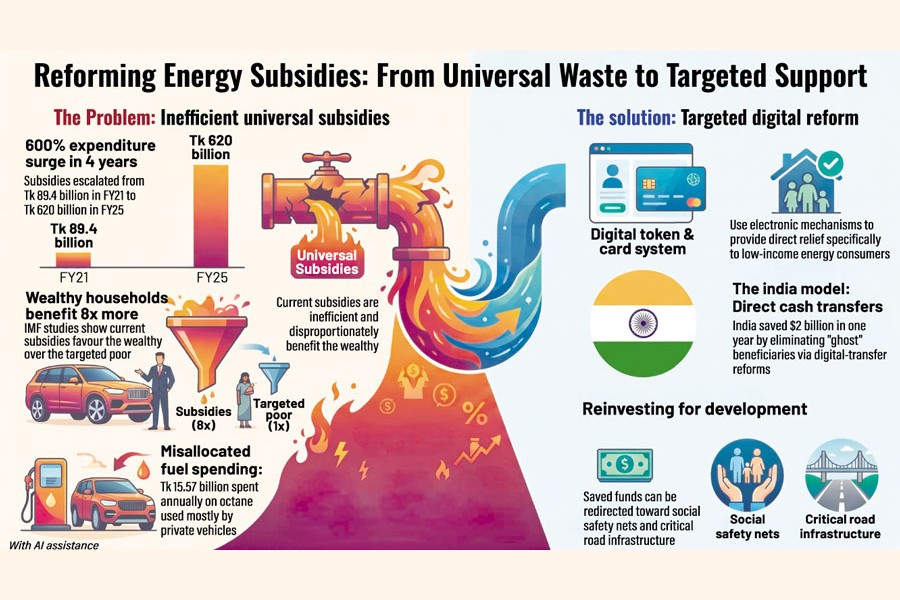
Although subsidies are aimed at supporting the poor and reducing social inequality, a study by the IMF reveals that wealthy households benefit eight times more than the targeted population.
For example, the government currently provides a subsidy of more than Tk 29 per litre of octane, the energy minister said at an event recently.
According to Bangladesh Petroleum Corporation (BPC), total annual consumption of octane is around 400,000 to 450,000 metric tonnes, most of which is used in private cars and SUVs (sport utility vehicles).
Subsidy spending on octane alone stands at Tk 15.67 billion per year. The amount has been rising as fuel prices climb in international markets.
Subsidy on diesel is another example where poor farmers are hardly the beneficiaries. Farmers purchase water for irrigation from pump owners who themselves enjoy the profit given in the form of subsidy.
In response to a question in parliament on Tuesday, the finance minister stated that continued subsidies during the US-Israel war against Iran would entail additional expenditure of approximately Tk 102.58 billion on fuel, Tk 111.70 billion on gas and Tk 198.21 billion on electricity in FY26.
The numbers illustrate why a targeted approach is needed to serve the purpose of subsidies while reducing fiscal pressure simultaneously.
Power and energy subsidies escalated from Tk 89.4 billion in FY21 to Tk 620 billion in FY25, representing 16.71 per cent of revenue collected during the year, according to annual reports of the Bangladesh Power Development Board.
Subsidy spending, excluding interest, in FY25 was 13.63 per cent of the annual budget and 4.42 times the subsidy allocated 10 years ago.
Amid such escalation in subsidy spending, the Power Division has sought Tk 594.5 billion as subsidy in the budget for FY27 on account of power purchases from private-sector plants and power imports.
If the government phases out the universal subsidy, money will be saved, including that spent on octane, and the funds can be utilised for purposes such as direct cash support for needy households, strengthening social safety nets and road construction.
"In a country like Bangladesh, where the poor population is large, the government must provide some level of support - but a country with limited resources cannot sustain this [subsidising power and energy] indefinitely," said Dr Fahmida Khatun, executive director at the Centre for Policy Dialogue (CPD).
"We need to move towards targeted, goal-oriented subsidies specifically for those in need," she added.
Subsidies focusing on the targeted population
Targeted subsidies could involve a token or electronic card system. For those below a certain income threshold, if their fuel consumption amounts to Tk 5,000, the government could provide Tk 2,000 in relief through an electronic mechanism that records the transaction to ensure the intended beneficiary is the one using it.
Energy expert Prof M Tamim, vice-chancellor of Independent University Bangladesh, said an accurate database and an efficient, honest administration are required to introduce targeted fuel subsidies.
"Such a database would include the income and energy bills of households and peasants," he said.
Emphasising the need for a database, he said farmers' cards - which the government has begun distributing in a pilot project as part of fulfilling the ruling party's election pledge - would not benefit the targeted beneficiaries.
Many other countries, including India, have already eased their fiscal burden by rolling out targeted subsidies. As part of India's "remove, target, and shift" approach, petrol and diesel subsidies have been phased out.
In 2015, India replaced LPG price subsidies with direct cash transfers under the Direct Benefit Transfer for LPG (DBTL) scheme. By eliminating ghost beneficiaries and middlemen, the reform redirected support to genuine recipients and reportedly saved over $2 billion in its first year.
Targeted transfers reduced benefits for wealthier households while protecting poorer groups through compensatory cash transfers, gradual price adjustments and limits on subsidised cylinders.
According to India's Press Information Bureau (PIB), the DBT system alone saved Rs 3,480 billion between 2009 and 2024 by reducing leakages. At the same time, the country's Welfare Efficiency Index rose from 0.32 in 2014 to 0.91 in 2023, reflecting more effective use of resources and greater inclusion.
The reform demonstrates how targeted subsidies can enhance efficiency, equity and fiscal sustainability while protecting vulnerable populations.
India largely mitigated negative impacts through tailored financial and structural support. Liquidity support, credit guarantees and formalisation initiatives provided the necessary cushion to micro, small and medium enterprises in the absence of energy subsidies.
Among the major concerns tied to the removal of energy subsidies in Bangladesh, the impact on exports is a crucial one that is repeatedly raised.
Asked whether export competitiveness would decline following any reduction in subsidies, Mr Tamim said that while the concern could not be ruled out, the impact would be significantly contained if the government improved infrastructure with the funds saved, cutting lead times and boosting export efficiency.
Asked why no government has moved towards rationalising subsidies, the energy expert said ruling parties have refrained from doing so, fearing pressure from influential groups that have always benefited from universal subsidies.
Dr Fahmida said the government should begin phasing out universal subsidies against a backdrop of continuous fuel subsidy escalation.
"The government must strengthen digital systems to close the loopholes of universal subsidies. Starting a digital system is essential to ensure the money actually reaches those it is meant for, rather than being diverted to other uses," she added.
Targeted subsidies could also curb the misuse of energy, as illustrated by the recent introduction of prepaid gas meter cards.
Consumers are now more mindful of their gas usage because the more they use, the more they pay. Before the introduction of meter cards, households kept their stoves burning even to dry wet clothes or to avoid lighting an extra match, since the charge for gas was fixed.
Golam Moazzem, research director at the Centre for Policy Dialogue (CPD), said the government should first address the non-competitive contracts that allow power producers to supply electricity at prices above the market rate.
The government could gradually reduce subsidies through adjustments based on proper pricing and an improved supply chain.
mufazzal.fe@gmail.com
© 2026 - All Rights with The Financial Express

