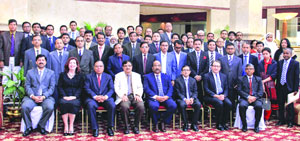
 Rashed Maqsood, Managing Director and Citi Country Officer along with Mr. Syed Md. Aminul Karim, Member (Income Tax Policy), National Board of Revenue, Shitangshu Kumar Sur Chowdhury, Deputy Governor, Bangladesh Bank, Helal Ahmed Chowdhury, Vice Chairman
 FE Report
Speakers at a workshop Tuesday laid stress on taking the domestic provisions into consideration while deciding to comply with the "Foreign Account Tax Compliance Act (FATCA)", a US law enacted in 2010.
They also emphasised on considering various important issues, including identification of Bangladesh's tax dodgers in overseas countries and fund transfer to abroad, which are involved in the compliance with the law here.
Citibank N.A. Bangladesh organised the day-long workshop on "Foreign Account Tax Compliance Act (FATCA)" at a city hotel to familiarise the banking sector officials with the USA law.
Officials said the banks here are required to commence complying with the law within June, 2014.
The USA law requires all the 'foreign financial institution (FFIs) to report to the US internal Revenue Service (IRS) information about certain accounts held by US taxpayers, its green card holders or by foreign entities in which they hold substantial ownership interest, they said.
As per the definition, all banks as defined under the Bank Company Act-1991 came within the provisions of FATCA; the law's ultimate goal is to ensure that income earned and assets held by US persons in offshore accounts or indirectly through ownership of foreign entities are appropriately reported to the IRS, official said.
The inaugural session of the workshop was addressed, among others, by Shitangshu Kumar Sur Chowdhury, Deputy Governor of the Bangladesh Bank (BB), Syed Md Aminul Karim, member (income tax policy), National Board of Revenue (NBR), Helal Ahmed Chowdhury, vice chairman of the Association of Bankers, Bangladesh (ABB) Ltd and managing director of the Pubali Bank Ltd, Ms Karyn Kenny, resident legal adviser of the Embassy of the United States of America in Dhaka, and Rashed Maqsood, Managing Director and Citi Country Officer for Bangladesh.
The technical session of the workshop was conducted by David Weisner, US Tax Counsel for Asia Pacific, Citigroup. About 70 representatives from the BB, NBR, Ministry of Finance, USA Embassy in Dhaka, and representatives from the scheduled banks participated in the workshop.
As the Bangladesh government is yet to decide to execute an intergovernmental agreement with the US, the obligation may be alternatively discharged at individual bank level by registering and signing 'participation agreement' with the IRS.
FATCA was actually made to help prevent US federal tax evasion by identifying US persons, who earn income through their overseas accounts, entities and investment.
At the opening session, Mr Aminul Karim said that Bangladesh also is working to identify the tax dodgers and prevent tax evasion. In this connection, we also need information from the overseas partners.
Showing respect to the FATCA, he further said that NBR is still not well conversant with the law; the revenue board needs to know more about it.
Saying that there are many important issues like fund transfer from Bangladesh to other countries are involved in the FATCA compliance, he said that those will also have to be taken into consideration in deciding to comply with the law here.
Mr SK Sur Chowdhury advised the banks and financial institutions (FIs) to study the FATCA while ensuring its provisions along with the domestic laws.
Saying that the banks need to arrange such workshop for dissemination about the laws and knowing about it, he thanked the Citibank NA for organising the workshop.
Ms Kenny said, "… the United Sates is committed to working closely with our international partners to eliminate offshore tax evasion around the world and a powerful tool to achieve this goal is the FATCA."
"In order for each of us to ensure compliance with our domestic tax laws, global cooperation is critical. The United States has been a leader in developing new international standards for greater transparency through the exchange of tax information," she said.
"Without a transparent, accountable and credible method to ensure that citizens are complaint with their tax obligations, democracies will struggle to function, and will be unable to provide public services and combat money laundering. This affects both rich and poor nations, alike," she added.
© 2026 - All Rights with The Financial Express

