United Power Generation & Distribution Company reported a steep 35 per cent year-on-year plunge in profit in the third quarter of FY26 due to lower electricity sales and higher finance costs.
The power producer's consolidated profit declined to Tk 2.76 billion in the January-March quarter this year from Tk 4.24 billion in the same quarter last year.
During the period, revenue dropped 30 per cent year-on-year to Tk 6.74 billion.
Profit fell primarily due to lower production levels and the absence of supplemental revenue, said the company in its earnings note.
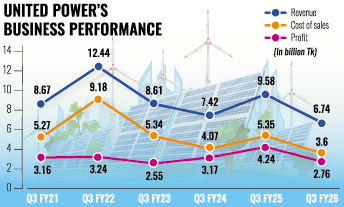
The company explained that in the prior year, a substantial amount of supplemental revenue arising from the bulk electricity price adjustment relating to prior gas price increases was recognised, which is absent this year, leading to lower revenue.
As a result, the consolidated and stand-alone earnings in the current year reflect only normal operating revenue, leading to a comparative decrease in profit, said the company.
In April last year, the Bangladesh Energy Regulatory Commission (BERC) raised the gas price for new industries to Tk 40 per cubic meter from Tk 30 per cubic meter and set the rate for captive power plants at Tk 42 per cubic meter from Tk 31.50 per cubic meter.
Although the government raised the gas price, the electricity price has not been adjusted in line with it, driving the cost of production higher. This affected top-line and bottom-line growth.
In the nine months through March this year, the company's profit fell 24 per cent year-on-year to Tk 8.66 billion, while electricity sales dropped 22 per cent to Tk 24.01 billion due to the same reasons.
Alongside lower revenue, finance costs jumped to Tk 985 million from just Tk 0.70 million year-on-year in the nine months to March, largely due to higher interest payments on bank borrowings.
United Power is the country's first commercially independent power producer. It supplies power to Bangladesh Export Processing Zones, the Bangladesh Rural Electrification Board, the Bangladesh Power Development Board (BPDB), and private customers.
The power producer's major revenue comes from the BPDB, which declined 27 per cent year-on-year to Tk 18.19 billion in the nine months through March this year, dragging overall earnings.
Income from private customers and export processing zones also fell 26 per cent and 9 per cent, respectively.
Only revenue from the Bangladesh Rural Electrification Board increased 9 per cent year-on-year in the nine months through March this year, according to its financial statements.
Cash flow weakened significantly, with net operating cash flow per share declining to Tk 7.22 in the nine months through March this year from Tk 15.17 a year earlier, mainly due to delayed payments from its largest client, the Bangladesh Power Development Board.
Despite the earnings pressure, analysts say the company remains fundamentally strong due to its long-term power purchase agreements (PPAs) and diversified customer base.
According to EBL Securities, United Power benefits from stable and predictable cash flows under medium- to long-term contracts, setting it apart from many independent power producers exposed to demand volatility.
United Power operates eight plants-six gas-fired and two heavy fuel oil-based-with a combined capacity of 895 megawatts.
Its unique presence in export processing zones allows it to supply electricity directly to industrial clients at negotiated rates.
It also has a long-term agreement with the Bangladesh Export Processing Zones Authority, alongside multiple contracts with the Bangladesh Power Development Board.
Annual performance
The latest earnings downturn comes after a robust performance in FY25, when the company posted a record profit of Tk 11.98 billion and declared a 65 per cent cash dividend.
Revenue from sales of electricity grew 12 per cent year-on-year to Tk 39.08 billion in FY25, riding on higher demand for electricity and one-off tariff gains.
Analysts at the time of the annual earnings disclosure warned that earnings might get squeezed unless electricity tariffs were adjusted to reflect higher fuel costs and payment cycles improved.
babulfexpress@gmail.com
© 2026 - All Rights with The Financial Express

