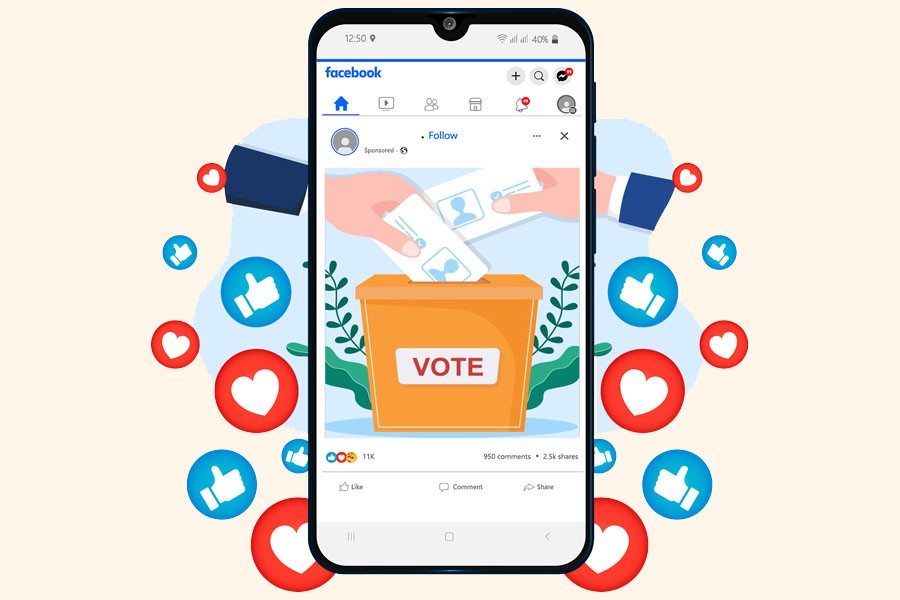
When the election campaign formally began on 22 January 2026, Dhaka did not suddenly fall silent. Loudspeakers still crackled in alleyways, leaflets were quietly slipped into hands at tea stalls, and candidates continued their rounds of courtyards and marketplaces. Yet something unmistakable had shifted. For the first time in Bangladesh's electoral history, the familiar visual grammar of elections -- walls layered with posters, lampposts wrapped in faces and symbols -- was largely missing.
The change didn't arrive overnight, nor did it erase the past at a single stroke.
The Election Commission imposed an unprecedented ban on physical posters, a rule that has nudged the 13th National Parliamentary Election decisively into the digital realm. With polling day set for 12 February, most major campaigns have moved their centre of gravity online, reshaping how candidates reach voters and how voters encounter politics.
The transition has been driven less by ideology than by arithmetic. Bangladesh today has close to 130 million internet subscriptions, a figure that places it among the largest online populations in the world. Social -media platforms have become unavoidable political arenas: Facebook remains the dominant space for political debate, YouTube hosts long-form explanations and talk-show style broadcasts, while TikTok -- once dismissed as frivolous -- has emerged as a powerful mobilising tool, particularly among younger voters.
That demographic reality matters. Roughly four in ten voters are under the age of 37, many of whom have little memory of politics conducted exclusively through rallies, posters and print manifestos. For this generation, politics now appears first on a screen -- compressed into short videos, graphic explainers, livestreamed speeches and algorithm-driven feeds.
As a result, campaigns have begun to resemble digital operations rooms. Parties commission constituency-level content, monitor engagement in real time and adjust messages within hours. Artificial intelligence tools are being used to analyse public sentiment in Bengali across millions of comments and reactions, offering campaigns a granular sense of voter mood that traditional field reports could never provide.
The Bangladesh Nationalist Party has leaned heavily into interactive online platforms, inviting voters to respond directly to policy proposals and development pledges. Jamaat-e-Islami has experimented with crowdsourcing ideas for its manifesto through dedicated websites. The National Citizen Party, formed in the aftermath of the 2024 student protests, has made TikTok and Instagram central to its outreach, translating protest energy into short, emotionally charged visual narratives aimed at first-time voters.
Yet this is not a fully digital election, and it is important not to overstate the transformation. Offline politics continues -- sometimes deliberately, sometimes by necessity. Candidates still hold courtyard meetings, party activists still canvass neighbourhoods, and rural campaigns rely heavily on interpersonal networks rather than data dashboards. In many constituencies, especially outside major cities, digital messaging supplements rather than replaces face-to-face politics.
This hybrid reality reflects a deeper structural constraint: the digital divide.
Despite impressive headline figures, a large share of Bangladesh's population remains outside the digital ecosystem. Millions lack reliable internet access, smartphones, or the digital literacy required to navigate online political content. Women, older voters, rural residents and low-income groups are disproportionately represented among those left offline or semi-connected. For them, political communication still arrives through words of mouth, local leaders, mosques, markets and occasional print material.
This divide raises uncomfortable questions. If political competition increasingly unfolds online, who is being excluded from the conversation? Whose concerns are amplified by algorithms, and whose are rendered invisible? There is a real risk that digital-first campaigning could deepen existing inequalities in political voice, privileging urban, young and connected voters over others.
The Election Commission appears conscious of both the promise and the peril of this shift. Alongside the poster ban, it has introduced a dense set of digital campaign rules. Candidates must register their social -media accounts in advance. Official campaign images are tightly regulated, limited to portrait photographs and restricted appearances. The use of artificial intelligence for deceptive purposes -- deepfakes, voice cloning or fabricated content -- has been explicitly criminalised. Misinformation, hate speech and content targeting religious or minority groups carry the threat of fines and jail terms.
To reinforce these safeguards, the government has tasked the National Cyber Security Agency with monitoring election-related digital threats, particularly as voting coincides with a nationwide referendum on the July Charter. Hotlines and reporting mechanisms have been opened to the public, reflecting growing official anxiety about how quickly false narratives can spread online.
What is unfolding, then, is not a clean break from the past but a contested transition. Bangladesh's 2026 election sits at the intersection of old and new forms of politics -- between rallies and reels, door-to-door visits and data-driven targeting, mass slogans and personalised feeds.
Whether this digital turn ultimately strengthens democracy remains an open question. It has the potential to reduce environmental waste, lower campaign costs and expand political participation among connected citizens. But without serious attention to access, literacy and inclusion, it may also redraw the boundaries of political engagement in ways that leave many behind.
As campaigning continues, the real test will not be how innovative the online strategies become but whether a democracy conducted increasingly through screens can still speak to those who live beyond their reach.
© 2026 - All Rights with The Financial Express

