In the bustling tea stalls of Dhaka and the quiet broadband hubs of rural districts, a new kind of political conversation is taking shape. As Bangladesh moves towards the national election on 12 February 2026, the ballot is no longer defined solely by food prices, employment or fuel subsidies. Increasingly, it is shaped by a deeper question: who will control the country's digital future?
With the Awami League legally barred from contesting, the election has evolved into a high-stakes two-way contest among the Bangladesh Nationalist Party (BNP) and the resurgent Jamaat-e-Islami-led alliance. However the student-led National Citizen Party (NCP), a member in Jamat-let 11 party alliance, has also promised their vision. Each has placed digital policy at the heart of its manifesto, signalling that connectivity, data governance and technological sovereignty have become central to political legitimacy.
Digital Politics as Economic Politics
Bangladesh's digital economy has expanded rapidly over the past decade. The country now hosts more than a million freelancers, a growing startup ecosystem and one of South Asia's fastest-growing mobile internet markets. Yet structural constraints persist: high data costs, limited global payment access, uneven broadband coverage and weak data protection frameworks.
Against this backdrop, digital policy has become both an economic promise and a political narrative. Parties are no longer competing merely on welfare schemes; they are competing on visions of how Bangladesh will connect, code and compete in the global market.
BNP: Infrastructure, Industry and Global Integration
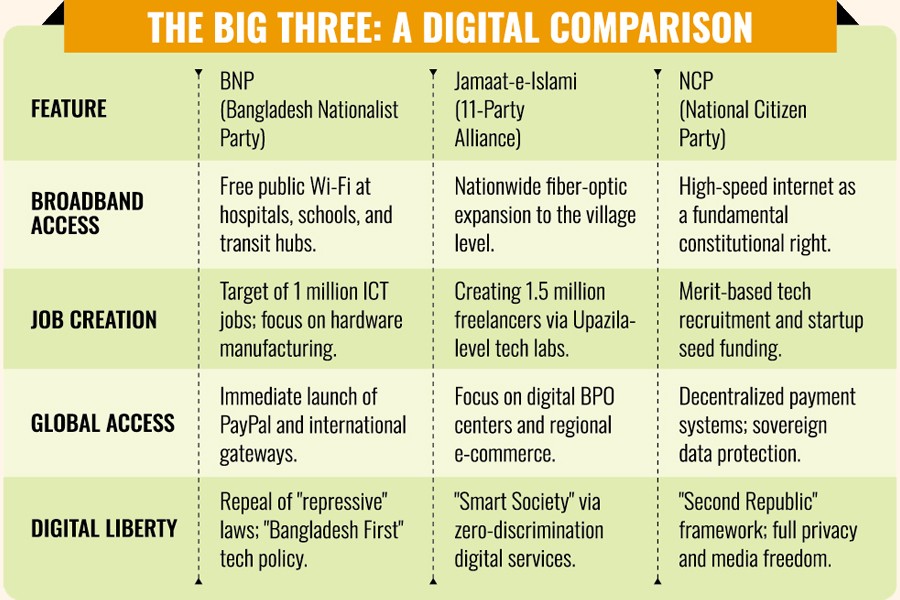
The BNP's digital agenda is rooted in scale and integration with the global economy. Its manifesto promises free public Wi-Fi at hospitals, schools and transport hubs, alongside ambitious targets for ICT job creation and hardware manufacturing.
Central to its appeal is the pledge to facilitate PayPal and other international payment gateways-an issue that resonates strongly with freelancers who have long struggled with cross-border transactions. By promoting local production of laptops and smartphones, the BNP seeks to position Bangladesh as a regional hardware hub, reducing dependence on imports and lowering entry barriers for digital participation.
Critics, however, question whether such industrial ambitions can be realised without large-scale investment, regulatory reform and supply-chain integration. Nonetheless, the BNP's narrative reflects a broader aspiration: digital infrastructure as a driver of economic nationalism.
Jamaat-e-Islami: Decentralisation and Human Capital
Jamaat-e-Islami, leading an 11-party alliance, has framed its digital vision around decentralisation and human capital development. Rather than prioritising urban-centric infrastructure, it proposes Upazila-level tech laboratories to train freelancers and expand digital skills beyond metropolitan areas.
Its emphasis on smart agriculture, digital social security and regional business process outsourcing reflects an attempt to integrate technology with social welfare and rural development. The proposed "Smart Social Security Card" aims to reduce corruption and improve targeting in welfare distribution through digital verification.
This approach appeals to voters outside Dhaka, where digital inequality remains stark. Yet questions remain about governance capacity and the sustainability of decentralised digital institutions in a resource-constrained state.
NCP: Rights, Privacy and the "Second Republic"
The National Citizen Party represents the most ideologically distinct digital vision. Emerging from the 2024 student movement, the NCP treats internet access as a constitutional right and places data privacy, freedom of expression and state accountability at the centre of its manifesto.
Its proposed "Second Republic" framework seeks to dismantle what it describes as the surveillance architecture of previous regimes. The party advocates comprehensive data protection legislation, limits on state monitoring and a decentralised digital governance model.
By prioritising startups over large corporations and proposing reductions in digital taxes for young entrepreneurs, the NCP appeals to a generation that sees technology not only as an economic tool but also as a space of political freedom. However, sceptics argue that rights-based digital reforms may face resistance from entrenched bureaucratic and security institutions.
A Rare Digital Consensus
Despite ideological differences, a striking convergence has emerged across party lines. All major contenders agree on three priorities: lowering data costs, expanding e-governance and strengthening digital literacy.
This consensus reflects a demographic reality. Nearly half of Bangladesh's electorate is under 37, a generation whose political expectations are shaped by smartphones, social media and global digital platforms. For them, digital access is not a luxury but a measure of citizenship.
Beyond Manifestos
Yet the digital election raises questions that extend beyond campaign promises. Can Bangladesh balance technological growth with democratic accountability? Will digital infrastructure become a tool of empowerment or surveillance? And can political parties translate ambitious digital visions into institutional reform?
As the country approaches polling day, voters are not merely choosing between parties. They are choosing between competing models of digital modernity: the BNP's industrial globalism, Jamaat's grassroots skill-building, and the NCP's rights-based digital democracy.
In this election, the future of Bangladesh may not be decided only in polling booths, but also in data centres, startup hubs and the invisible networks that increasingly shape everyday life.
© 2026 - All Rights with The Financial Express

