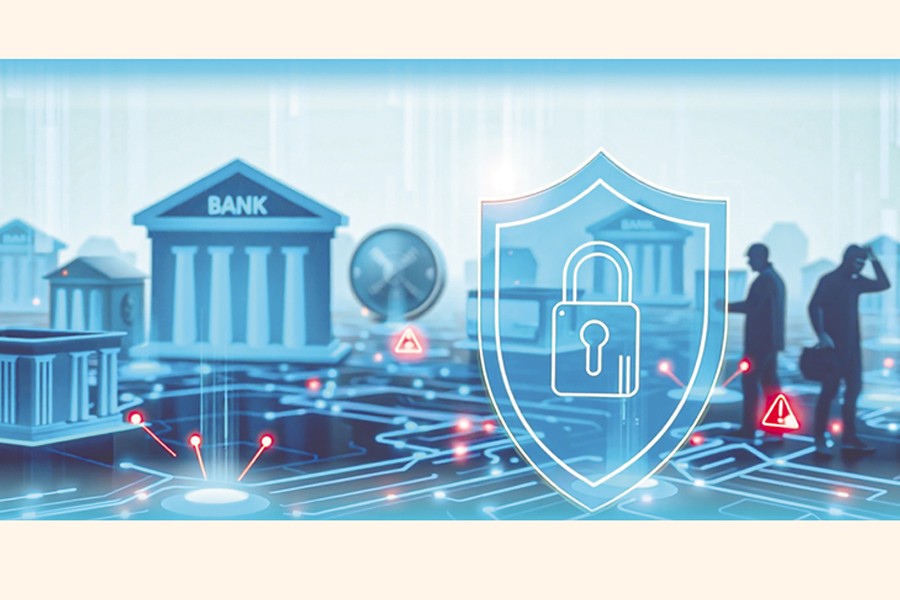
Bangladesh's journey towards a digital economy has been remarkable, with its financial sector leading the way. An explosion of Mobile Financial Services (MFS), online banking, and digital payments has brought unprecedented convenience and inclusion to millions. However, this rapid digitisation has also cast a long shadow, creating a fertile ground for cybercriminals who are deploying ever more sophisticated attacks. As the nation's reliance on digital finance deepens, understanding and neutralising these emerging threats has become a critical priority for economic stability and national security at large.
The evolving threat landscape is all the more brain-teasing. The era of simple computer viruses is a distant memory. Today's cyber-threats are stealthy, multifaceted, and often orchestrated by organised international syndicates. For Bangladesh's financial institutions, the challenge has moved far beyond securing physical branches to defending a sprawling digital ecosystem.
A primary concern is the rise of Ransomware-as-a-Service (RaaS). This nefarious business model allows criminals with limited technical skills to lease powerful ransomware tools, launch attacks, and cripple organisations. A successful RaaS attack on a major bank could encrypt core banking systems, customer data, and backups, bringing operations to a grinding halt while attackers demand millions in cryptocurrency.
Simultaneously, the weaponisation of Artificial Intelligence (AI) in social engineering poses a grave threat. Cybercriminals are using AI to craft hyper-realistic phishing emails and text messages (smishing). The technology has even enabled "deepfake" audio calls, where a criminal can convincingly mimic a CEO's voice to authorise a fraudulent high-value transaction, making it incredibly difficult for even vigilant staff to detect deception.
Recent attacks: from heists to hacktivism: While the audacious 2016 Bangladesh Bank heist remains a stark reminder of the potential for catastrophic loss, the nature of attacks has since diversified, becoming more frequent and varied. Recent incidents demonstrate that criminals are targeting the sector from multiple angles.
In 2019, the financial sector was rocked by a sophisticated attack on Dutch-Bangla Bank. An international hacker group known as "Silence" breached the bank's network, not for a simple wire transfer, but to orchestrate a large-scale, coordinated ATM cash-out. Using cloned cards, foreign nationals withdrew over US$3.0 million from various ATM booths. This attack highlighted a dangerous evolution from purely digital theft to complex operations that bridge the digital and physical worlds, proving that vulnerabilities in ATM networks can be ruthlessly exploited.
More recently, the battleground has expanded to social media and public perception. In a stark example from just this month, October 2025, the official verified Facebook page of Islami Bank Bangladesh PLC was hijacked by a group calling itself 'Team MS 47OX'. The hackers defaced the page and posted threatening messages, promising further attacks. While this did not result in a direct financial breach of the bank's core systems, it represents a significant reputational assault. Such incidents erode public trust, can be used to spread disinformation, and demonstrate that a bank's entire digital footprint-not just its transactional systems-is a target.
These high-profile incidents are compounded by a relentless barrage of lower-level threats. Government bodies like the BGD e-GOV CIRT frequently issue alerts regarding planned Distributed Denial-of-Service (DDoS) attacks by hacktivist groups aimed at disrupting online services. Furthermore, phishing and smishing campaigns targeting MFS and bank customers are rampant, tricking countless individuals into revealing PINs and one-time passwords (OTPs), leading to the steady erosion of both personal savings and confidence in the digital payment system. Charting a resilient path forward is a must-do to navigate such pitfalls on the information superhighway. To defend against this multi-pronged assault, experts suggest, Bangladesh's financial institutions must adopt a proactive and layered security posture.
First, implementing a 'Zero Trust' security architecture is essential. This model operates on the principle of "never trust, always verify," requiring strict identity verification for every person and device trying to access resources on the network, regardless of their location.
Second, investing in AI-powered threat detection is no longer a luxury. These advanced systems can analyse network activity and user behaviour in real time, identifying anomalies and potential threats far faster than human teams can.
Finally, the human element remains the most crucial line of defence. This requires continuous cybersecurity training for all employees, from the teller to the boardroom. This must be complemented by sustained public- awareness campaigns to educate customers on how to spot scams and protect their digital credentials.
Collaboration between financial institutions and regulators like the Bangladesh Bank and national cybersecurity agencies is a paramount necessity. By fostering a culture of shared threat intelligence, the entire financial sector can build a collective defence, fortifying the digital frontier and ensuring that Bangladesh's financial future remains secure and prosperous.
© 2026 - All Rights with The Financial Express

