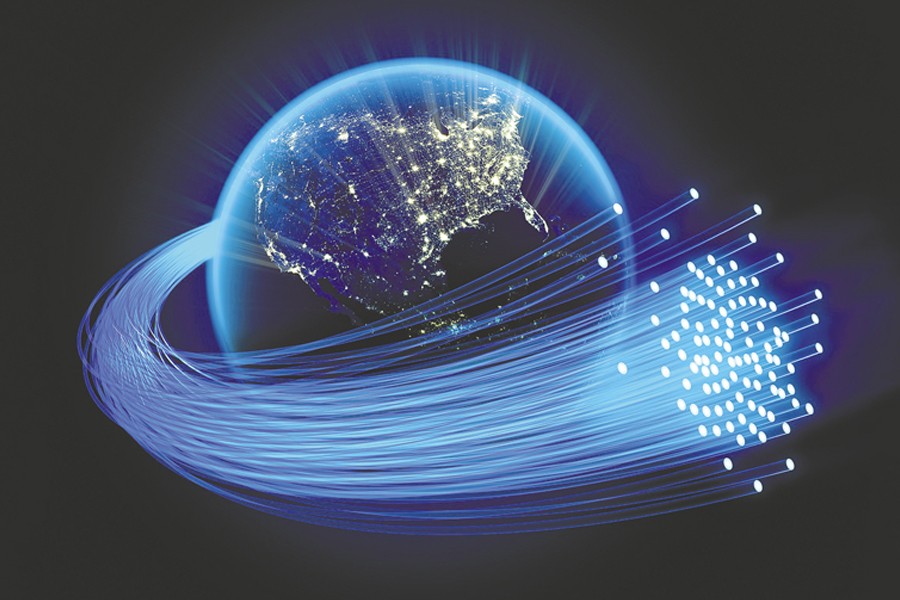
 Bangladesh gears up for one of its most ambitious digital projects yet, which is meant for making things unthinkably faster. It is to create a national digital platform called Fibre Optic Bank. The innovation plan is simple but radical-pool thousands of kilometres of underused state-owned fibre cables into one centrally managed megastore of electronic powerhouse. The goal is slash internet costs, fast-track 5G services, and turn a dormant asset into a billion-taka revenue stream.
Chief Adviser of the interim government Muhammad Yunus, who is well-conversant in the magical workings of fibre-optic cables for his pioneering moves with GrameenPhone, has already given the go-ahead. The telecom and ICT divisions are now moving to bring Bangladesh Railway and Power Grid Company of Bangladesh (PGCB) into a consortium with Bangladesh Telecommunications Company Limited (BTCL) and Bangladesh Computer Council (BCC) to make it. Together, they would "control the backbone of the country's digital future", officials say.
In a letter to Railways and Power Adviser Muhammad Fouzul Kabir Khan, Faiz Ahmad Taiyeb, special assistant to the chief adviser, was blunt: "We are wasting a vital national asset by leaving large portions of optical fibre unused. It is time we came together and built a centrally managed, transparent, and efficient fibre ecosystem for all."
The numbers back him up. BTCL, PGCB, Railway and BCC combined, there are 78,400 kilometres of fibre-optic cable in the ground or running along power lines and railway tracks. Almost 40 per cent of it is dark-never lit, never used. It is digital potential buried beneath years of siloed planning and restrictive policy.
The idea of consolidating networks is hardly new. Australia's National Broadband Network, Singapore's Next Generation Nationwide Broadband Network and the European Union's open-access rules all rest on the same principle: share the fibre, cut duplication, and open the field to competition. In North America and Europe, utilities have long-leased dark fibre to telecoms, creating steady income for the state and cheaper connectivity for the market. Bangladesh's version borrows from all these models but gives it a distinctly public-sector twist.
The payoff could be huge. Wholesale bandwidth prices could fall by as much as 70 per cent-from Tk 18,000 per gigabit to around Tk 5,000. That means cheaper broadband for homes, affordable packages for businesses, and lower data costs for mobile users. Idle fibre, once monetised, could pump over Tk 5.0 billion into the treasury every year. With BTCL taking the lead on maintenance, operational costs could drop by nearly a third.
For the mobile sector, the prize is even bigger. Only one in four towers in Bangladesh is connected to fibre, a major roadblock for 5G. A national backbone could light up every tower, paving the way for a fast, low-cost rollout of next-generation services. Overlapping networks would also build redundancy, so if one line goes down in a flood or storm, traffic can be rerouted instantly.
But the road ahead is far from smooth. One of the biggest knots is InfoSarkar-3, a 27,695-kilometre government network handed to two private firms-Summit Communications and Fibre@Home-under a deal that gives them 90 per cent of revenues. Bringing that network under the bank's umbrella will mean sensitive, perhaps bruising, renegotiations.
Then comes the bureaucracy. Four ministries, four agencies, different standards, different priorities. Stitching them together into one coherent operating model will take deft coordination. Add in the technical headache of merging networks built at different times with different vendors, and the scale of the challenge becomes clear. And, finally, the money question: how to split revenues fairly among asset owners, regulators, and operators without triggering disputes.
Still, the prize is too big to ignore. Consider Salma, an artisan in Rangpur, who sells traditional Nakshi Kantha online. Today, uploading photos takes hours, video calls with buyers are impossible, and online payments are unreliable. With fibre extended to her village through the new bank, everything changes. Her business runs on fast, stable internet. She streams live showcases, partners with designers in Dhaka and London, and hires five other women. The fibre-optic cable that once lay dormant becomes her lifeline to the global economy.
That is the story policymakers want to write for millions of Bangladeshis. For years, state entities were barred from competing on the open market, which policy critics say enriched a few private players while leaving public assets to gather dust. The Fibre Optic Bank is designed to flip that script: a transparent, GIS-mapped inventory of every strand of fibre, opened up for commercial and social use.
If it works, Bangladesh will not just have cheaper internet or faster 5G. It will have a model of how vision, collaboration, and public assets can be harnessed to create a fairer, more connected digital future.
© 2026 - All Rights with The Financial Express

