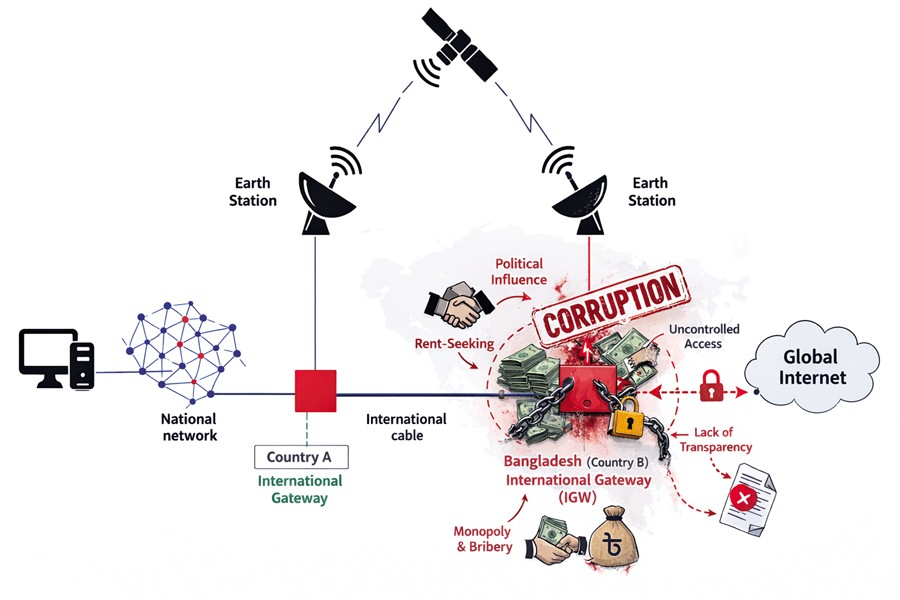
Now that a new government prepares to take full charge of the telecommunications and ICT sectors, questions are resurfacing about one of the most controversial arrangements in Bangladesh's international call-routing system-the operations of the IGW Operators Forum (IOF). The incoming administration, along with newly appointed officials overseeing the telecom and ICT portfolios, is expected to review several regulatory decisions made over the past decade.
Among the issues drawing renewed scrutiny is the network structure introduced under the IOF framework and its implications for government revenue and market competition.
Industry observers say the transition in political leadership provides an opportunity to reassess policies that shaped the international call-termination market in recent years. The central question now being raised in policy circles is whether the system will continue largely unchanged or the new authorities will undertake structural reforms.
A system under scrutiny: The controversy centres around a network configuration introduced in 2015 under the supervision of the Bangladesh Telecommunication Regulatory Commission (BTRC), which allowed international gateway operators to route traffic through a shared switching arrangement known as the IGW Operators Switch (IOS).
The arrangement was implemented through the IGW Operators Forum, a platform representing licensed International Gateway (IGW) operators. It was initially described as an experimental topology aimed at improving traffic management and coordination among operators.
However, telecom analysts and some industry participants later questioned whether the system deviated from the principles laid out in the International Long Distance Telecommunication Services (ILDTS) policy, introduced in 2007 to regulate international call handling and curb illegal Voice over Internet Protocol (VoIP) operations.
Under the ILDTS framework, international calls were supposed to pass through a three-tier structure: IGW operators would receive the calls, Interconnection Exchange (ICX) operators would route them, and mobile or fixed-line operators would ultimately terminate the calls.
Critics argue that the IOS arrangement effectively centralised the routing process through a single operational point controlled by the IOF, potentially altering the balance among operators in the system.
Questions over market structure: Some industry insiders say the system may have given greater influence to a limited group of IGW operators in determining the flow and pricing of international traffic. This concentration, analysts say, stoked concerns about market competition and the distribution of revenue within the sector.
Telecom expert T. I. M. Nurul Kabir believes the new government should commission an independent review of the system. According to him, a detailed techno-commercial audit could clarify how the IOS network operated over the years and how revenue from international call termination was calculated and distributed. Such an audit, he argues, would examine the architecture of the network, the pricing mechanisms used by operators and the management of funds associated with the system.
Declining international call traffic: The debate surrounding the IOF structure has also coincided with a sharp decline in the volume of incoming international calls through legal channels. Industry data suggest that daily international call traffic once exceeded 100 million minutes but has fallen to around 10 million minutes in recent years.
Analysts attribute this decline partly to the growing popularity of internet-based calling platforms and partly to the resurgence of illegal VoIP routes that bypass official gateways.
In response, the Bangladesh Telecommunication Regulatory Commission revised the floor rate for international call termination several times in an effort to maintain competitiveness in the global voice traffic market.
Market Development Fund under investigation: Another issue drawing attention is the Market Development Fund (MDF) established under the IOF framework. According to information available from the Bangladesh Telecommunication Regulatory Commission, more than Tk 6.31 billion had been deposited into the fund by the end of December 2024. Of this amount, roughly Tk 6.25 billion was reported as spent.
Investigators are examining how the money was utilised and whether the expenditures complied with regulatory guidelines.
Questions have also cropped up regarding payments made to Beximco Computers Limited, a subsidiary of Beximco Group, which does not hold an International Gateway licence.
Legal proceedings already initiated: The BTRC has already initiated legal action related to alleged irregularities involving the IOF system. Cases filed under the Bangladesh Telecommunication Act 2001 and relevant provisions of the Penal Code accuse several individuals of breaching licensing conditions and misusing funds associated with the telecoms sector.
Some of the accused appeared before Dhaka Chief Metropolitan Magistrate Court and were granted bail while investigations continue.
A test for the new administration: For the incoming government, the IOF controversy could become an early test of its approach to governance and regulatory oversight in the digital economy. Telecommunications remain a major source of government revenue and an essential component of Bangladesh's digital infrastructure. Ensuring transparency in how international-call traffic is routed and how revenues are shared among operators is, therefore, considered crucial for both market stability and public trust.
Industry observers say the new minister and adviser responsible for the telecoms and ICT sectors will face pressure to review the existing framework and determine whether further reforms are necessary.
Whether the IOF model continues, is modified, or replaced entirely will depend on the findings of ongoing investigations and the policy direction adopted by the new administration.
For many within the sector, the hope is that the leadership transition will lead to a clearer regulatory framework-one that strengthens oversight, restores confidence in the market and ensures that public revenues from international telecommunications are properly safeguarded.
© 2026 - All Rights with The Financial Express

