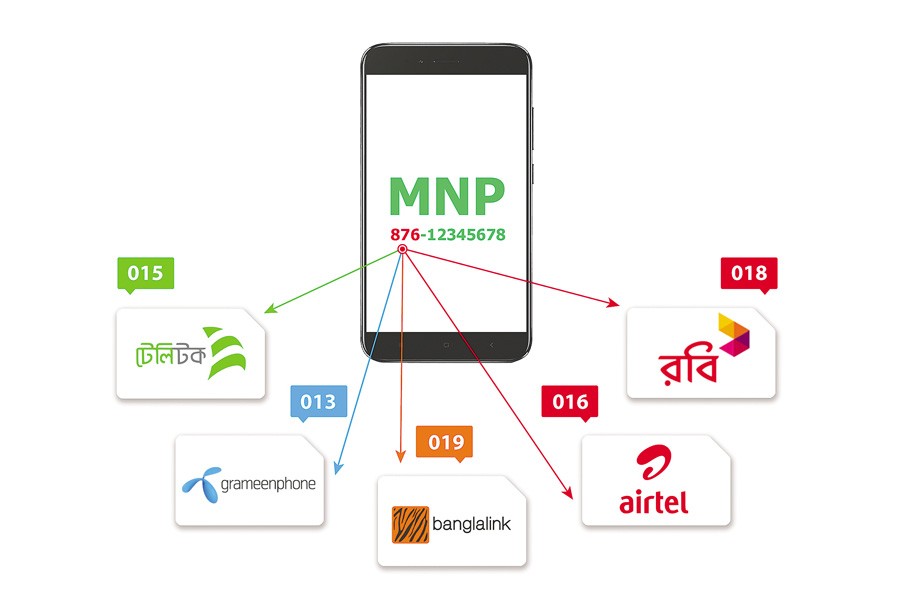
When Mobile Number Portability (MNP) was introduced in Bangladesh in October 2018, it was hailed as a game-changer. Consumers, long stuck with underperforming operators, finally had the freedom to switch networks without losing their mobile numbers. The reform promised to boost competition, improve service quality, and give power back to customers.
Six years on, that promise has largely gone unfulfilled.
According to the Bangladesh Telecommunication Regulatory Commission (BTRC), fewer than one per cent of the country's 186.5 million active mobile connections have been ported since MNP was launched. A tool designed to disrupt the telecom market has ended up as a little-used feature, bogged down by red tape and ineffective implementation.
"I tried to port once," said Shamima Akter, a university student in Dhaka. "The process was confusing and took too long, so I gave up." Her story mirrors those of many others. Users cite complicated procedures, service disruptions, and lack of support as major obstacles to porting.
The country's sole MNP operator, Infozillion Teletech BD, reported that around seven lakh users ported in the first year. In the next five years, that number merely doubled, despite a growing number of mobile subscribers.
At a recent seminar, Infozillion officials pointed to regulatory roadblocks, poor industry cooperation, and flawed network design as reasons for MNP's sluggish growth. They also highlighted how lack of public awareness and restrictive rules have discouraged potential users.
Lack of Real Competition
In theory, MNP encourages competition by allowing dissatisfied customers to easily switch networks. In practice, however, Bangladesh's telecom market is dominated by Grameenphone, which holds over 45 per cent of market share. Smaller players like Robi and Banglalink hoped to gain ground through MNP, but they struggled to lure users away from GP, which maintains a strong nationwide signal.
Even when users do switch, many later return to their original operator due to similar or worse service issues. One telecom executive noted, "There's little incentive to move if the alternative isn't better."
A deeper issue lies in the lack of public education around MNP. The BTRC, which oversees telecom regulation, restricted mobile operators from advertising the service just before its launch. Infozillion officials argue this restriction severely limited outreach and contributed to public confusion.
They noted that the MNP licence requires both the regulator and the operators to promote the service. "Barriers to communication must be lifted to ensure consumers know their rights," said Infozillion CEO Brigadier General (Retired) Md Mustafa Kamal. He added that 45 per cent of customer porting requests are currently being rejected by the operator they wish to leave - a rate they say should be capped at five per cent.
Technical and Structural Flaws
Another challenge is the technical limitation that affects ported users, especially regarding SMS delivery. Voice calls go through an interconnection exchange (ICX), which ensures routing between networks - including ported numbers. But no such mechanism exists for SMS. As a result, users who switch networks often find they can no longer receive texts from some operators.
Infozillion said this flaw stems from network design and can be resolved with support from the regulator. Meanwhile, poor access to MNP kits in many service centres also restricts availability. While new SIMs and replacements are easy to obtain, porting remains cumbersome.
Infozillion's Managing Director Mabroor Hossain said their company undertook the project with 50 per cent foreign direct investment. "We wanted to empower consumers, but that empowerment is being blocked. If implemented properly, MNP would raise government revenue and attract further investment.
Learning from Global Examples
Other countries have implemented MNP far more successfully. In India, more than 650 million porting requests have been processed since its launch in 2011. The process is digital, takes just one day, and costs little to nothing. Operators are forced to compete on service and pricing to retain customers.
In Kenya, the service is entirely free and widely used. Regulators ensured a consumer-friendly process, giving smaller operators a fair chance in a competitive market. In the United States, number portability is fast, simple, and widely expected - an essential feature of consumer choice.
By contrast, Bangladesh's system remains inaccessible and obscure to many, especially in rural areas.
Reclaiming the Vision
Mobile Number Portability was meant to shift the balance of power in favour of consumers. Instead, it became another stalled reform. But with the right regulatory push and industry cooperation, its potential can still be realised.
Ultimately, MNP is not just about keeping your number - it is about making telecom companies earn your loyalty.
© 2026 - All Rights with The Financial Express

