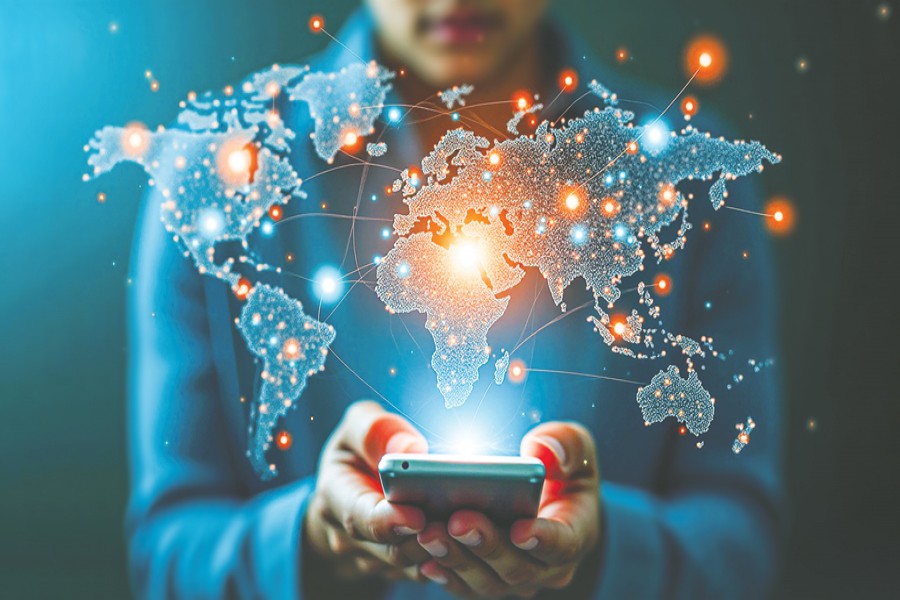
In today's hyper-connected world, access to information is easier than ever before. With a few taps on a screen, people are flooded with news alerts, social-media updates, trending videos, and opinion pieces. While the democratization of knowledge has many benefits, the downside of this phenomenon—information overconsumption—is increasingly affecting individuals and societies in ways we are only beginning to understand.
Take the case of Farzana Akhter, a university student in Dhaka. She starts her day by checking headlines, scrolling through Facebook, watching YouTube commentary, and jumping between news portals. By mid-morning, she gets mentally exhausted—not from the academic load but from the sheer volume of content she’s processed. “It feels like my brain is full, but I can’t remember anything,” she admits. Her experience is not unique.
Poor decision-making in a saturated mind: When our minds are constantly overloaded, critical thinking takes a backseat. The ability to pause, reflect, and make sound decisions diminishes. Hasan Mahmud, a young entrepreneur from Chattogram, admits he made a costly investment decision based on a viral video that exaggerated market trends. “I didn’t verify the facts. It was just everywhere, and I thought it must be true,” he says. With too much information and too little time to process it, people often react emotionally rather than rationally—leading to missteps in both personal and professional domains.
Downside of connectivity: Cyberbullying and harassment are taken first here for an illustration.
The very platforms that deliver this constant stream
of information also enable toxic behaviour.
The anonymity of the internet emboldens many to engage
in cyberbullying and harassment
For Rafiul Islam, a schoolteacher in Khulna, a casual political comment on Twitter led to a barrage of insults and threats. “It was overwhelming. I had to delete my account,” he laments. The digital realm, while a space for free expression, has become a minefield of hostility for many.
Eroding privacy in a data-driven world emerges as a cardinal concern. An alarming consequence of this information
age is infringement of privacy.
As people share more and more of their lives online,
often unknowingly, their data are collected, stored, and sometimes misused. From targeted advertising to
identity theft, the risks are real.
Shamima Nasrin, a homemaker in Rajshahi, has a tale to tell. She was shocked to find her photos circulating on dubious websites. “I didn’t even know how they got it,” she says.
In a world where every click leaves a trace, privacy is
becoming a luxury.
Misinformation-- a fast-spreading virus: Perhaps the
most dangerous aspect of information overconsumption is the spread of misinformation. During the COVID-19 pandemic, false cures and conspiracy theories spread like wildfire on WhatsApp and Facebook, leading to panic
and dangerous behaviours.
Even now, during election seasons or national crises, misleading narratives cloud public perception. “I’ve seen my uncle believe and forward messages that had no basis in truth,” says Moumita Dey, a journalist based in Sylhet.
“And once it’s out there, it’s hard to pull back.”
A call for digital mindfulness: In this ever-evolving information landscape, what’s needed is a new kind of literacy—digital mindfulness.
People must learn not only how to access information but also how to critically evaluate it, manage exposure, and protect their mental wellbeing. Schools and workplaces in Bangladesh and elsewhere are beginning to recognize this imperative. Some universities have introduced sessions on media literacy, while NGOs run campaigns about cybersafety. But the awakening effort must be more widespread.
Finding balance in the age of abundance: Ultimately, the solution is not to withdraw from the digital world but to engage with it more consciously.
Just as we are advised to eat a balanced diet, we must now curate a balanced information diet. Choosing credible sources, limiting screen time,
and taking regular digital detoxes are some
steps in the right direction.
As our world continues to change—faster than
ever before—so too must our ability to adapt. For people
like Farzana, Hasan, Rafiul, Shamima,
and countless others, managing the barrage of information
is no longer a luxury—it is a necessity for survival in
the 21st century.
© 2026 - All Rights with The Financial Express

