For millions of Bangladeshis, the smartphone has evolved far beyond a communication device. It has become a digital wallet, a classroom, an office, a marketplace and, for many freelancers and entrepreneurs, an indispensable tool for earning a living. From mobile financial services and online education to e-commerce and public services, everyday life increasingly depends on affordable access to smartphones.
That is why the prospect of a sharp increase in handset prices from July has unsettled consumers, retailers and importers alike.
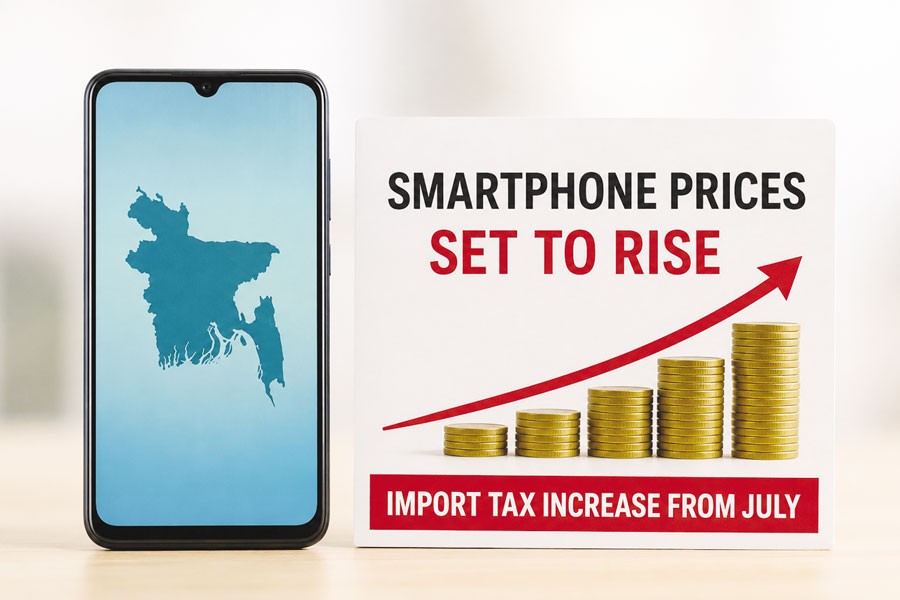
Industry insiders warn that smartphones imported through official channels could become up to 25-percent more expensive if the government allows a temporary customs-duty concession to expire at the end of June. The increase would arrive at a time when consumers are already grappling with rising living costs and when the government's ambition of building a digitally connected Bangladesh relies heavily on widespread smartphone adoption.
Behind the anticipated price rise lies a combination of domestic fiscal policy and international market pressures. While the proposed national budget for the 2026-27 fiscal year offers incentives to encourage local manufacturing and assembly, it does little to address the immediate concerns surrounding imported smartphones, particularly premium and flagship models that cannot be produced economically within Bangladesh.
A temporary tax relief nears its end:
The immediate concern centres on a special customs-duty concession introduced by the interim government earlier this year.
On January 13, the government reduced customs duty on officially imported smartphones from 25 per cent to 10 per cent through a special notification. The measure significantly lowered the overall tax burden on imported handsets from 64.25 per cent to 43.43 per cent.
The relief was intended as a temporary measure and is scheduled to expire when this financial year expires on June 30.
Since the proposed national budget does not include any provision to extend the concession, importers expect customs duty to revert to its previous rate of 25 per cent from July 1.
According to the Mobile Phone Industry Owners Association of Bangladesh (MIOB), retail prices of officially imported smartphones could rise by between 20 and 25 per cent almost immediately once the higher duty takes effect.
For consumers, the financial impact is substantial. A smartphone currently selling for Tk 50,000 could cost between Tk 60,000 and Tk 62,000. A handset priced Tk 80,000 may become Tk 16,000 to Tk 20,000 more expensive, while premium models currently retailing for Tk 100,000 could increase by Tk 20,000 to Tk 25,000.
Such increases would place many popular flagship devices beyond the reach of middle-income consumers.
Devices that cannot be built locally:
The proposed national budget continues policy of encouraging domestic smartphone assembly direction by reducing Advance Income Tax on twenty-two categories of manufacturing raw materials to one per cent, a move intended to strengthen domestic production.
However, local manufacturing has practical limitations.
According to industry estimates, assembling many premium smartphones in Bangladesh is not commercially viable. The market for flagship devices remains relatively small, while production requires sophisticated components, highly specialised manufacturing processes and complex international supply chains.
A global industry under pressure: The local tax issue comes against the backdrop of a persistent global cost inflation within the electronics industry.
Even before concerns emerged over Bangladesh's import duties, smartphone retailers across Dhaka and other major cities had already begun adjusting prices upward. Depending on the model, retail prices have reportedly increased by between Tk 500 and Tk 5,000 in recent months.
Manufacturers worldwide continue to experience elevated costs for semiconductor chips, memory modules, processors, display components and lithium-ion batteries. Bangladesh imports virtually every critical smartphone component -- even for locally assembled devices -- these international price increases inevitably feed into domestic manufacturing and retail prices.
When higher global production costs combine with increased domestic taxation, consumers face a double burden.
A delicate balance between protection and affordability: The government's industrial policy seeks to nurture a domestic electronics manufacturing sector capable of creating employment, encouraging technology transfer and reducing import dependence. Tax incentives for local assembly form an important part of that long-term strategy.
Yet industry representatives argue that the current situation requires a more nuanced approach.
Grey market returns to the spotlight: Unofficially imported smartphones have remained a persistent feature of the country's electronics market for years. Such devices often enter Bangladesh outside formal import channels by dodging customs duties and other taxes. As a result, grey- market phones are frequently sold at considerably lower prices than officially imported equivalents.
If customs duty returns to 25 per cent, however, that gap is expected to widen once again.
Industry representatives estimate that identical smartphone models could cost between Tk 15,000 and Tk 25,000 more through official channels than through unofficial sellers.
For many consumers, particularly those purchasing expensive flagship devices, such price differences may prove difficult to ignore. And the consequence could be a renewed shift towards unofficial import.
Could higher taxes produce lower revenue?: The debate also raises broader questions about tax policy itself. Conventional fiscal thinking often assumes that increasing tax rates automatically generates higher government revenue.
Industry representatives argue that maintaining moderate tax rates encourages compliance, supports authorised distributors and expands the formal tax base.
Whether policymakers accept that argument remains to be seen.
Smartphones as essential infrastructure: The debate surrounding smartphone taxation extends beyond commercial interests. Smartphones have become essential infrastructure for Bangladesh's rapidly expanding digital economy. They enable mobile banking, digital payment, online education, telemedicine, government services, remote employment, freelancing, ride-sharing, food delivery, social commerce and countless small businesses operating through social-media platforms.
If smartphones become significantly less affordable, digital inclusion may slow precisely when Bangladesh is attempting to accelerate digital transformation and expand access to technology-based services.
Waiting for a government decision:
As July approaches, the smartphone industry remains in a state of uncertainty. Importers hope the government will reconsider and extend the temporary customs- duty concession, arguing that doing so would preserve affordability, discourage grey-market activity and sustain legal import.
For millions of Bangladeshis preparing to purchase their next smartphone, the coming weeks could determine whether that essential digital companion remains within financial reach or becomes considerably more expensive overnight.
© 2026 - All Rights with The Financial Express

