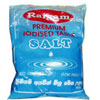
Abdus Sabur , a farmer of Shekher Khil union under Bashshkhali upazila in Chittagong this year sold his salt at Tk2.2 per kg. The same salt, after being refined, packed and marketed, was bought at Tk25 per kg at Nawabganj Bazar in Dhaka yesterday.
"I've bought a packet of thin salt at Tk25 a kg," said Raufun Reza, a NGO official at Dhaka residing at Nawabganj Bazar area. He has no idea that salt was sold so cheap at the farm level.
Hearing from the FE about the farm level price, he expressed his anger saying that it was surely an injustice to both farmers and consumers.
After visiting the city's key kitchen markets, the FE correspondent found refined and iodised salt being sold at Tk25 per kg packet of ACI, Fresh, Molla, Alibaba brands while ½ kg pack was sold at Tk13-15.
Fat granule salt with iodine like Brac Salt was sold at Tk8-10 per ½ kg pack while open salt of various companies was sold at Tk 12-14 per kg in a few groceries in the city.
However, talking to the FE over cell phone on Sunday, Abdus Sabur at Bashkhali said salt prices fell to just Tk2.0-T2.5 per kg this season.
He said this year production was good as they got 38-40 maunds (per maund 37.32 kg) from per 'kani' land (40 decimals).
"We failed to recover even our investment of Tk20,000 per kani of land", he said.
"Dependence on imported salt by big market players like Pubali, Molla, ACI, Fresh and Padma has been increasing significantly in recent times. This has put farmers to a dire strait", Shahidullah Chowdhury, president of the Bangladesh Laban Chashi Samity, the biggest association of salt farmers, told the FE.
He said Chittagong and Cox's Bazar are now producing more than 1.5 million tonnes of salt enough to meet the national demand.
"Despite this, private importers are bringing in 0.6-0.7 million tonnes of Indian salt per year", he said.
When asked, he said Indian salt is very cheap as farmers there grow salt in government-owned lands free of cost.
According to the Samity, nearly 55,000 households or 0.25 million people are engaged in salt farming in Chittagong and Cox's Bazar districts on 61,000 acres of land.
A wholesaler at Khatunganj area of Chittagong told the FE over cell phone that many companies create artificial crisis to justify imports despite having huge stockpiles at home.
"The artificial crisis is used as an excuse for salt import", he said.
A Bangladesh Small Cottage Industries Corporation (BSCIC) official requesting anonymity told the FE that the country's highest demand for salt is 1.5 million tonnes against local production of 1.5 to 1.6 million tonnes.
He said there is no need for import, but the importers are very influential within the government.
He said recently four big salt companies have upgraded their factory machinery keeping imported Indian salt in their mind.
"The Salt Policy 2011 should be implemented to safeguard the farmers", he said.
© 2026 - All Rights with The Financial Express

