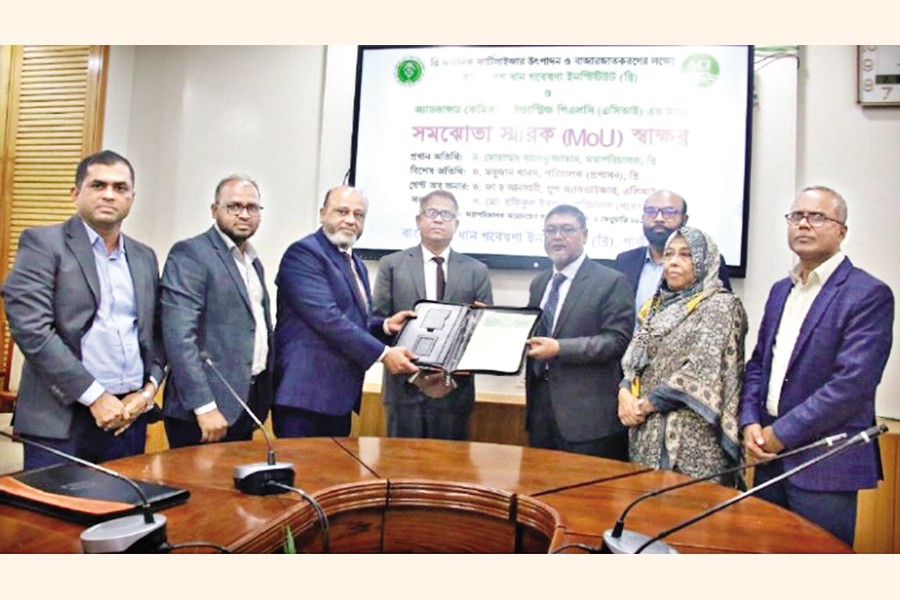
 ACI Group Adviser Dr FH Ansarey and BRRI Director General Dr Mohammad Khalekuzzaman signed an MoU on the BRRI campus in Gazipur on Monday.
 In a significant step towards ensuring sustainable, environment-friendly, and cost-effective rice production in Bangladesh, the Bangladesh Rice Research Institute (BRRI) and Advanced Chemical Industries (ACI) PLC have signed a Memorandum of Understanding (MoU) for the transfer of technology related to BRRI organic fertiliser, says a press release.
ACI Group Adviser Dr FH Ansarey and BRRI Director General Dr Mohammad Khalekuzzaman signed the MoU on behalf of their respective organisations on the BRRI campus in Joydebpur, Gazipur on Monday.
Under the MoU, BRRI will transfer its innovative BRRI Organic Fertiliser production technology to ACI PLC. Using this technology, ACI will produce and market high-quality organic fertiliser for farmers across the country. To ensure production efficiency and quality control, ACI will establish its own manufacturing facilities and modern laboratories.
BRRI Organic Fertiliser is an innovative and sustainable organic input developed using household waste, cow dung, poultry litter, rock phosphate, biochar, and beneficial microorganisms.
Research findings indicate that applying only 500-750 kg per hectare of BRRI Organic Fertiliser can completely replace phosphate fertiliser in rice cultivation.
Additionally, reducing nitrogen fertiliser use by 25-30 per cent while applying this organic fertiliser can achieve yields comparable to those obtained using 100 per cent chemical fertilisers.
The use of BRRI Organic Fertiliser enhances soil organic carbon, improves water-holding capacity, and increases beneficial microbial activity, resulting in stronger root development. Over time, it improves soil fertility and ensures sustainable rice yields while reducing environmental pollution and greenhouse gas emissions.
Currently, the government provides substantial subsidies for urea and phosphate fertilisers in rice production.
Large-scale adoption of BRRI Organic Fertiliser at the national level could eliminate the need for phosphate fertiliser and reduce urea consumption by approximately 30 per cent, leading to significant savings in subsidy expenditures.
© 2026 - All Rights with The Financial Express

