Yasir Wardad back from Bandarban | November 18, 2014 00:00:00
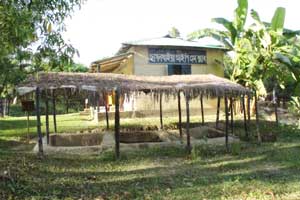 A compost fertiliser plant in front of Chhagol Khaia IPM club at Lama, Bandarban
Good agronomical practices have opened up new horizon for the farmers of the Chittagong Hill Tracts.
Both the crop farmers and gardeners are 'appropriating' smart farm techniques, which are helping them to reap greater benefits.
The farmers have brought diversity in plantation and have adapted integrated pest and fertiliser management, resulting in robust production, said peasants and officials in the hilly districts.
Usy Marma, a farmer at Referpara under Ali Kadam upazila in Bandarban district once only involved in tobacco farming.
"For the last six years, I've expanded cultivation of vegetables and rice to six Kanis of land (1 Kani=40 decimal in the area)," Mr Usy said.
Visiting his homestead last week, this correspondent found it occupied with local bean and vegetable leaf plants.
"Our homestead is also a source of food crop," he said.
"Compost manure, cow dung and other natural fertiliser are being used instead of chemical fertilizer, which helps reduce output costs," he said.
"By adopting Integrated Pest Management (IPM), use of chemical pesticide has nearly become zero," he said.
Mr Usy said he grows radish, brinjal, local bean, chilli in his land.
"I've spent Tk6200 at per Kani of vegetable field this year and I expect to get crop of Tk16,000 from the same piece of land," he said.
Mr Usy is now selling 300 kgs of vegetable every week from his six Kanis of land. which would continue for next four months.
Abul Hamid, a farmer at Gazaria Union-1 at Lama upazila told the FE they are planting Dhaincha plant (Sesbania aculeata) across the crop field.
The Dhaincha plant can control various kinds of pests and green leafs are also used as the substitute of urea fertiliser, he said.
"We used TSP (Triple Super Phosphate), Diammonium Phosphate (DAP) and MOP (Muriate of Potash) fertiliser to some extent", he said.
Mr Hamid said the matured plant of Dhaincha is also used for fuel and fence.
He said the IPM club run by the Department of Agriculture Extension (DAE) and British American Tobacco Bangladesh (BATB) are creating IPM literate farmers in his territory.
Lama Upazila Agricultural Officer Rustam Ali, who trains farmers at Chhagol Khaiya village IPM Club, said the DAE with the help of BATB is running three IPM clubs in Lama for the last six years.
He said: "We have so far trained 200 farmers in Sagol Khaia area".
"Every trained farmer is called 'Soldier' and he has duty to train another 10 farmers," he said.
The programme usually focuses on integrated cultivation management--- from selection of seed to harvest stage, he pointed out.
Deputy Director of the DAE, Bandarban district Md Altaf Hossain told the FE that IPM clubs help reduce use of chemical fertiliser and pesticide.
He said the production is also increasing and output cost is showing a reducing trend, which is helping the farmers to cash more profits.
The DAE official said that production in Aman season is outstanding this year.
"Farmers cultivated Aman crop at 11,650 hectares of land and 20 per cent harvest are completed so far," he said.
"We are getting more than 3.0 tonnes per hectare against 2.99 tonnes per hectare last year," he said.
Meanwhile, farmer Md Abdur Rashid at Bomobilchari Union under Chakoria upazila in Cox's Bazar (it is an adjacent area to Lama upazila of Bandarban) said marketing is still a key problem for the farmers.
He said rice price is stubbornly high in the retail market, but they are getting only Tk650-680 per maund for paddy this year.
He said: "Vegetable and ginger production has been increasing gradually but price at the farmers' level is much low."
However, apart from crop farming, gardeners in the hill area are also adopting smart agronomical practices by planting herbal medicinal plants, fruits, vegetables and spices in wood gardens.
Mamataz Uddin Ahmed, a gardener of nearly 8 hectares at Fashiakhali Union in Bandarban, once had only wood trees like Acacia mangium, Rain-Tree Koroi etc half a decade back.
But for last seven-eight years, he is cultivating fruits and herbal plants.
"I've now 42 species of fruits and medicinal plants in my garden," he said.
"I've sold woods nearly of Tk3.3 million this year and expecting to begin sale of fruit and herbal plants worth Tk0.6-0.7 million per annum in next three or four years," he said.
Mr Ahmed told the FE that he gets plants and training from 'the Banayon' (literal meaning forestation) project run by BATB.
"I've got more than ten thousands of saplings so far from the Banayon project under which nearly 85 million plants have been distributed in the country," said Mr Mamataz, who also trains other gardeners in the area.
However, the DAE officials said output from Jhum harvest, the traditional farming of indigenous people is also outstanding this year.
Nearly 13,000 tonnes of rice has been harvested this year from Jhum cultivation, breaking all the previous records, DAE officials said.
tonmoy.wardad@gamil.com
© 2026 - All Rights with The Financial Express

