Bangladesh's cotton imports declined in 2025 after a strong rebound a year earlier, as spinning mills cut purchases amid subdued global apparel demand while diversifying sourcing towards Brazil, the United States, and Australia.
The shift was driven by quality considerations, pricing advantages, and reciprocal tariff issues linked to US trade policies, industry insiders said.
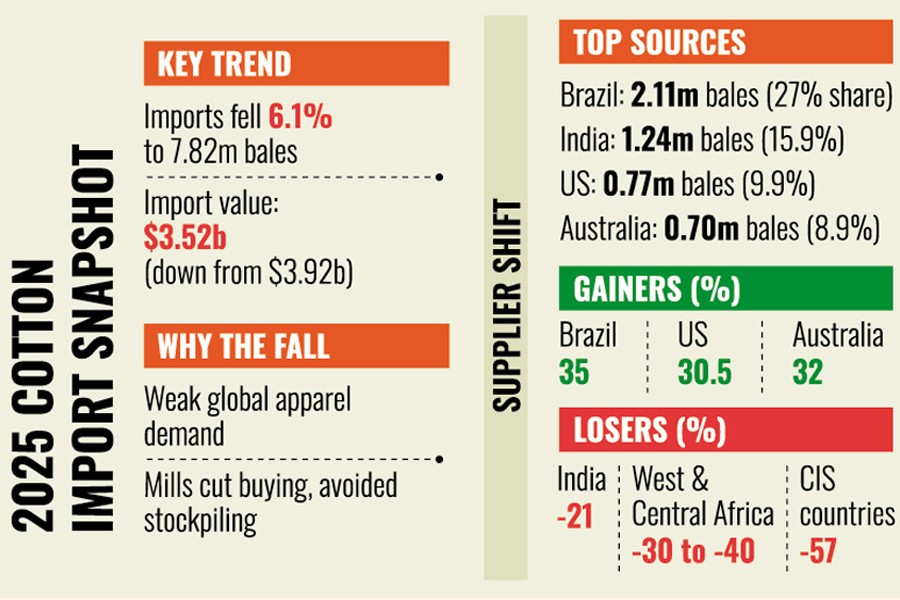
The National Board of Revenue (NBR) data shows total cotton imports fell to 7.82 million bales in 2025 from 8.33 million bales in 2024, marking a 6.1 per cent decline.
In value terms, imports dropped to $3.52 billion from $3.92 billion, reflecting both lower volumes and softer international cotton prices.
The contraction followed a sharp recovery in 2024, when cotton imports surged by nearly 33 per cent as mills replenished stocks after a prolonged slowdown in export orders.
Meanwhile, Bangladesh's apparel exports to the United States slipped slightly to $3,838.8 million during July-December 2025 from $3,842.6 million in the same period a year earlier, according to the Export Promotion Bureau (EPB) data.
Industry insiders said most exporting countries recorded negative growth in the US market during the period, except Vietnam.
They told The Financial Express due to quality and price competitiveness, cotton imports from Brazil, the United States, and Australia increased significantly in 2025.
They also noted the Trump-era tariffs encouraged US farmers to expand exports to Bangladesh.
They added that if the US administration formally announced a tariff waiver on the use of US cotton, it would further boost exports to Bangladesh.
Thanks to the Trump administration's tariff measures, Bangladesh's apparel exports to the US saw growth earlier, while most other markets experienced negative trends.
However, the apparel sector faced continuous negative growth over the past five months.
According to the NBR data, Brazil consolidated its position as Bangladesh's largest cotton supplier, accounting for 27.0 per cent of total imports in 2025, up from 18.7 per cent a year earlier.
Imports from Brazil rose to 2.11 million bales in 2025 from 1.56 million bales in 2024, while the import value increased to $943.8 million.
Industry insiders said competitive pricing, stable supply, and consistent quality helped Brazilian cotton gain market share at a time when mills were reducing overall purchases.
India slipped to second place among suppliers as imports fell by more than 21 per cent to 1.24 million bales in 2025 from 1.57 million bales in 2024.
As a result, India's share of Bangladesh's cotton imports declined to 15.9 per cent from 18.9 per cent.
In 2021, India was Bangladesh's largest cotton supplier with a 31.39 per cent market share, indicating reduced reliance amid price volatility, export policy uncertainty, and quality concerns, according to industry insiders.
In contrast, imports from the United States and Australia rose sharply in 2025.
US cotton imports increased by 30.5 per cent to 0.77 million bales, raising its market share to 9.9 per cent.
Imports from Australia grew by nearly 32 per cent to 0.70 million bales, accounting for 8.9 per cent of total imports.
Analysts attributed the rise to the growing demand for high-grade, contamination-free cotton, particularly for export-oriented garment manufacturers supplying to premium markets.
Textile millers said US buyers' recommendations and the Trump-era tariffs prompted them to increase the sourcing of US cotton.
At the same time, the Bangladesh government removed several tariff barriers, including the mandatory double-fumigation requirement, to boost the imports of US cotton as part of efforts to improve bilateral trade.
Imports from major African suppliers declined sharply in 2025, reflecting a consolidation of sourcing by Bangladeshi mills.
Shipments from Benin fell by 31 per cent to 0.80 million bales, reducing its market share to 10.2 per cent.
Imports from Burkina Faso dropped by nearly 40 per cent to 0.38 million bales, while Mali's shipments declined by more than 41 per cent to 0.35 million bales.
Purchases from Cameroon, Chad, and the Ivory Coast also declined or remained marginal.
Collectively, West and Central African suppliers lost market share as mills adopted a more cautious procurement strategy amid weak yarn and fabric orders. Cotton imports from the Commonwealth of Independent States (CIS) recorded the steepest decline, plunging by more than 57 per cent to 0.06 million bales in 2025.
Trade disruptions, higher logistics costs, and geopolitical risks were cited as the main reasons for the sharp fall.
Despite the year-on-year decline, Bangladesh remains one of the world's largest cotton importers, driven by its export-oriented textile and apparel sector.
Market participants expect import demand to remain cautious in the near term, with mills aligning cotton purchases closely with confirmed export orders rather than stockpiling.
Envoy Textiles Founder and Chairman Kutubuddin Ahmed told The Financial Express the company had directly procured 250 tonnes of US cotton from ginners.
Of this, 200 tonnes had already arrived, while the rest was scheduled to be shipped next week. The delay occurred due to issues in Minnesota, he said.
US cotton delivered the best results when blended with Brazilian cotton, he added.
The company is using US cotton at the request of US buyers, although its cost is higher than other varieties.
For denim production, Envoy Textiles has observed that US cotton prices are around three cents higher than West African cotton and about five cents higher than Brazilian cotton.
Annually, Envoy Textiles imports around 2,200 tonnes of yarn to produce nearly 4.5 million yards of denim fabric.
The company has completed the backward process to produce 25 tonnes of blended yarn per day, of which 12.5 tonnes are already in production.
The remaining capacity will come online soon as the required machinery is currently in transit.
Sayeed Ahmed Chowdhury, director (operations) of Square Denims, said Square Textiles consumed around 200 metric tonnes of cotton daily, of which about 30 per cent was sourced from the United States.
The group had slightly increased its imports of US cotton, he added, noting that if the US government formally declared a tariff waiver on the use of its raw materials, it would further boost cotton imports from the US.
A senior official of a leading textile mill also expressed concern over the exclusion of the bond facility for yarn imports, warning that such a move could push garment manufacturers to import fabrics from Pakistan and other countries, potentially affecting the local apparel orders.
"If the readymade garment (RMG) sector does not receive sufficient orders, how will local mills sell their yarns and fabrics?" the official questioned.
Seeking anonymity, a leading textile mill director said their company supplied yarn to nearly 200 garment factories, with suppliers to H&M and Inditex accounting for around 50 per cent of the total yarn buyers.
newsmanjasi@gmail.com
© 2026 - All Rights with The Financial Express

