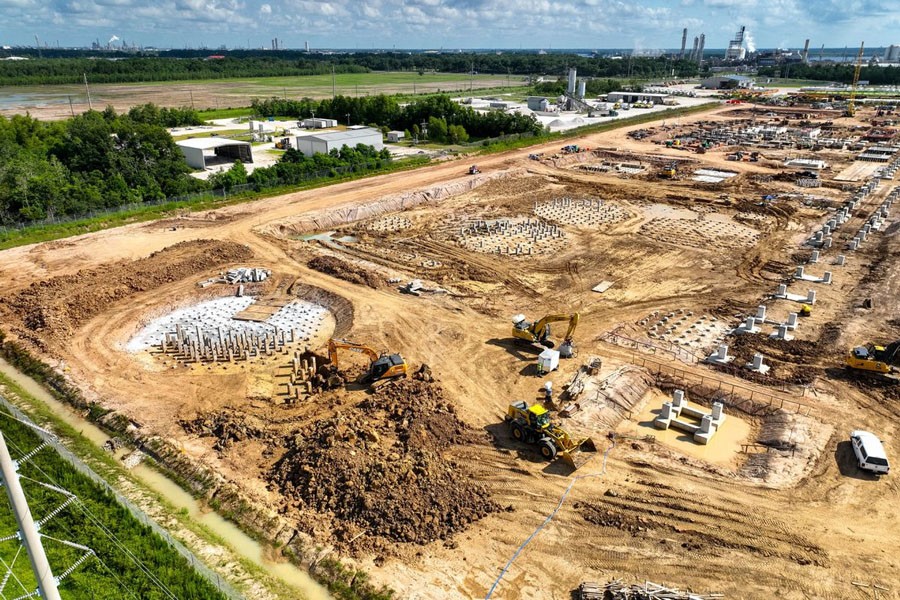
 The construction site of OCI Global's plant in Beaumont, Texas, where it will capture and sequester carbon dioxide from the production of ammonia. -Reuters
 Without a single sales contract in hand, Dutch fertilizer company OCI is building a $1 billion plant in Texas to produce ammonia with low greenhouse gas emissions, a gamble requiring heavy government subsidies, new markets and a contingency plan, reports Reuters.
OCI's plant would be the world's first new commercial facility to capture and sequester 95% of the emissions produced from making ammonia. The hydrogen and nitrogen compound is mostly used as fertilizer.
But the lure for OCI and others of making ammonia with a smaller carbon footprint is a business with potential beyond the farm. That includes production of fuel for coal-burning Asian utilities and for ships, both uncertain but potentially lucrative commercial possibilities.
"'Are you crazy?' is the question, and I think it's a good question," OCI CEO Ahmed El-Hoshy told Reuters, when asked why his company is betting on producing so-called "blue ammonia."
Producing blue ammonia costs up to $119 per metric ton more than the conventional method, but US Inflation Reduction Act (IRA) subsidies worth roughly $145 per ton cover the difference, said CRU Group fertilizers analyst Alexander Derricott.
To make the economics of his Beaumont, Texas plant work, El-Hoshy said he also needs Asian utilities paying premium prices to justify the capital cost.
The $430 billion IRA aims to cut carbon emissions across the U.S. economy, mostly through technologies that are uneconomic without subsidies.
But even with U.S. support, blue ammonia economics hinge on further government incentives. This time the incentives are expected from Japan and South Korea for utilities to produce electricity with less emissions, using coal and 20% ammonia. That is the percentage utilities consider technologically feasible for now without causing emissions of another pollutant, nitrous oxide, to increase.
If utility premiums don't emerge, OCI plans to use its Texas blue ammonia to make fertilizer in The Netherlands, where the company has under-utilized its plants due to high natural gas prices. It can also sell it to industrial buyers looking to decarbonize, or sell it in the United States, El-Hoshy said.
OCI's Texas plant, to start production in 2025, will produce 1.1 million metric tons annually.
Global ammonia demand looks to climb 10% by 2030 from 2021 to 203 million tons annually, according to TD Cowen and Yara data. Demand then soars to 294 million tons by 2040 and 470 million by 2050, according to the data.
Others are tiptoeing into the sector. Fertilizer rivals CF Industries, Yara and Nutrien are mulling building their own US Gulf Coast plants, but are at least a year from breaking ground.
Japanese utility JERA has signed non-binding agreements to buy low-emissions ammonia from CF and Yara, with commercial production slated around 2027. Mitsui is a partner with CF on its Gulf project and Mitsubishi (8058.T) has signed a non-binding offtake agreement with Nutrien.
CF has committed $285 million to capture emissions at two U.S. ammonia plants and says it has firm buyers for all the blue ammonia it would produce from the possible new plant with Mitsui.
Investors and analysts are not yet convinced. Yara last month postponed an initial public offering of its clean ammonia business, citing low market valuation.
"Probably the biggest unknown is if the end markets will really be there," said Stephan Werner, senior portfolio manager for Germany's DWS Group.
© 2026 - All Rights with The Financial Express

