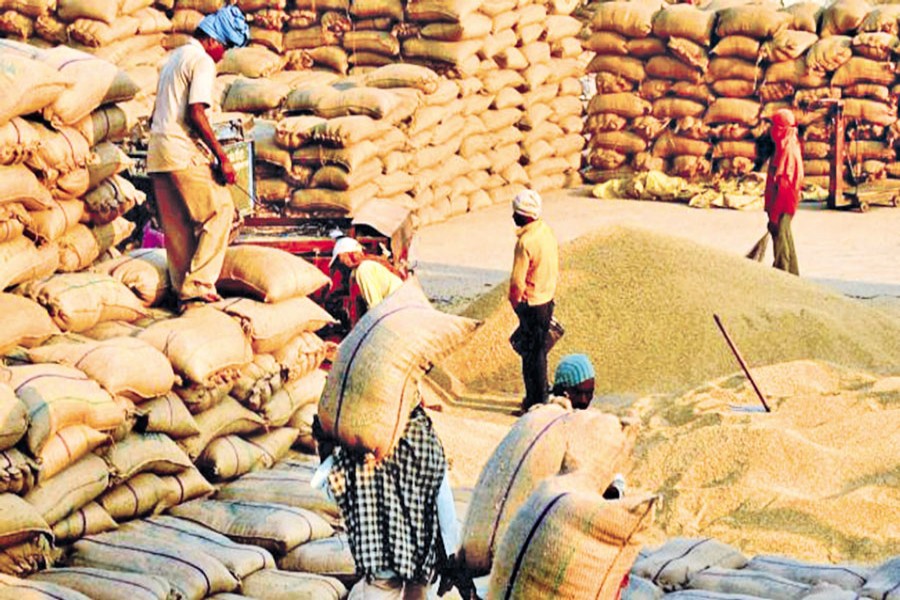
The Food Planning and Monitoring Committee (FPMC) had refused a proposal from the Ministry of Food to replace a portion of government paddy procurement from farmers with rice purchases from millers, reaffirming its commitment to supporting growers through direct procurement.
The decision was taken at an FPMC meeting held on June 10, chaired by Home Minister Salahuddin Ahmed, also chair of the committee.
Agriculture, Food, Disaster Management ministers along with other committee members, attended the meeting.
According to meeting sources, the Ministry of Food, through the Directorate General of Food, proposed purchasing an equivalent volume of rice from millers instead of the targeted paddy procurement, citing the slow pace of paddy collection from farmers during the ongoing Boro procurement drive.
The ministry informed the committee that only around 0.17 million tonnes of paddy had been procured by June against the seasonal target of 0.5 million tonnes.
In contrast, rice procurement was progressing well---0.45 million tonnes against the target of 1.25 million tonnes, while wheat procurement remained negligible at around 4.0 tonnes.
Officials argued that converting the uncollected paddy quota into rice purchases from millers would help bolster public food stocks more efficiently.
However, the proposal was strongly opposed by both FPMC Chairman Salahuddin Ahmed and the Agriculture Adviser.
The chairman said the government had introduced paddy procurement primarily to make sure farmers receive fair prices during the harvest season.
"The government has given priority to farmers. Under that policy, we have decided to procure a significant volume of paddy directly from them. The quantity will be increased gradually as procurement capacity expands," he told the meeting.
The Agriculture Minister also opposed the proposal, saying direct paddy procurement has a positive impact on the market by supporting farmgate prices during the peak harvesting period.
He noted that the country's public food stock was currently at a record level, reducing any immediate pressure to alter the procurement strategy.
Following the discussion, the committee decided to continue paddy procurement until August 31, extending the existing procurement period.
After the deadline, if the paddy procurement target remains unmet, the Ministry of Food will be allowed to compensate for the shortfall by purchasing an equivalent quantity of rice from millers.
The committee also approved a pilot project during the upcoming Aman season to procure paddy directly from farmers in a major rice-producing upazila.
Based on the outcome, the government plans to gradually expand direct procurement from farmers across the country.
Asked, farm economist Prof Golam Hafeez Kennedy said the decision came at a time when paddy prices declined during the peak Boro harvest, affecting growers' incomes despite a generally satisfactory harvest.
He said the country's food stock capacity should be 3.5 million tonnes for the growing population.
Direct paddy purchase would be the best option to ensure rational prices for the growers as well as for the consumers, he said.
Although flash floods damaged crops in parts of the haor region, Bangladesh is still expected to produce around 22 million tonnes of Boro rice this season, according to the Department of Agricultural Extension (DAE).
Directorate General of Food said the public food stock is now at 2.3 million tonnes, of which rice comprises 2.1 million tonnes.
tonmoy.wardad@gmail.com
© 2026 - All Rights with The Financial Express

