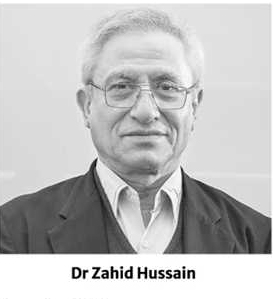
Dr Zahid Hussain, a prominent figure and former lead economist at the World Bank's Dhaka Office, has expressed optimism that the general point-to-point inflation rate could be reduced to between 6 to 7 per cent in the next fiscal year (FY26) if the country does not face natural or political calamities.
"My projection is that it will be possible to bring down inflation within 6 to 7 per cent if there is no major disruption. Prices of several commodities are still increasing. The prices of essential items like rice, lentils, and fish, which significantly impact the common people, need to be reduced," he stated.
The esteemed economist shared these insights during an interview with BSS at his residence in the capital. It is noteworthy that the general point-to-point inflation rate in Bangladesh slightly eased in December, reaching 10.89 per cent, down from 11.38 per cent in November 2024.
Data from the Bangladesh Bureau of Statistics (BBS) indicated that this decline was driven by a fall in both food and non-food inflation. In 2024, point-to-point food inflation decreased to 12.92 per cent in December, from 13.80 percent in November, according to BBS data.
Similarly, non-food inflation also saw a slight decline, reaching 9.26 per cent in December, down from 9.39 per cent in November 2024.
When asked about the possibility of general point-to-point inflation falling below double digits in the coming days, Dr. Zahid stated that while one can hope, it is not something to be counted on.
Regarding GDP growth for the current fiscal year (FY25), he commented, "If 4 per cent growth is attained by the end, compared to 1.81 per cent in the first quarter, then I would consider it a good achievement given the current circumstances."
He further elaborated, "My projection is that if we can move towards stability in the next fiscal year (FY26), then we could reach a new normal by mid-2026, coinciding with the completion of the election process."
Dr. Zahid emphasized that if this new normal materialises, stakeholders and investors would not wait until June 2026. "Should they perceive that everything is heading in the right direction, they would begin preparations to capitalize on moving early," he added.
He added that if everything proceeds as planned, the country might witness a significant turnaround in investment by the end of this year. "A GDP growth rate of 4.5 to 5 per cent in the next fiscal year (FY26) will then be attainable. Subsequently, we can work towards surpassing a 5 percent GDP growth rate and gradually emerge from the middle-income trap."
When asked about the state of the banking sector, he remarked that, unlike the previous regime, the central bank's policies are now being implemented effectively. "We now see much more proactivity and consistency from the central bank," he noted.
Although the central bank has printed money to provide some liquidity support, he mentioned that they did not follow their predecessors' approach to financing the budget. The interest rate caps, both visible and invisible, no longer exist, and the exchange rate has remained stable despite some instability last December.
© 2026 - All Rights with The Financial Express

