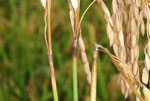
Spread of the neck blast disease in many areas of 20 districts has badly affected Boro farmers who are already hard hit by the paddy price fall, growers and officials have said.
Untimely rain with hailstorm and fluctuation in temperature were key reasons for spread of the neck blast disease, they said.
Experts, however, feared that the disease might cause up to 2 per cent yield loss in the current Boro season.
The neck blast (Magnaporthe grisea) is a plant-pathogenic fungus that causes a serious disease affecting rice. The disease has no cure but prevention is the only way to save rice field from it.
Apart from the fungus, the blast might occur from attack of pests like majrapoka, gandhipoka and so on, according to agriculturists.
Paddy fields in many areas in Rangpur, Kurigram, Dinajpur, Lalmonirhat, Nilphamari, Thakurgaon, Jessore, Rajshahi, Chuadanga, Jhenidah, Netrakona and Chandpur districts witnessed the neck blast disease.
Framers from different districts told the FE that the neck blast started hitting rice fields at the mature stage of the crop from mid-April.
Md Kabir Dewan, a farmer in Saheber Alga union under Ulipur upazila of Kurigram told the FE that his five bigahs (33 decimals per bigha) of land witnessed the neck blast. "Eighty per cent of the crop has been lost, I got just 2.5-3 maunds from per bigha against 18-20 maunds."
He said the disease added to their miseries as they were already affected by the fall in paddy prices.
He said lower output and fall in prices "caused me a loss of Tk 50,000 this year." Paddy is being sold at Tk 450-500 per maund in his area.
However, the farmer said he cultivated Brridhan-28 and seed was bought from a sub-dealer in his area.
Another farmer Md Adil Basunia in Kholeya area under Gangachara upazila of Rangpur said he grew hybrid varieties on his 5 bighas of land and Brridhan-29 on 2 bighas.
"Hybrid fields came under blast infection, I got just 2 maunds from per bigha, but Briidhan-29 field is okay and I will start harvesting from next week," he said.
He also said the condition was worst in the Pakuria Sharif area of the upazila where the blast disease was first noticed.
Md Sadek Ali, a farmer at Joradaha union under Harinakunda of Jhenidah told the FE that he cultivated Miniket variety on four bighas of land.
After the rain and hailstorm that occurred between April 1 and 10, the paddy started maturing, but most of the crops were hit by the neck blast.
When asked about the matter, deputy director at the monitoring unit of the Department of Agriculture Extension (DAE), Dr Mohammad Abduhu, told the FE that the extension office was yet to make a report on it.
Plant pathologist and director at the state-run Bangladesh Rice Research Institute (BRRI) Dr Moh. Ansar Ali told the FE that the neck blast fungus could infect a rice plant in just 15 minutes and make blocks in its phloem and xylem vessels overnight.
"Due to the block in the vessels, mature fruits can't get food from the plant," he said.
He said the neck blast occurred in the current year severely in the northern and north-western regions due mainly to the odd weather condition.
He said usually hailstorm and Kalbaishakhi (nor'wester) occur in the county from mid-April, but in the current year it started earlier--from the last of March.
The fluctuation in temperature is the key reason behind the blast disease.
He said the paddy varieties which were nearly at the flowering stage in mid-April were mainly infected.
He said: "We were apprehensive of the neck blast in April last, but the government agencies' timely actions have helped prevent the severe crop failure."
"The disease may cause 1 to 2 per cent yield loss if it spreads to new areas," he said.
According to the DAE, 30 per cent of Boro harvest was completed until Monday evening.
The country is expecting 19.0 million tonnes of rice from 4.8 million hectares of land this Boro season.
tonmoy.wardad@gmail.com
© 2026 - All Rights with The Financial Express

