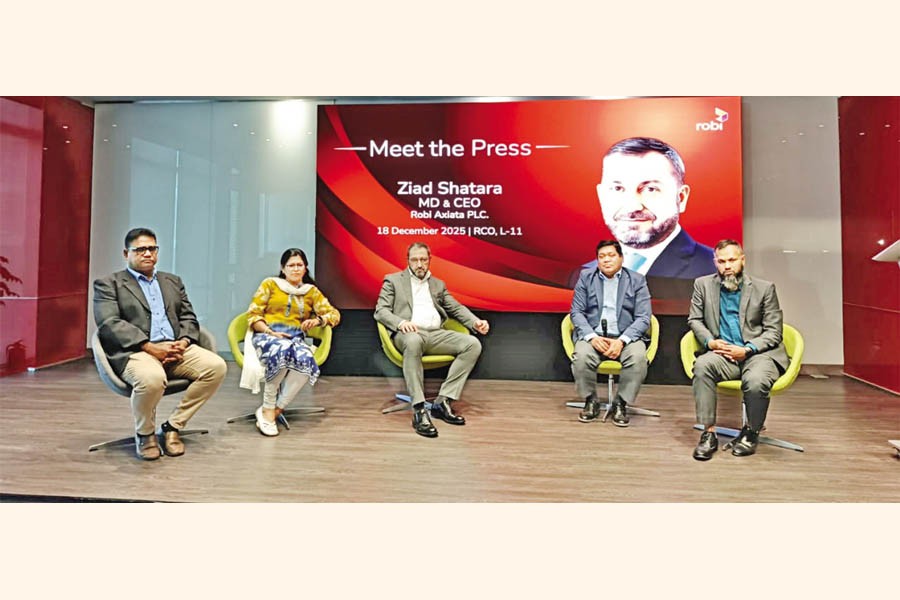
 Robi Axiata Chief Executive Officer Ziad Shatara met the press at the Robi office in the capital on Thursday— FE photo
 Robi Axiata Chief Executive Officer Ziad Shatara on Thursday called for auctioning the much-awaited 700 MHz spectrum after the national elections, arguing that large-scale investment required a stable political and economic environment, as well as clear regulatory signals.
Speaking at a press meet at the Robi office in the capital, he described the 700 MHz band as "extremely important" and a "public asset", but said the timing of the auction must be optimal.
"For a company to invest large sums of money in the spectrum, its management, board, and shareholders must be able to properly assess the political and economic conditions," he said.
"We have already conveyed to the Bangladesh Telecommunication Regulatory Commission (BTRC) that we should wait for the elections."
He cautioned that holding the auction at a sub-optimal time "may not benefit everyone", stressing the need for consistency and certainty to justify long-term capital commitments.
Shatara and Robi's Head of Corporate Regulatory Affairs Shahed Alam also raised concerns over the newly-implemented telecom licensing policy and its subsequent guidelines, saying inconsistencies were making it difficult to reassure investors.
Robi invests around 30 per cent of its annual revenue as capital expenditure, Shatara said, calling the telecom sector "highly capital-intensive".
"The licensing policy should be a guiding factor for future investment. But inconsistencies between the policy and the guidelines create a negative signal when we present investment plans to shareholders," he added, warning that such uncertainty sent "a very bad signal to foreign investors".
Addressing market confusion over the continued use of the Airtel brand, Shahed clarified that Airtel Bangladesh Limited as a company had ceased to exist after the merger, with all its assets and liabilities transferred to Robi Axiata Limited under a court order.
"The requirement is that products and services be registered under the company name, not necessarily the brand name," he said, noting that Airtel remained a valuable brand, particularly among young customers.
On the long-standing issue of converting Airtel's 016 numbers to Robi's 018 series, he said the company had consistently maintained that automatic conversion was "never possible" due to technical constraints.
He noted that a BTRC committee later reached the same conclusion, and the regulator eventually allowed the continued use of the 016 series, in line with the court's directive that no customer should be adversely affected.
Shahed also flagged challenges in tower-sharing, saying insufficient investment by tower companies and local-level complexities were affecting network expansion and quality of service.
"If we want to run at 100 kilometres per hour, but the tower infrastructure runs at 20, our speed will also be limited to 20," he said.
bdsmile@gmail.com
© 2026 - All Rights with The Financial Express

