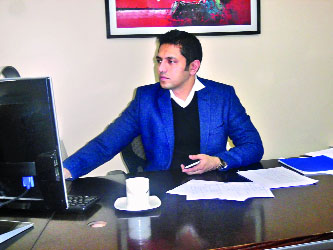
 \"Recognise talent, grow talent and compensate talent properly…,\" says Sharif Zahir, managing director at Ananta Group.
 A.Z.M. Anas
Sharif Zahir has one obsession: building a good company. He possesses all the attributes a new generation entrepreneur should have-vision, entrepreneurial energy, western education, seriousness, dynamism, zest for innovation, and focus on results.
He is also powerfully persuasive. As managing director of Bangladesh's fast-growing apparel maker Ananta Group, he has cajoled some of his Ivy Leaguer pals and younger brother into returning home to help him reinvent the 23-year-old firm-all left cushy and plum jobs in multinationals, from Google to Deloitte.
Today, no one perhaps has any reason to grumble. In less than a decade, Mr Sharif, himself an overseas returnee, has parlayed Ananta Group to a formidable clothing manufacturer that has been expanding at a rate of 25 per cent to 30 per cent in the past few years.
Last year, the company pulled $165 million in export sales, which are on track to reach $250 million by 2016. Employment has also surged sevenfold to 18,000 from 2,500 in 2006 when he took the reins of the family-run enterprise.
"We started from scratch. The factory is now running at 65 per cent efficiency," the company's slender, soft-spoken boss tells the Financial Express in an hour-long interview at his corporate office in swanky Gulshan.
"We want to diversify. We're looking at new products. And we'll be making products that were not made in Bangladesh before," he says.
Ananta has already established its mark in manufacturing newer products. It has partnered with Romania's Universal Menswear to make men's suit and the US's T&S Buttons to produce metal button- both are done by a few local players, for example.
One of Mr Sharif's key goals is to build a 'good organisation' with right talent and leaders. But he is aware of the challenge in cherry-picking right talent and minting leaders in a country, where supply of quality human resources is conspicuously scarce.
To plug the gap, he is relentlessly trying to get unfettered flows of new ideas and knowhow from the advanced nations into the country. "Countries like the US are 100 years ahead of us. It's a matter of bringing in those ideas," he says.
He has tied up with western firms, enabling Ananta to garner sophisticated technology and foster innovation.
"The company is unique. We're investing a lot in people and have installed good software. We're building backbone this way," he explains.
"Recognise talent, grow talent and compensate talent properly-that is how we look at business," says Mr Sharif, who holds a degree in economics and finance from the University of Texas, Austin.
He notes that foreign clients while negotiating deals value the education and exposure of his management team that includes alumni from Harvard, and U Penn.
Going beyond buyers' compliance, the company has introduced two shifts in its factories, where workers need to stay seven and a half hours a day instead of eight hours, which Mr Sharif claims to be 'rare' in the garment industry, infamously known as sweatshop. The company, which sews 18,000-19,000 bottoms per day, provides lunch and transport to the workers.
"We're trying to bring good image of the country," he says.
With the economy growing 6.0-7.0 per cent and the apparel industry being projected to expand 20 per cent, he frets over unplanned growth.
"Growth is good. But if it is unplanned, it may lead to more disasters-Rana Plaza and Tazreen like issues."
Mr Sharif's negotiating prowess, global network and best practices have paid off. Today, the Group is among a few local companies that have corralled cheaper credits from the World Bank's International Finance Corporation, Germany's DEG and the Netherland's FMO. It has also attracted equity investments from Swedish hedge fund and private equity behemoth Brummer & Partners.
The company's foreign debt financing has amounted to more than $20 million and it is in talks to secure additional equity funds, officials say.
Already, the Group has transformed itself into a holding structure and makes consolidated reports, which helps its management to see "all financial ratios" to judge investment potentials, according to Mr Sharif.
The company head doesn't like the way a traditional enterprise in Bangladesh "having so many companies and so many subsidiaries working independently" hides its financial reporting, which he says makes it difficult to understand the company's liability position.
This practice also complicates loan approval by banks and financials. Even a bank's board cannot scrutinise project loans properly because of multiple sets of accounts a company maintains, says Mr Sharif who is a vice chairman of private lender UCB.
While ready-made garment remains the company's core focus, it has expanded into finance, properties, energy and information technology consultancy. Its old-guard business line produces and sells denim bottoms, men's suit and high-end sweaters to top western retailers such as H&M, Gap, Next and Jack & Jones.
Presently, denim bottoms make up the bulk-or 60 per cent-of the company's sales, but Mr Sharif says the upcoming product lines may change the revenue mix.
As the country's non-compliant garment factories struggle to secure orders, Ananta is reinvesting to ramp up capacity. The company has poured $20 million into building a state-of the-art factory at Adamjee Export Processing Zone and another $8.0-million-factory will begin operation in January next year. It expects to generate additional 7,000 jobs by 2016, bringing the total to 25,000.
Born to an industrialist father, Mr Sharif cut his entrepreneurial teeth on Ananta Energy Resources, then a CNG refilling station, even before his graduation. Father Humayun Zahir, who was slain in 1993, was involved in a range of industries including banking and manufacturing.
"It (business) has to be in your blood," he smiles, but hastens to add that specialised education also helps advance business career.
"He (Mr Sharif) has an extraordinary ability to foresee, identify and capitalise on opportunities. He is a quick decision maker," says an investment expert, who had tracked the firm while serving with Brummer. The expert says Ananta Group purchased 18 bighas of land at Adamjee export zone at the time when few could grasp its potential.
Mr Sharif, who has just turned 37, carefully straddles between his personal and business life, notwithstanding his hectic schedules. His wife gave up job with the US oil major Chevron to groom the couple's only son.
"You need to keep your personal life disciplined. Relations with your family members are important," he says. "It's not creating organisation after organisation. It's also dealing with other people and outside world."
Even with success, Mr Sharif says: "It's important to be humble. You need to have modesty."
azmanas1@gmail.com
© 2026 - All Rights with The Financial Express

