Agribusiness leaders on Tuesday urged the National Board of Revenue (NBR) to reduce duties and taxes on feed, raw material, and fruit imports to help ensure food security and stabilise prices.
However, NBR Chairman Md Abdur Rahman Khan indicated that tax cuts were unlikely, offering instead the move to address structural bottlenecks.
Speaking at a pre-budget consultation at the NBR headquarters in the capital's Agargaon, he acknowledged the sector's concerns but maintained that lowering taxes was not the preferred solution.
"Instead of asking for tax cuts, tell us what your problems are. We will try to solve them," he said, highlighting the need to balance sectoral support with revenue mobilisation.
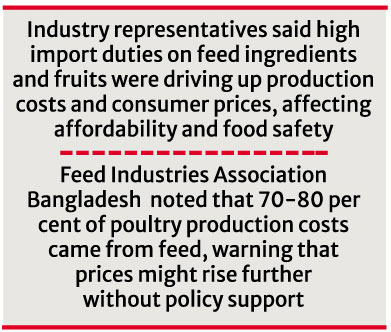 Industry representatives said high import duties on feed ingredients and fruits were driving up production costs and consumer prices, affecting affordability and food safety.
The Feed Industries Association Bangladesh (FIAB) noted that 70-80 per cent of poultry production costs came from feed, warning that prices might rise further without policy support.
Fruit importers also called for lower taxes, arguing that reduced duties would improve access to safe and nutritious food, especially in urban areas.
The NBR chief cautioned against across-the-board tax cuts, citing a pattern of escalating demands.
"Our experience shows that once taxes are reduced, demands continue - even to zero, followed by calls for subsidies. This cycle has no end," he said.
He also questioned the assumption that lower tax rates automatically improved compliance.
While ruling out broad tax reductions, Khan said the NBR was open to "rational adjustments" where justified.
Other industry groups echoed similar concerns, seeking duty concessions on raw materials for agrochemicals, fertilisers, and pesticides, as well as tax relief for poultry and agro-processing sectors.
The Bangladesh Agro Processors Association (BAPA) requested the withdrawal of supplementary duty on bottled water, arguing it was an essential source of safe drinking water rather than a luxury item.
The NBR, meanwhile, highlighted reforms aimed at improving business operations, particularly the automation of VAT and income tax refunds.
Khan acknowledged longstanding complaints about delays and said new online systems would enable automatic transfers directly to bank accounts once fully operational.
He added that VAT refunds were already being processed through an automated system, while the income tax refund system was nearing completion.
The Agriculture Machinery Manufacturers Association-Bangladesh (AMMA-B) called for revisions to statutory regulatory orders (SROs) to reduce ambiguity in tax treatment.
It proposed replacing specific product names such as "Thresher Machine," "Combined Harvester," and "rice transplanter used in agriculture" with broader definitions, covering all types of such machinery.
AMMA-B President Alimul Ehsan Chowdhury said unclear terminology often created confusion among tax and VAT officials, causing difficulties for importers.
The Bangladesh Agrochemical Manufacturers Association (BAMA) sought duty concessions on 32 raw materials used in pesticide production and export.
BAMA President KSM Mostafizur Rahman said tariff and non-tariff barriers were hindering local pesticide production.
He added that the high duty burden discouraged domestic manufacturing and effectively turned Bangladesh into a market for imported pesticide products.
Also, he noted that the current duty and VAT structure favoured the imports of finished goods over local production.
According to him, pesticide products can currently be imported by paying only 5 per cent duty, while local manufacturers face up to 58 per cent tax on imported raw materials.
Industry representatives also alleged that VAT was applied irrationally to raw material imports.
In response, the NBR chairman said duty reductions would be considered only if the Ministry of Agriculture submitted a formal proposal.
He added that the NBR was responsible for removing barriers to promoting domestic industries.
The Bangladesh Fresh Fruit Importers Association called for lower taxes on fruit imports, while the Bangladesh Fertiliser Association (BFA) proposed reduced duties on various raw materials.
The Bangladesh Crop Protection Association (BCPA) recommended several measures, including exemption from advance tax on agricultural pesticides, reduced duties on products used for public health protection, and setting tariff values based on actual import prices.
It also sought full tax exemption on auxiliary ingredients used in pesticide formulation, along with duty waivers on biopesticides, fruit bags, sticky traps, and personal protective equipment (PPE).
Representatives from the Bangladesh Agro Feed Ingredients Importers and Traders Association (BAFIITA), the Shrimp and Hatchery Association of Bangladesh (SHAB), and the Animal Health Companies Association of Bangladesh (AHCAB) also attended the meeting.
newsmanjasi@gmail.com
© 2026 - All Rights with The Financial Express

