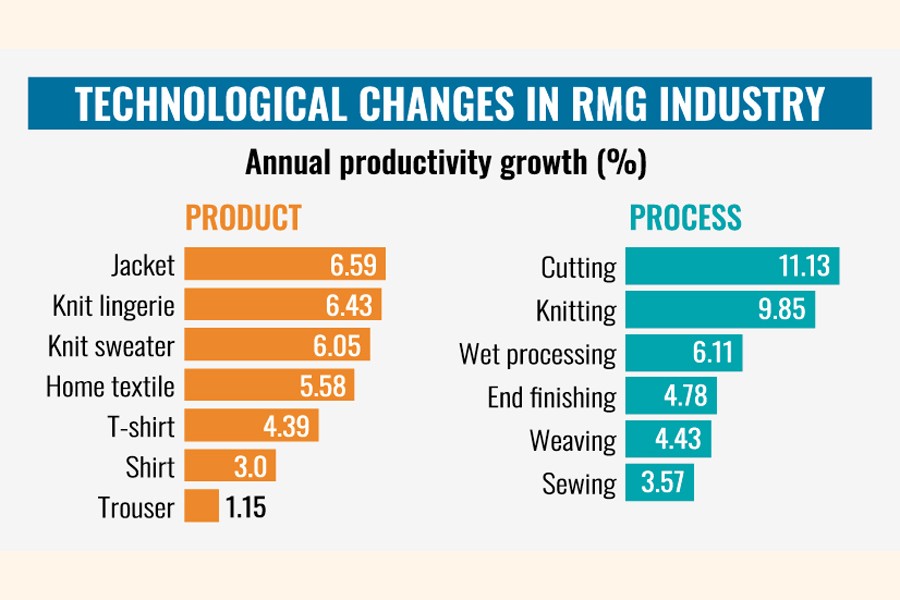
Automation and technological upgradation have boosted productivity at the cutting and knitting levels of garment production, while high efficiency has been found in jackets in the product category, says a study.
The Bangladesh Institute of Development Studies (BIDS) study conducted on six processes - knitting, weaving, wet processing, cutting, sewing, and end finishing - of eight types of products explored whether technological convergence was taking place across firms and tasks.
It found automation-intensive areas drove the strongest performance, with cutting achieving an annual productivity increase of 11.13 per cent, knitting 9.85 per cent, and wet processing 6.11 per cent.
In contrast, sewing, which remained the least automated and most labour-dependent component of the production chain, posted the lowest growth of 3.57 per cent.
Weaving and end finishing gained moderate growth of 4.43 per cent and 4.78 per cent, respectively.
The study findings, published on December 7, also said the industry maintained a compound annual productivity growth rate of 4.19 per cent during the last 10 years since 2014.
Productivity was defined as output per unit of time at the task level.
The study titled "Technological Changes at the Process and Sub-Process Level in the RMG Industry in Bangladesh" analysed technological changes at the task level of 51 apparel firms covering eight products, 39 processes, and 140 sub-processes.
The products included knit-lingerie, denim trouser, sweater, T-shirt, jacket, woven trouser, woven shirt, and home textile.
Talking about the findings, BIDS Research Associate Kazi Zubair Hossain said while the early 2000s marked the start of the RMG industry's modernisation, the following two decades were defined by automation and commitment to sustainability, such as energy and water-saving technology.
He said they documented the changes in machines and technologies over time for each process of a product and the results indicated that the industry experienced around 4.19 per cent annual growth in productivity over the last 10 years.
According to the data, jackets and knit lingerie emerged as the top-performing categories with 6.59 per cent and 6.43 per cent average annual productivity growth, respectively, while traditional woven items like trousers and shirts showed significantly slower growth of 1.15 per cent and 3.0 per cent growth, respectively.
Other products showing strong productivity growth included knit sweaters (6.05 per cent), home textiles (5.58 per cent), and T-shirts (4.39 per cent).
The BIDS researcher said a convergence of technology was occurring between large and medium-scale firms.
Technologies previously exclusive to large companies, including automated cutting, semi-automatic sewing heads, laser/ozone finishing, auto-dosing in dyeing, and digital QC tools, were becoming widespread in medium-scale factories, he said.
Inamul Haq Khan, vice president of the Bangladesh Garment Manufacturers and Exporters Association (BGMEA), told The Financial Express fabric was one of the major parts, which constituted about 60 to 70 per cent of a clothing item, and savings in this segment meant a lot of benefits.
To gain efficiency, apparel makers had invested millions in installing automatic cutting and fabric spreading machines that could be operated by apps, he said.
He, however, said big factories had the capability to go for full or semi-automation at several process levels as they had support from either banks or their buyers.
"But small and medium-sized units that need technological upgradation the most hardly get banking or other support in this regard," he noted.
He said balancing, modernisation, rehabilitation, and expansion (BMRE) had also taken place in sewing and other process segments, resulting in enhanced productivity, efficiency, and reduced manpower.
Industry insiders said significant capacity expansion in garment factories had taken place over the past decade through a rise in technical professionals like graduates and diploma textile and industrial engineers, increased use of software, direct exports, and certifications.
Investment in research and development had also increased in some products like home textiles and sweaters, they added.
Munni_fe@yahoo.com
© 2026 - All Rights with The Financial Express

