The global multilateral development finance system had reached a critical turning point as shrinking aid budgets, geopolitical fragmentation, and mounting fiscal pressures in donor countries threatened the availability, affordability, and predictability of development finance, with potentially serious consequences for South Asian economies, including Bangladesh, speakers said at a virtual discussion on Wednesday.
The webinar, titled "OECD Multilateral Development Finance 2026 Report (MDFR): Perspectives from South Asia," was jointly organised by the Centre for Policy Dialogue (CPD) and the Organisation for Economic Co-operation and Development (OECD).
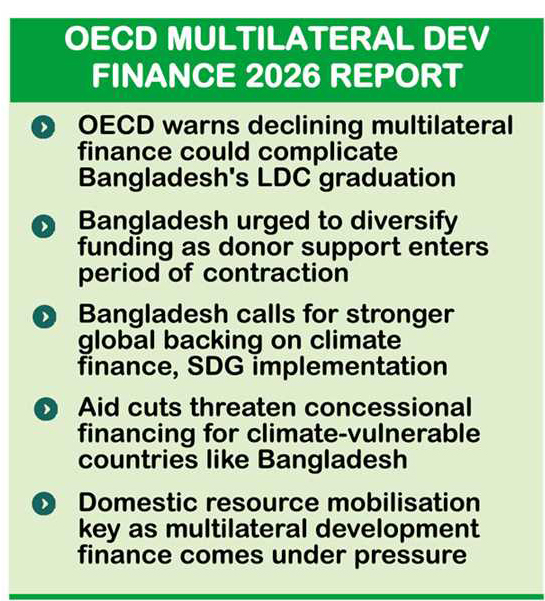
The event examined the implications of the OECD's Multilateral Development Finance Report 2026, which warns that declining aid and changing donor priorities could significantly affect climate finance, concessional resources, debt sustainability, and financing for countries approaching graduation from the least developed country (LDC) category.
Addressing the event as the chief guest, Dr Rashed Al Mahmud Titumir, adviser to the prime minister on the ministry of finance and planning, said the report should be viewed not merely as a warning about declining aid but as "a call to rethink how development will be financed over the coming decades."
He said Bangladesh was pursuing a more diversified financing strategy through stronger domestic resource mobilisation, capital market reforms, development of the bond market, and greater private sector investment.
Dr Titumir also urged multilateral organisations to regain their "moral authority" by responding more effectively to the realities faced by countries vulnerable to climate change, food insecurity, and energy shocks.
Chairing the session, Dr Fahmida Khatun, executive director of CPD, said the report came at a particularly important time for Bangladesh and South Asia as the global multilateral development finance system had reached "a historic turning point."
While Bangladesh had benefited substantially from development finance in infrastructure, health, education, and social protection, she warned that the reversal in global financing trends could create fresh challenges as the country prepared for LDC graduation.
Introducing the report, Henri-Bernard Solignac-Lecomte, senior economist and head of unit, architecture and analysis at the OECD, said the central question was no longer simply how to improve the multilateral system, but "whether and how we can preserve it and renew it."
Although the system's unique value was under threat, he said it could still be safeguarded through bold and carefully designed reforms.
Presenting the report's findings, OECD co-author Leonardo Altieri said the multilateral development finance system was entering "a different phase" characterised by contracting resources.
He noted that both core and earmarked contributions declined in 2024, while total contributions from Development Assistance Committee (DAC) members to the multilateral system were projected to fall by between 23 and 30 per cent during 2023-2027.
Co-author Marius Guérin said multilateral outflows reached nearly $300 billion in 2024, masking early signs of financial stress.
He cautioned that concessional resources remained the backbone of support for the poorest and most fragile countries but were often among the first to be reduced during periods of fiscal constraint.
The OECD report also found that 11 DAC members announcing official development assistance cuts for 2025-2027 accounted for roughly two-thirds of total DAC contributions to the multilateral system in 2024, highlighting the sector's heavy dependence on a small group of traditional donors.
At the same time, emerging contributors such as China, India, Pakistan, Qatar, and the United Arab Emirates have increased support to the United Nations Development System, although not enough to offset the broader decline.
From Pakistan, Dr Abid Qaiyum Suleri, executive director of the Sustainable Development Policy Institute, urged developing countries to speak with "a single voice" in defending multilateral finance and called for separate treatment of emergency, concessional, and non-concessional financing, particularly for climate-vulnerable nations.
Dr Pratyush Sharma, head of research and innovation at Southern Voice, warned that cuts to multilateral organisations could create a "reverse leverage effect", disrupting development delivery, and urged policymakers to move beyond gross domestic product-based criteria when assessing financing needs.
Dr Paras Kharel, executive director of the South Asia Watch on Trade, Economics and Environment, said sustained support was essential for irreversible LDC graduation, while Dr Roshan Anne Perera of Sri Lanka's Centre for Poverty Analysis described multilateral finance as a "stabilising anchor" that helped countries avoid costly commercial borrowing.
Dr Muhammad Asif Iqbal, managing director of Pakistan's Social Policy and Development Centre, said development finance had become "an instrument of geopolitics" and urged broader eligibility criteria for concessional finance, including climate vulnerability, debt sustainability, and economic resilience.
Shah Asif Rahman, director general of the Multilateral Economic Affairs Wing at Bangladesh's Ministry of Foreign Affairs, called for stronger commitments from developed countries and international financial institutions to support Sustainable Development Goal implementation, climate finance, and LDC graduation.
bdsmile@gmail.com
© 2026 - All Rights with The Financial Express

