The imposition of higher duty on garment samples is making it difficult for buying houses to secure work orders from global apparel brands.
It also adds to the financial burden on them and erodes buyer confidence.
To help sustain further growth, encourage new entrepreneurs to enter the trade, and assist garment makers in getting global work orders, the trade body for buying houses has urged the government to withdraw the import duty.
Garment samples are physical or digital prototypes of clothing used during apparel production to validate fit, design, and quality.
They bridge the gap between initial design sketches and final bulk manufacturing, ensuring the end product meets the requirements.
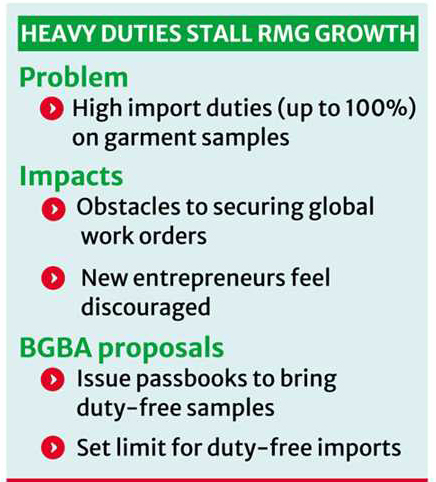
Bangladesh Garment Buying House Association (BGBA) also proposed issuing passbooks to its members -- as given to members of the Bangladesh Garment Manufacturers and Exporters Association (BGMEA) and the Bangladesh Knitwear Manufacturers and Exporters Association (BKMEA) - to bring duty-free samples.
BGBA President Abdul Hamid in a recent pre-budget proposal to the National Board of Revenue (NBR) said the association had been playing an important role in creating foreign markets for locally made ready-made garments (RMG) and other products, as well as contributing to the collection of about 25 per cent or around $15 billion worth of work orders.
By attracting buyers, BGBA members collect purchase orders for garment products, which are produced at factories in the country and then exported, he explained.
A buying house usually works with five to 10 buyers and imports at least 100 to 300 RMG samples from buyers every month based on their needs and season.
But a wide range of duties on samples are creating obstacles to obtaining purchase orders from foreign buyers, which is very costly, especially for new entrepreneurs, he explained, requesting the government to withdraw the duty, which for many samples goes up to 100 per cent.
Echoing the BGBA leader, its Vice President AKM Saifur Rahman told The Financial Express that as a result of high duty and the release cost of samples, new entrepreneurs are not coming into the trade.
Rather, their number is gradually decreasing despite huge opportunities in the buying business in Bangladesh, he said.
Mr Rahman, also the managing director of Wikitex BD, said his company had to pay about Tk 0.25 million per month only for samples and all houses could not afford that.
Responding to a question, he said buying houses usually collect samples using their own addresses as part of their business strategy.
He said the BGBA has some 2,000 registered members and they can be given passbooks as like BGMEA members to import garment samples without any duty for obtaining purchase orders.
Mr Rahman also proposed the government put a limit either on the value or the volume, explaining that a buying house could be allowed to import 350-400 garment samples per year without customs duty.
The government through the textile and jute ministry could strictly monitor potential misuse, he added.
Munni_fe@yahoo.com
© 2026 - All Rights with The Financial Express

