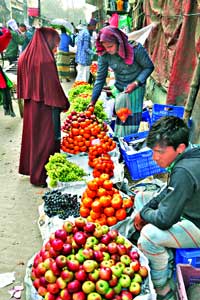
 Buyers\' traffic has thinned on the capital\'s footpath since political turmoil erupted, threatening the livelihoods of small traders like hawkers. The photo was taken from Babu Bazar Wednesday. — FE Photo
Hawkers in the capital are passing very tough time as their daily sales have come down drastically over the last few weeks following the restive political situation, small traders say.
The mini traders make little amount of investment for their livelihood by showcasing low-cost clothing, foods, books, crockery items, shoes, toys and electronic items on the footpaths.
But the ongoing countrywide indefinite blockade programme made a strong bite on their daily sales turnover, which witnessed a massive fall--between 60 to 70 per cent for the last three weeks.
The scenario of poor sale was found after visiting hawker-populated areas like New Market, Gulistan, Farmgate, Baitul Mukarram, Motijheel, Dilkusha, Elephant Road and Malibagh in the city over the last several days.
Mohammad Sohel, who sells shoes in front of Fulbaria Super Market in Gulistan, said he used to sell products of Tk 3,000 to Tk 3,500 daily one month ago.
"The amount has now reduced to Tk 500 to Tk 1,200 due mainly to poor presence of customers because of blockade," he said.
Gulistan-based cloth trader Sirajul Islam said he has to spend Tk 6,000 as house rent, Tk 800 electricity bill, Tk 4500 as food purposes for six people and Tk 2500 for other purposes.
"How can we survive if the situation deteriorates further? It will ultimately drive us out of the business," he said.
In the wake of the poor trading, hawkers carrying white flag organised a rally at National Press Club Wednesday from where they called upon the political parties to refrain from calling programme that hurt businesses and trades.
Hundreds of hawkers from various parts of the capital joined the rally and made the call.
Talking to the FE, President of Bangladesh Hawkers Federation MA Kashem said there are 0.2 million vendors in the capital. "If a single trader incurs financial loss at the tune of Tk 500 per day. The aggregate loss will stand at Tk 100 million a day," he said.
He said the hawker community used to make unethical payment of at least Tk 200 to policemen, local political leaders, electricians and cleaners on daily basis if they showcase their products from roadside.
"Making a profit now is a thing of the past. Their (hawkers) survival is now at stake. They will be unemployed and netted with loans from NGOs and banks," he added.
There are 235,000 hawkers in the capital city. Of them, 65,000 are permanent, 75,000 temporary and 95,000 mobile vendors, according to Work for a Better Bangladesh (WBB) Trust, a campaign group.
It said usually roadside vendors make investment ranging between Tk 200 and Tk 50,000 and their daily income varies between Tk 500 and Tk 1,000 depending on their investment and business locations.
National Advocacy Officer of WBB Trust Maruf Hossain said the blockade has had an adverse impact on the lower income groups, especially on the traders of lower investment.
In the face of continuous losses, the community already started maintaining daily expenses of their families with the amount they deposited, he said.
"If it (blockade) continues, they will be unemployed and ultimately it will push up the rate of poverty. That will not be a good sign at all for a country that aims to become a middle-income nation by 2021," he added.
jubairfe1980@gmail.com
© 2026 - All Rights with The Financial Express

