The Bangladesh Telecommunication Regulatory Commission (BTRC) has decided to restart nationwide enforcement drives against the marketing, sale, and distribution of illegal mobile handsets as grey-market smartphones continue to capture an increasingly large share of Bangladesh's mobile phone market.
The decision was made at a recent commission meeting following a proposal from the regulator's Enforcement and Inspection (E&I) Directorate.
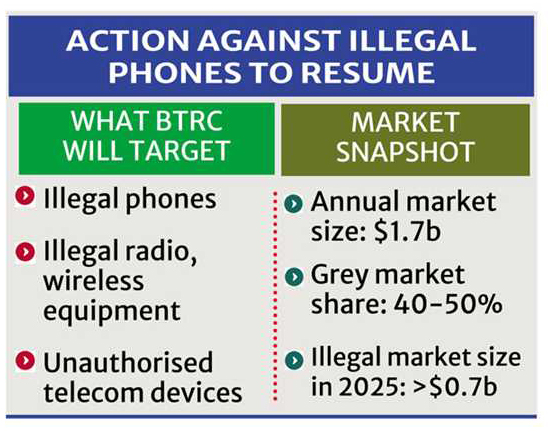
Alongside mobile handsets, the regulator will also intensify action against illegal radio, wireless, and telecom devices across the country.
The drives will resume after a pause of more than three years.
According to officials, the renewed move comes amid growing concern within the telecom regulator over the rapid spread of unauthorised handsets in divisional cities, city corporation areas, and district towns, where illegal imports, assembly, distribution, and sales have expanded significantly in recent years.
The BTRC noted that such activities were punishable under the Bangladesh Telecommunication Regulatory Act 2001 and were creating multiple challenges, including loss of government revenue, unfair competition for legitimate manufacturers, network management complications, and the circulation of substandard devices among consumers.
The telecom regulator had previously carried out regular joint drives with law enforcement agencies to seize illegal handsets and unauthorised telecom equipment.
However, enforcement against illegal handset traders remained largely suspended from April 2023, although operations against devices, such as signal jammers, repeaters, boosters, and illegal VoIP equipment, continued.
BTRC documents show the suspension was linked to the rollout of the National Equipment Identity Register (NEIR) system, as well as administrative preparations related to the 13th parliamentary election scheduled for 2026.
Introduced in 2021, the NEIR system was designed to create a central database of legal mobile devices by linking handset IMEI numbers with SIM registration and national identity information.
The initiative was intended to identify illegal handsets, block unauthorised devices from mobile networks, and discourage grey-market imports.
However, the system soon became mired in controversy and operational uncertainty.
Mobile operators, handset importers, and industry stakeholders raised concerns over the technical readiness of the platform, potential disruption to consumers, and the absence of a clear implementation framework.
Questions also emerged over how millions of the existing unofficial handsets already in use would be treated if blocking mechanisms were activated. Although the regulator launched awareness campaigns and initially announced deadlines for blocking non-compliant devices, the enforcement mechanism was repeatedly delayed.
Eventually, the key feature of automatic handset blocking was never activated, leaving the system largely dormant despite substantial preparations.
Industry insiders said the prolonged policy uncertainty surrounding NEIR weakened market discipline and indirectly encouraged the expansion of illegal handset trading networks.
In recent months, the BTRC relaunched parts of the NEIR platform, but officials said the final decision on activating handset blocking would still require policy approval from the new government.
Meanwhile, industry stakeholders say a combination of factors has fuelled the rapid expansion of the grey market over the past few years.
These include weak enforcement, repeated increases in supplementary duty and VAT on handsets, rising global component prices, foreign exchange pressures, and the depreciation of the taka against the US dollar.
As the prices of officially imported smartphones rose sharply, many consumers increasingly turned to unofficial channels, particularly for premium and mid-range devices.
According to industry estimates and BTRC data, grey-market smartphones now account for around 40-50 per cent of Bangladesh's handset market, which is valued at approximately 1.7 billion US dollars annually. The unofficial market alone is expected to exceed 0.7 billion US dollars in 2025.
Officials say illegal handsets not only deprive the government of customs revenue but also complicate telecom security and lawful interception systems because many such devices bypass formal registration and quality compliance procedures.
To tackle the situation, the E&I Directorate has proposed restarting coordinated enforcement drives with agencies, including the police, the Rapid Action Battalion, and executive magistrates.
The commission has approved the proposal in principle and decided that nationwide drives will resume at an appropriate time following further instructions.
bdsmile@gmail.com
© 2026 - All Rights with The Financial Express

